Showing posts with label Military Procurement. Show all posts

2026/08/08

New frigates for the German navy

.

I did recently write about an optimal escort (GP frigate) and a minimum escort (GP frigate or corvette). I also wrote about modern (naval) escorts in general in 2018. Now I'll write about a realistic sensible option for a new German frigate. I refuse to be bothered by the overpriced official designs and that offer from a frigate-inexperienced arms supplier.


First thing first; FUCK BMD (ballistic missile defence) of the American way (hard kill). It's too expensive to build a ship for hard kill defence against quasiballistic/aeroballistic medium range missiles or hypersonic missiles. Those missiles likely have difficulty hitting ship targets (particularly the correct ones) without any defences in place anyway and the recent ballistic missile wars of attrition around Ukraine and Iran should have brought home the point that you can be forced to run out of hard kill munitions (two expensive interceptor missiles per incoming missile or warhead), so I stick to my opinion that we should exercise self-discipline and modesty and accept that in war you take some blows. This means we need early warning (mostly by satellites and offboard radars) and A LOT of soft kill countermeasures. Basically, the incoming missile should not "see" its correct target in any spectrum and it should see lots of obscurant also in a safe distance to the real target.

This kills the entire BMD-heavy approach. A two-ship convoy escort shouldn't aim for having any super AAW destroyer, either. The escorting would happen far away from Russian (or Chinese) air bases and a few AAW destroyers wouldn't help much if the Americans or Chinese attack Europe.

The threat scenarios remain the same as in the minimum frigate blog post: Multiple boats, one auxiliary cruiser, divers, explosive boats/semi-submersibles in port, submarine trying torpedo attack (incl. from ambush position resting on seabed and having anti-helicopter air defences), salvo of up to 32 stealthy or supersonic anti-ship missiles incoming, strike fighter trying to drop guided bombs from very high altitude.

Keep in mind spending domestic means about 40...60% of the spending returns to your own country's public finances as taxes, saved unemployment pay and so on. That's a rule of thumb, but in today's Germany we should relax about it because we have a skilled labour shortage - the additional spending doesn't lead to additional government revenues if it fully crowds out other spending.

Moreover, all equipment that's dependent on American, Chinese, Russian, Indian political goodwill is untrustworthy. All equipment from these countries that can receive and process radio signals is untrustworthy. The Englishmen are confused about whether they're Europeans  or Americans, have proven to almost exclusively elect terrible politicians (even a lying clown) and are a five eyes member, so they are a bit suspect as supplier as well.

As a base, I take the FDI, which by today would probably cost 600...750 million € apiece if ordered from French shipyards if they had the capacity left. Plus development expenses for modifications.

Such FDI frigates would not be battleships, they would be escorts. Look at the dedicated convoy escorts of WW2 (example). They weren't high end - they were the low end component (and mostly built in wartime or repurposed old ships). A clearly-defined mission set allows for an affordable design that's of some use outside the core mission set as well (see destroyer-escort action at Leyte Gulf '44). 


  • 24 VLS for Aster 30: The newer Aster 30 NG is meant to be a capable hard kill defence against short range aeroballistic missiles. It should suffice against Oniks and possibly Zircon missiles.
  • 24 VLS for CAMM-ER missiles (as likely to be integrated for the Swedish FDI order) or with additional systems integration costs the more trustworthy (at least to Germany) 24 IRIS-T SLM.
  • 76 mm gun: It's acceptable for a ship this size, though you'd need a very close convoy formation to protect a convoy with two frigates against cheap drones. Luckily, masses of cheap drones and torpedoes are rarely a threat at the same time, so the detrimental effect of a close formation on sonar operation is not too bad.
  • Exocet 3C: Replace these with 2x4 refurbished RBS 15 taken from K130 class, for the French likely integrate these for the Swedish FDI order anyway, at Swedish expense.
  • Torpedo tubes: These lightweight torpedo tubes are marginal weapons, but they may double as storage containers for ASW torpedoes and might be useful for hard kill anti-torpedo defence sometime.
  • 20 mm Narwhal: We should be able to refurbish, update and re-use 27 mm MLG27 from decommissioned F123s instead. 20 mm Narwhal would be acceptable if systems integrations of MLG 27 costs much or if MLG 27 is too big.
  • Mistral: I have very low expectations for the effectiveness of Mistral, so I would use its positions (and others) for soft kill launchers. This would include RF fog (Pandarra fog/chaff), MASS and 3DDS. 

  • Stick with the Thales SETIS 3.0 combat management system! To replace the CMS would require much more systems integration budget than switching Narwhal to MLG27, adding soft kill systems and adding the T-650.

  • The public knows little about soft kill defence against torpedoes. FDI has a acoustic decoy/jammer, but I have yet to see a published answer to wake-homing torpedoes. Maybe a hull vane, a towed counter-torpedo mine or just go slow?

Why no RIM-116 RAM? Because the ones in inventory are getting old, new ones are ridiculously expensive and they might receive a kill switch code signal from an American anti-ship missile via their RF receiver. Moreover, surplus RAM from decommissioning F123s would boost munition stocks for F125s that use RAM.

Have a honest tender for building these ships in Europe. Domestic offers get a 25% discount on domestic value added in the tender, but the domestic shipyards absolutely should lose the bids if they are much more expensive than foreign bids. The license fees would have to be paid by the shipyard.

Most of all; change the personnel system, so we can cut down operating expenses and make do with ONE crew.

- - - - - 

The F123 and F124 frigates should and hopefully will be decommissioned before the late 2030's. The K130s are very weak, but they could bolster a two-frigate convoy defence with a bit more firepower against sea skimmer missiles up close, drones, ships, add some UAVs and help with SAR. The new frigate order would create the German surface navy mainstay by the late 2030's.
 
In the meantime we should focus on the readiness of the only really capable (though Americans missiles-compromised) F124 frigates, sell off the K130 (including the new ones, which aren't worth the operating expenses to us) to allies. The F125 frigates should receive the planned upgrade with IRIS-T SLM and should also be upgraded with CAPTAS-4 Compact. Both needs proper CIC/CMS.
 
All of this only if one thinks that having a German frigate fleet makes sense, which is very debatable IMO.
 
 
There's no one size fits all. Different navies and different times lead to different appropriate solutions - and nobody is obliged to agree with me on which solution is appropriate. We know for sure that the German naval procurement has been total crap for a long time, though. K130 and F125 are underarmed subsidy programns for shipyards. The 3rd EGV was a brazen shipyard subsidy as well. F124 is now Americans-dependent and was IMO underwhelming until ESSM Blk II. The F123 ASW frigates are helicopter-dependent and their sonar equipment remained underwhelming despite upgrade opportunities. Meanwhile, we neglected readiness, spare parts stocks and munition stocks. So what are the odds that the German navy is getting it right now?
 

S O

defence_and_freedom@gmx.de

update: Add a trainable ASW rocket launcher.

.

2026/04/03

On the issue of IFV and APC costs

.
"Kraftfahrzeuge und Panzer" 1st Ed. by Werner Oswald (1970) has a nice list of the approximate prices of AFVs as of end-60's. I appreciate it as a look back at the price ratios of a time before electronics bloated the prices of AFVs.

M-113 (tracked APC, 11 dismounts, machinegun ): 250k DM 

HS 30 (tracked IFV, 5-6 dismounts, 20 mm gun): 350k DM

Marder (tracked IFV, 7-8 dismounts, 20 mm gun OWS): 800k DM

Leopard (MBT, 105 mm gun): 1,000k DM


Marder protection upgrade over M-113 and HS 30 was mostly resistance to 14.5 mm API, which was later cheaply realised for Israeli M-113 with add-on armour. The Leopard's protection (maximum 70 mm steel) was barely enough to protect against a T-34/85 and T-44, unsatisfactory even against a T-54. 

The only substantial electronics in these vehicles were a radio and an intra-crew communication system. The Leopard had a gyrocompass and main gun stabilisation. HS30 and M-113 had petrol instead of diesel engines at that time, but a diesel wouldn't have changed the price much.

Electronics got MUCH more expensive starting in the 1980's when thermal imagers (sometimes for gunner AND commander) and laser rangefinders were introduced in quantity. That is, except for APCs, which didn't need those because they had no weapon to "justify" the expense. Many IFVs (IIRC beginning with some Bradley upgrade in early 90's?) even receive full main gun stabilisation (Warrior being a notable Western exception).

So the cost multiplier between having a bullet-proofed and fragment-proofed box driving off-road with a strong infantry section and a full-blown IFV combat vehicle with a small infantry section systemically increased.

The ability to provide high offroad mobility with protection to great many infantrymen thus vanished. Nowadays you may spend more than a million Euros per dismount seat if you stick with the IFV concept.


In this light I'm hoping for good success of the Trackx, a new tracked APC project by Patria - a company known for having the most affordable yet good 6x6 APCs  among Western countries.


It's more of a MT-LB successor than a M-113 successor, but it would be most promising with a mass-produced C-UAS RCWS (low price due to economies of scale, with machinegun).


S O

defence_and_freedom@gmx.de

.

2025/12/15

Civilian Germany doesn't understand the scale of wastefulness in the military

.

This guy wasted about 2.3 billion Euros by grossly mishandling protective mask purchases during the Corona pandemic. His level of competence and his level of ethics fits to his party, so he's now his party's 2nd most powerful member and currently very influential on federal legislation.


I could tell more (very!) bad things about this very unnecessary person, but I'm writing this blog post in reaction to the disinformation in the screenshot. It's taken from one of the less terrible German media organisations that's usually not under suspicion of campaigning for his party (unlike many others).

They claim his waste of public funds (a.k.a. taxpayer money) is likely the greatest any German politician is responsible of.

This is a symptom of the widespread defence policy illiteracy - and this media outlet (or at least its print twin) is one of the more active and history-rich ones in terms of reporting on bad military or defence policy. 

2.3 billion Euros damage - here's a short list of worse waste of money that politicians bear responsibility for (IMO the minister of defence bears full responsibility albeit members of parliament and career officers effed up as well, of course):

  • near-useless Tiger helicopters
  • near-useless NH-90 helicopters
  • useless heavylift helicopter (CH-47) order
  • useless F 125 frigates
  • F-104 Starfighter (corruption and tunnel vision, not plain incompetence)
  • F-35 (2.3 billion € spent fixed cost for nothing so far)

To compile this list took a minute. There's more, so much more.

S O

defence_and_freedom@gmx.de

.

2025/11/27

Constellation class program aborted

.

The U.S. government (mostly) cancelled its navy frigate program that was meant to slightly adapt a foreign frigate design for the USN so a lower cost general purpose ships could do all the escort tasks that Arleigh Burke destroyers cannot do because they're busy escorting carriers.

The NAVSEA bureaucracy ruined the program with so many changes that the program turned into a mess. They didn't get much of anything right post-Cold War anyway. The Arleigh Burke was the last important ship class that was not a mess - but even its fist batch of ships was flawed due to the lack of a helicopter.


Some background: 

The Americans always followed a general purpose ship design philosophy regarding escorts for four decades, while some European countries use smaller ships dedicated to either air defence or anti-submarine warfare. There are also some general purpose ships in Europe and both some Europeans and the Japanese have ships that are Arleigh Burke equivalents, but the Americans clearly favour general purpose (GP). GP nowadays means not just AAW and ASW, but also defence against quasiballistic missiles and hypersonic missiles. The use of quasiballistic missiles by the Houthis against ships now help to justify this. I believe the GP approach is the correct one for such warships, my reasoning is here. 


So there we have one of the reasons why it's so difficult for the American naval bureaucracy to exercise self-restraint and modesty. They want a first rate AAW ship that's also a first rate ASW ship and has the endurance for transoceanic escorting. There's just no way that's going to end up being compact or cheap, especially if you have the hypersonic missile threat in mind. That's why they de facto stick with the Arleigh Burke class, albeit that hull is kinda overburdened by now (both the newest hulls and upgraded ones).


The feasible quantity of frigates wouldn't have sufficed for much ambition anyway. The hopes of the Americans for the case of a Sino-American war rest on holding the so-called island chains as bases for air power so the carriers (their aircraft are rather too short-ranged for much direct attack on the PRC early in such a war) would only have to sortie if some task force or convoy attempts to run the blockade or knock out / invade one of those islands. The Chinese submarine fleet isn't terribly big (in relation to possible tasks) or of a high quality and would rather not bring Pacific & Indian Ocean maritime transport to a standstill. It might not even be able to cut the Tokyo-Hawaii route.

The need for American frigates only exists if Chinese naval or air power can somehow run the blockade and get into position to attack whatever the frigates would be tasked to protect. 

I wrote some suggestions how the USN should reform and I can live with nothing of it being done.


In my opinion the Americans do not need frigates so much - even though that's widely regarded to be an extremely obvious need. 


The U.S. armed forces need to prepare differently for a Sino-American War:

  1. container sets to create armed merchantmen from container ships for a distant blockade enforcing role
  2. container sets to create self-protecting armed merchantman convoys capable of (at least mostly) surviving a weak air attack and a single submarine in blue water
  3. some form of transport to resupply forwardmost island chain bases with kerosene*
  4. composite island garrison regiments (USMC&USAF) that defend and run an airbase on an island (including jump ski** and arrestor gears to reduce dependence on long runways)
  5. many more munitions, especially anti-ship missiles and anti-submarine munitions (the USN should introduce Type 07, as it's much superior to VL ASROC)
  6. preparations to use C-17s as missile saturation attack launch platforms
  7. USAF fighter/strike fighter procurement of CVN-compatible aircraft (replace F-35A with F-35C with additional interface for USAF-style midair refuelling) to ensure the carrier don't easily run out of aircraft due to combat attrition and the island chain airbases can operate without lengthy runways 
  8. A-10s transfer to ANG or some kind of USMC reserve with 99% of their role being buddy-buddy tanker so F-35s based on island chain airbases can be refuelled without using giant long runway-dependent tankers
  9. figure out how to convince the PRC leadership to take an exit from war once it's started


Meanwhile, European countries should in my opinion use a rather non-military approach to deter the PRC:

  1. We should establish a "Stay out of Europe doctrine" regarding East Asian powers and enforce it.
  2. No patrols of European warships between Singapore to Alaska
  3. Clarify in public that Europeans would join a Sino-American War only if Article V North Atlantic Treaty gets triggered (Chinese aggression including attack on CONUS)
    /2017/07/just-reminder-about-north-atlantic.html
    /2018/11/natos-boundaries.html
    This would serve as a deterrent against escalation of a hot conflict.
  4. Clarify in public that Europeans would enact a total economic, communications, travel embargo and asset freezes against whoever starts a war between the PRC & Taiwan, South Korea, Japan, Philippines and/or the U.S..


related:

Eight part series about escorts (I'm still 95+% fine with what I wrote there)

/2021/05/navies-obsession-with-peacetime-hull.html 

/2023/04/chinas-naval-geography-problem-and-usn.html

/2023/07/shipbuilding-disparity-and-usn.html


S O
defence_and_freedom@gmx.de


*: There are two historical (mostly WW2) precedents: Fast surface combat ships (mostly destroyers and fast minelayers) use as fast transports that run a blockade by sprinting (not very promising nowadays) and transport submarines.

**: To use a fixed jump ski (not facing into the wind) approximately halves the necessary runway length for take-off with high trust to weight aircraft such as F-35.

2024/09/13

Elegance in procurement

.

Some people who comment on military affairs develop an inadvisable fixation, such as everything should be "light, or everything should be "small" , "unmanned", "8x8". One might think that "elegance" (reducing things to essentials without luxuries) is my weakness. Maybe it is, but I have very rational reasons(,too):

Think about my lists of really essential equipment, examples of how we could reduce the variety of weapon systems in an army.

The army bureaucracies and the associated ministry of defence bureaucracies are not coping well with the current fashion of having very many different weapon systems in use, procurement, under development.  Their badly limited competence at buying things (the initial purchase and replacement purchases, spare parts purchases) could and IMO should be focused on fewer, truly important systems.

Moreover, large countries should have a look at how small countries buy stuff for their armies There are differences, and in recent years it appears that the big countries tend strongly towards having systems developed to their own specs (then often cancelled instead of introduced), while smaller ones either buy market leader equipment  versions (CV90, F-16, FN SCAR), domestic equipment (Czech Republic with Tatra, similar in Slovakia) or unusual systems such as Korean AFVs or Israeli tech.

Sometimes the smaller armies get superior kit, sometimes they get worse kit. Sometimes a procurement by a small army is so badly expensive in terms of per-copy price that it smells of corruption, other times a procurement by a large army is so badly expensive in terms of per-copy price that it smells of corruption.

It's interesting to see that small armies do not appear to make worse deals on average despite obviously more limited procurement establishments (smaller, no domestic testing infrastructure). They sure do freeride on the equipment testing and R&D of the bigger countries, but they also appear to often procure equipment more quickly and less stupidly.


Any quick repair of an army from rotten state to fitness for purpose should focus on the key equipment pieces. Everything else can stay at 1980's level or be commercial off-the-shelf. Our resources for competent procurement are too stretched by too many programs.

Standardisation is not only a theoretically costs-saving approach; it may also be a beneficial impetus towards self-discipline.


S O

defence_and_freedom@gmx.de

.

2024/01/28

Do the British carriers make sense?

.
The article

"Floating mausoleums to political vanity: Our two new aircraft carriers cost almost £8 billion to build but, with the Middle East on fire, they're languishing in Portsmouth. We'd be better off selling them, says DAVID PATRIKARAKOS"

https://www.dailymail.co.uk/news/article-13011743/aircraft-carriers-8-billion-middle-east-portsmouth.html

creates a bit of a stir.

Some online responses claim that it's error-ridden while agreeing somewhat. 

I would certainly have edited the part about the missile threat to carriers; the anti-ship cruise missile threat appears to be in check IF the attacked ship or a well-positioned escort is on alert. The old and neglected Moskva probably didn't even have effective combat systems and no proper damage control preparations when it was struck by two missiles.

I would point at the "ballistic" anti-ship missile threat instead; the British carriers (and the American ones!) may be kept out of the range of Houthi ballistic anti-ship missiles because they pose too much of a risk. The British escorts are likely less well-equipped to deal with that threat than the American ones, at least that's what I read from the success of American-made SAMs against ballistic missiles and the development of a new generation of Aster missiles (the British escorts' SAM) to improve anti-ballistic missile ability.

I picked the British carriers as examples for the cost of carrier aviation relative to land-based airpower about 15 years ago. The high costs were never a secret or news.

Nor was the issue of the British not really buying enough F-35 for two carriers to make sense any insider knowledge:


There's not really much new about the naval vs. land-based aviation argument.

The American carriers are instruments for land attack against countries that cannot effectively defend themselves against it, and it's been that way since late 1943. Most other carriers showed marginal utility since then.

Land-based aviation has come such a way that bombing Afghanistan from Diego Suarez and Kuwait was more practical than bombing over Afghanistan using carrier-based aircraft. Midair refuelling is the key, and navies try to ignore it because midair-refueling using converted (plentiful) airliners extends the airpower-dominated maritime areas so much that surface fleets make very little sense in a peer war. They need to be either awfully far away from hostile land or enjoy land-based assistance by fighters (which usually means that the carrier isn't needed as a base in the scenario).

Personally, I think that CROWSNEST (having an airborne early warning helicopter) was the brightest part of the British carrier investment effort of the past 20 years (albeit it's apparently technically not terribly great). Rotary AEW assets coupled with lock-on after launch surface to air missiles can substitute for carrier fighters in the defensive role, and likely cope much better with surprise saturation attacks than carrier fighters could. Admirals would prefer to have the fighters as additional defence layer (and their radars as additional sensors), but admirals are not known for being good at allocation of scarce resources (budget) for very good reasons.

A small carrier with affordable combat aircraft (Harrier II with APG-83 and modern air-to-air missiles) might nevertheless make much sense in some scenarios, but only so if ambition and costs are kept small. A few such 15,000 tons carriers with enough aircraft for three on station and three on 5-minute readiness as interceptors could make quite a difference as escort carrier between Japan and Hawaii. The Americans have no need for these, as they could improvise with land-based AEW and their amphibious carriers, of course.


So what's a single French carrier good for? Launching a few airborne missiles throughout four decades of service? That could be substituted for by a chartered small cargo ship and some containerised cruise missiles.

What are two British carriers with effectively one air wing good for? The British delude themselves into thinking they can do American-style land attack in every year (the French cannot when their carrier is in the shipyard for maintenance). That's it. Again, buying some standard (not capsuled for submarine use) surface-launched cruise missiles to be launched from some otherwise non-combat ships (volume and deck area on frigates and destroyers is too scarce) would yield about the same land attack capability, especially paired with midair-refuelled land-based combat aircraft being in range (within thousands of kilometres and if necessary overflight rights).


Other (online) commentary I saw recently called for a British focus on the naval realm, at the expense of the land forces. But what could be achieved in the naval realm? Russia has a crap navy and China has a navy on the far side of the globe that could very largely be neutralised by land-based aviation. So what's to be gained by adding a couple more British warships? Prettier naval parades for more tourism? Navy enthusiasts being happy? (Navy enthusiasts always want more, though. They're never happy!)


Here are musings about what could/should have been done for security in Europe instead, spending-wise:

/2016/12/what-europeans-could-do-for-more.html

That would have been much less "sexy" than aircraft carriers that could fit tennis courts inside.


related:

/2010/03/naval-procurement.html

/2010/09/almost-unique-british-defence.html 

/2013/03/rebuttal-to-mcgrathid-about-carrier.html

/2016/12/musings-about-naval-power-in-european.html

/2018/04/a-deconstruction-of-micc-propaganda.html

/2023/04/chinas-naval-geography-problem-and-usn.html


S O

defence_and_freedom@gmx.de

.

2022/11/19

The military technology death spiral

.
The quintessential platforms of army, navy and air forces seem to get more and more expensive, and ever less affordable. This was sometimes described as a "death spiral" and may lead to a point when it's about time to give up on such a platform concept. 
 
I will try to offer a concise, illustrated explanation of this very important phenomenon. My model is simplified* and assumes among other things that there's always a counter to a counter possible.
 
- - - - -
 
At first, let's look at a simple modelling of a spiral between attack and defence. A form of attack (or firepower) is introduced, which provokes a countermeasure that largely or entirely mitigates this capability. The response is an improved attack capability that overcomes the defence. Rinse, repeat.
This was seen in tank development, when penetrative ability of tank guns and protective ability of tank armour were competing. Alternatively, you could think of the tank's protection as enabling attacks and as anti-tank guns ' ability to penetrate the tank's armour as the defensive side.

(click on image for a bigger version)

The costs of attacking and defensive abilities escalate together with said abilities. A 3.7 cm anti-tank gun did cost much less than a 8.8 cm anti-tank gun, and 15 mm of steel plate did cost less than 100 mm of steel plate. My model assumes that capability and costs are proportional (normally costs rise more than proportionally) to reduce one layer of detail that doesn't matter right now.


You see an additional dimension in the next diagram; the utility or usefulness (for deterrence, in warfare or both).
 
This scenario shows a rising usefulness, as the platform becomes more capable over time. Still, the escalating costs may eventually exceed the usefulness in warfare. The entire concept of this platform (which unites offensive and defensive capabilities such as a strike fighter, a tank or a destroyer) should be questioned at the latest at this break-even point. Further improvements are not worth the associated expenses. Different ways of 'doing business' in war should be found. The platform that unites offensive and defensive abilities is likely already obscenely expensive at this point.


Many metrics could be used to describe usefulness, such as how deadly a platform is, but in the end this is not a value that can truly be calculated. The entire model does not offer a formula for calculation. It is meant to create awareness in the reader's mind about this break-even point and why it will be reached eventually.
 
The next diagram shows a different, more pessimistic scenario. The platform's usefulness in warfare actually degrades as its evolution is driven by the attack-defence spiral instead of by the mission.


Medieval knights were a good example for this. They were initially an all-round mounted force, but at the latest by the 11th century the weight of armour reduced their utility to a specialised battlefield shock attack force. The personnel also gained a high social status. Other cavalry tasks such as scouting or foraging were thus usually left to light cavalry. Horse cavalry only re-united into a unified cavalry in the 19th century when firepower had won so clearly over the cavalry's defence that the heavy cavalry niche became impractical.

The next diagram shows a special case in which the costs of a system escalate not as a sum of attack and defence, but are almost entirely about one of both. A fortress' costs are being driven almost entirely by its defensive qualities, and a land attack missile system's costs may be driven almost entirely by its offensive qualities. The break-even point will nevertheless be reached eventually.
 
 
Asymmetric arms races (such as cruise missiles versus air defence missiles) add another aspect. The offensive capability may keep getting funded for good reasons after its costs exceed its direct utility: Such a decisions an be justified by taking into account indirect utility; the expenses incurred on the opposing forces for defence against the threat. Land attack cruise missiles won't be self-defeating by high costs if the defence against them are more expensive missiles. Then the production of the threat system (cruise missile) would be escalated as long as the opposing forces waste their resources trying to build up a defence against it. Finally, the defenders may cease to throw more resources into a hopeless arms race and then the optimum for the threat system (cruise missile) would in theory exist: A maximised difference between the (sum of direct and indirect) utility and the (lower) expenses for it.
So in the end, the asymmetric arms races can be described using the same graphics, just keep in mind that utility = direct utility and indirect utility in such cases.
 
- - - - -
 
Certain platforms -especially tanks- have been proclaimed "dead" when a new iteration of a counter looked particularly convincing, such as the rise of anti-tank guided missiles in the 1960's. But engineers usually find a new iteration that counters the counter, such as composite and reactive armours that kept 1960's anti-tank missiles from penetrating most of a 1980's tank's front. Potential technical counters are known to just about all forms of attack today. Likewise, counters to just about all forms of defence can be found.
 
I assert - and this model visualizes -  that the real death knell for a concept is not some spectacular-looking iteration of a counter to it: It's that the death spiral of escalating costs does at some point exceed the usefulness (the utility) of a platform. This doesn't necessarily stop the evolution, though. Usefulness in warfare cannot easily be monetised and compared to expected costs of a platform evolution step. We may - and likely do so regularly - keep going in the death spiral, wasting resources on platforms that have long become inefficient.

The exact quantity of iterations until the cost-utility break even varies.
The figures in the diagrams are symbolic.


S O
 
You may use and modify the model with proper attribution (author Sven Ortmann, Defence & Freedom blog).
 
*: Models should be simple and reduced to one thought or essence when meant for explanation. Complicated models are good for simulation purposes only.
.

2022/10/15

Defence policy layers


Defence policy (in the sense of providing security to your own nation against blockade/bombing/invasion, not in the sense of quasi-imperialistic meddling) can be separated into layers.

Here's an example:

  1. Foreign policy to create a safer world (by sanctioning aggressions, for example)
  2. Abstaining from starting or needlessly joining a war
  3. Forming or joining collective security treaties (defensive alliances)
  4. Deter aggressors
  5. Be able to defeat aggressors if deterrence fails
  6. Limit damage incurred in case of war

(Any blogger with a bit of visual design skill would now use one of those onion layer graphics to illustrate the concept.)

I'm fine with layers 1...5 and think that they were somewhat neglected.

#1 Hypocrisy kept us from sanctioning aggressions and microaggressions committed by friendly countries

#2 We needlessly joined the Afghanistan War, and needlessly send troops into many other countries that are irrelevant to our security.

#3 We are in NATO, but fail to emphasise the defensive nature of NATO (see Kosovo Air War 1999 and the frequent tolerated loudmouthing by NATO general secretaries)

#4 This works for NATO almost without effort, as there's no aggressor capable of taking even only on a fourth of our conventional forces without using nuclear warheads.

#5 See #4

- - - - -

So, what's my issue with #6?

I think #6 is cost-inefficient. It's extremely unlikely that #1...#4 fail to keep us in peace. Resources spent on #6 are better-spent on #1 (sanctioning aggressors at some economic cost to yourself) and #4 (deterring war in the first place, instead of trying to make it less horrible).

- - - - -

This blog post was triggered by news about political efforts for a missile defence in Central and Eastern Europe. That would be an extremely expensive endeavour, and by now we know that Russia has a) largely depleted its missile stocks and b) is too dumb to cause much damage with missiles.

Moreover, an aggressor would be tempted to launch many missiles with a strategic surprise, which means that such a defence system would be surprised and thus likely fail to live up to expectations.

To establish a very large area defence against cruise missiles (supersonic or stealthy) AND (quasi-)ballistic PGMs (different from cruise missiles by carrying the oxidiser for the propulsion rather than breathing air) AND hypersonic missiles (high & very fast-flying, typically air-breathing) and to stay ahead of threat munitions with all three defences would be extremely expensive. To just buy some American missiles and radars would not live up to expectations.

We need such strategic missile defences neither to deter nor to defeat. This is overreach, overspending, primitive and poorly thought-out feeding of arms industry big business.

It's yet again a primitive low effort thinking reaction, just as the primitive EUR 100 billion boost with which politicians who were too incompetent to do their job want to calm their security policy conscience in Germany.


S O

defence_and_freedom@gmx.de

.

2022/09/09

It's the four big levers and the basics, stupid!

.

The recent wars (Azerbaijan-Armenian and Russo-Ukrainian) confirm and -to those who pay attention- remind us of what really matters in defence, and it's not what you normally read about.

Only a few key levers absolutely need to be covered with good-enough hardware, even against a 1st rate opposition:

  1. You need to be able to destroy many main battle tanks.
  2. You need to be able to very largely mitigate the effects of hostile air power.*
  3. You need to have effective support fires.**
  4. You need to be able to usually maintain quick (message) communications***

Then everything else is about will (morale), good-enough doctrine (what is being taught & trained), good-enough training (quantitatively & qualitatively)**** and getting basics right.

The latter includes avoiding building a hollow force.*****

Your doctrine doesn't need major updates over what was state of the art (of war) up to the 1960's. Most things haven't changed much anyway, and (almost?) all armies are incapable of matching that level or tactical, operational and strategic proficiency anyway.

To get the basics right is laborious, inglorious, largely the job of non-commissioned officers and it's hardly profitable for the arms industry. Politicians know much about allocating more funds to the military, and next to nothing about what basics their army and air force don't get right, and how to fix that.

S O
defence_and_freedom@gmx.de

*: "very largely" ~ 80+% / This does not require big, expensive hardware. All that it takes could be distributed on civilian pickup SUVs.

**: Artillery shooting 105 mm HE shells of WW2-ish quality and range would suffice, as long as the gun and its crew are survivable enough to pull it off.

***: "usually" ~ 80% connectivity even in face of a main effort attack / "quick" = quicker than motorcycle couriers, so by cable or by light or by radio frequency comms. Such quickness is important to achieve responsive (and thus effective) support fires. High bandwidth is no requirement. One 100 bytes message per minute is plenty bandwidth on a company leader to battalion HQ line.

****: Well-trained troops have better morale and are incredibly more effective. A well-trained reservists crew could be reassembled after two years of civilian life and be 10x as useful with a Soviet-era (1983) Buk M1 air defence system than the average Russian crew could be with the newest (2006) Buk M3 air defence system, for example.

*****: If you raise an army of a thousand howitzers, you better also buy millions of shells, fuzes and proportional quantities of propellant charges for it and store those properly. So for a thousand howitzers better have at least two million shells, and if that's too much in your opinion then a thousand howitzers are too many. If you think you can make do with 200,000 shells, then don't buy and train for more than a hundred howitzers. One might disagree on how many shells per gun exactly are appropriate and the correct figure may be different for Singapore than for Vietnam, for example. Yet the figure surely is between 1,000 shots and about 10,000 shots. At certain high round per gun counts you'd additionally need to be have certain spare parts and the corresponding maintenance & repair capacity, for that will be needed long before 10,000 rounds can be spent. .

2022/07/01

Air warfare: Payload and what it means

.
The aviation community's opinion of tactical combat aircraft during the 1980's was split between awaiting the publication of rumoured stealth aircraft and fascination with extreme agility airframes that drove the F-16's high agility concept to extremes. 

By the 1990's and early 2000's another view took hold, mostly in the shadow of stealth aircraft that captivated the attention of only superficially interested laymen: Avionics had become extremely expensive and extremely capable since the 1980's. Seeing in darkness, very versatile radars, electronic warfare tools in all tactical combat aircraft, spectacularly successful (in '99) towed decoys, active radar seeker missiles, missile approach warners and much more had transformed old 1970's light alloy aerodynamically stable airframes beyond all public expectations for performance from the 1980's. Avionics, not stealth, were the real star in air warfare. Furthermore, agility performance expectations were shifted from the manned airframe to the self-guiding missile. The F-35's of today are not extremely better than F-16s from the late 80's in terms of rolling, turning, yawing, climbing, acceleration (if better at all) - but they make use of air combat missiles of drastically improved agility, sensor performance, manoeuvering logic and range. The stealth aircraft in general are not known for carrying much "payload", most of the promises of the F-35 were and are about avionics and peripheral offboard electronics.

You may look into books on aircraft and find payload or bombload figures. Tactical bombers of the USAF typically carried up to 4,000 lbs of bombs, for example. Payloads of individual aircraft were much higher than that during the 60's to 80's, especially with such types as Tornado IDS, Su-24, F-4, A-6, A-7. The A-4 was considered to be a great air/ground aircraft becuase its small airframe was able to carry an astonishing bombload over a good range.

The importance of big bombloads dwindled during the post-1991 period, nowadays tactical aircraft often take off to combat air/ground missions with more mass in external fuel tanks than in air/ground munitions. Still, payload seemed to be an important performance characteristic.

This view appears to be largely obsolete to me.

The real strength of manned aircraft of today isn't their payload, it's their avionics, specifically the mission-directed avionics. A Bayraktar TB-2 isn't so great because of its few puny guided glide bombs (albeit those destroyed much when air defences permitted it). It's the gimballed Argos II HDT sensor that's so important. It's a flying artillery spotter even when ordinary battlefield air defences keep it at a distance.

Whatever targets an aircraft detects, identifies and reports can be hit by artillery out to impressive ranges (over 70+ km with guided munitions), so having an artillery spotter that can see and ID a car out to 20 km is oppressive to the enemy.

Likewise, today's air/air missiles are essentially the same thing as a second stage of an area air defence (surface to air) missile might look like. You can see this clearly with the French MICA missile and the related two-stage Aster missile that uses about the same active radar guidance as MICA RF.

So basically as long as you're close to friendly ground forces you could shoot at a hostile air target with a two-stage surface-to-air missile instead of an air-to-air missile. About the same thing arrives at the target and stands about the same chance to hit it.

This means a defensive or air superiority fighter would not need much payload in terms of air-to-air missiles. Instead, its bird's view is what really matters. It could most of the time be used as an AEW asset, a flying radar platform that attempts to stay out of fights, but informs firing forces about contact vectors and identifications.

The payload of a tactical aircraft of today that really, really matters is its sensor payload. This is true both in air/air and air/ground.
To influence the ground war largely requires to have a bird's view on the ground, which requires a flying platform fairly close to hostile ground forces. This can be expected to cause high attrition, so a drone may be the best choice. A radar's bird's view onto the ground is less relevant in my opinion because it can be jammed much easier (lasers can also be used on drones using E/O and thermal sensors, but a powerful radar in SAR or GMTI mode is simply giving away its position much more).

To gain air superiority does not require to be far forward, as the primary sensor for this is still the radar. Air targets at normal altitudes can be detected and identified by land-based sensors quite well, but air targets at very low altitudes still require airborne radars for early warning. So the niche for the fast 8+ ton (maybe optionally manned) tactical aircraft of the future may be the use of a powerful look down radar, possibly in rather long wavelengths (L-band?) to devalue stealth. Such an aircraft might have a powerful radar with side-looking capability. This way it could fly parallel to an air war 'front line' while looking.

So the payload are the sensors, the shooters of munitions can be on the surface (which would greatly save costs despite more rocket propellant being required).
This applies to state of the art high end large scale warfare in my opinion. The optimum looks different for a Latin American country, for an African country, for a Southeast Asian country and for a carrier navy.

And below all this the air and ground war may soon be dominated by smaller than human drones on the battlefield, evading detection most of the time and able to act autonomously to avoid bandwidth and radio link reliability issues.

related:

S O
 
.

2022/06/11

Luxury radars

.

I have an academic background in business (and engineering). This means I was indoctrinated at the university, indoctrinated with an aversion against wasteful use of resources.

Parkinson's law is the adage that work fills the time available in a project - regardless of how much time is available. Something similar is going on with budgets. It's only human that people become wasteful if equipped with a lavish budget.

Something like this is going on with radar equipment.

To equip armies and navies with (combat-related) radars is being considered self-evident, albeit it's not always this clear-cut if you look at the technology. The Russian army would likely fare better if its battlefield air defence was resting on the "cheap" Sosna-R which does not use a radar than on the now serially self-embarrassing radar-equipped Tor systems. The radar emissions can be detected even by satellites, and intelligence on where and when such radars are active informs the drone operational command, leading to destruction of Tor systems when they are not radiating.

Likewise, air defence warships have huge and powerful air search radars. The explanation for the same has long become questionable, considering that even the best ship-mounted radar would still be quite useless against the Super Etendard/Exocet combination attack that sunk HMS Sheffield in 1982 (aircraft very low level approach below the ship's radar horizon for almost all the time, seaskimming missile). AAW warships depend on airborne radars (AEW) and active radar seeker missiles (for non line of sight shots) anyway, so why the distinction of specialised AAW warships at all? Their radar betrays them and doesn't help against many normal threats any more than a normal-sized multipurpose search/fire control radar would.

Yet some radars make sense, or at least seem to make sense, on a battlefield. Especially the multipurpose radars are enticing, artillery has good use for muzzle velocity radars and I personally expect tethered rotary drone radars for use by motor vehicles on the move, at least in the ground surveillance task out to 20 km (detection range against motor vehicles).

We should be wary of relying very much on battlefield radars or of spending terribly much on battlefield radars because countermeasures including artillery fires on detected radars are likely against a 1st or 2nd rate opposing force.

Luxury radars are another problem; needlessly expensive "99% solutions". The most obvious such approach is the multi-antenna AESA radar. 


https://defense-update.com/20191017_ltamds.html

https://vpk.name/en/578046_diehl-defense-successfully-demonstrated-the-iris-t-slm-air-defense-system.html

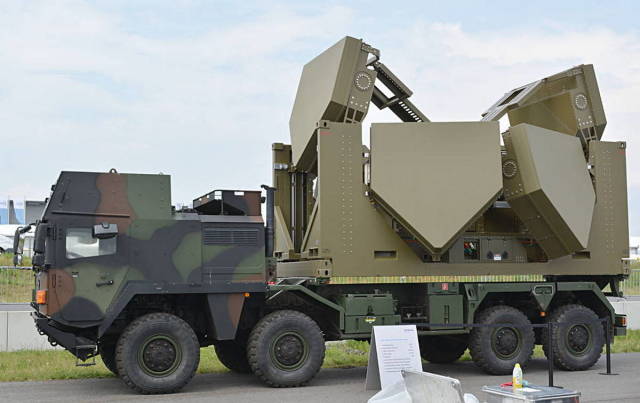
Classic radar antennas need to be mechanically turned into different directions to search all-round, which is slow. AESA and PESA antennas can switch the direction almost instantly, albeit an AESA antenna is limited to 90...120° in this. So the wasteful "99% solution" approach is to mount four such AESA antennas to cover the whole 360°, even on tanks. That's an issue, because old school mechanical antennas are cheap metal powered by a single transceiver unit linked by cables, while the AESA antennas are very expensive electronics (up to hundreds of individual transceiver/receiver modules) themselves.

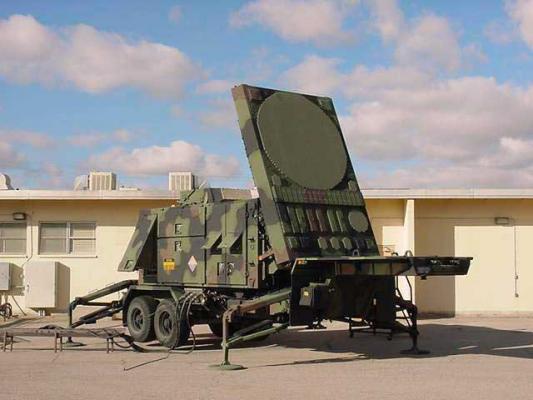
The Patriot air defence system was always crap because its big electronically steered radar was unable to rotate for 360° coverage. Its field of view was only 90...120° (sources disagree, but performance would be degraded beyond 90° anyway).

Patriot's AN/MPQ-53 radar, the work of idiots or saboteurs

It was an air defence system for a forward-facing line of SAM batteries, which is tactically an idiotic (too easily defeated) approach. You needed four Patriot batteries to protect one place not quite as well as a single SAMP/T battery can defend it using a rotating AESA radar antenna.

So the obvious approach to resources-irresponsible armed forces was to push for a Patriot upgrade/successor with four AESA antennas instead of one or two rotating ones. And then the system grew so irresponsibly expensive that of course Germany ended up buying zero copies (only in part because of this, admittedly).

99% solutions are stupid. It's much better to go along with "good enough", and survivability is extremely important. A vehicle with four fixed radars (360°) is less useful than two vehicles with two rotating radars. The latter can be used alternatingly, with one vehicle breaking contact or lying in wait while the other one radiates. The radiating one can shut down when an anti-radar missile or drone appears to approach it (thus making the attack more difficult), and the second one activates. A freak accident or lucky shot may disable a radar vehicle, and the all-in-one-basket solution would be a complete failure, while the two radar vehicles solution would still be fully capable for most of the time.


We should strive for robust, good-enough equipment, not for 90...99% solutions in the armed forces!

 
.

2022/04/16

Russian military incompetence

.
The Russian war of aggression against Ukraine revealed some issues that confirm Russia as the successor of the Soviet Union's Red Army and the Tzarist army. These are long-lasting issues that will most likely persist and not be removed or reduced by much during a couple years of military reform. They are lasting features of the Russian way of war. Some examples:
 
(1) Some Russian soldiers were completely unaware of where they were and why they were supposed to fight. They believed they were going to participate in exercises. Some soldiers who had fought at a small town were unaware of whether Kyiv had fallen already or not, for they had received no news for weeks. This reminds me of stories about how the Soviet Red Army conscripts sent to Afghanistan often only found out inside Afghanistan where they were, what this war was about and so on.

(2) Many troops particularly of the ill-fated push through the Pripyet marshes NW of Kyiv had lived in horrible conditions in Belarus for weeks (during wintertime!) and were thoroughly demoralised by the time they were sent into Ukraine. Their primary thoughts were about a soft bed in a heated room and some decent hot food, not about military action.

(3) The traffic jam NW of Kyiv and actions elsewhere were reminiscent of a stupid form of 'command push'. It was common during WW2 for Red Army attacks to fail even with surprise, and then the commanders would receive orders to keep press forward. The would order attack wave after attack wave to the same place, from the same direction, without surprise. This was particularly prevalent in 1941/1942. This kind of stubborn top-down commanding was apparently also seen at the cities in the North and around Mykolaiv (though we'll likely have to wait years for confirmation by detailed reports).

(4) Agile and responsive artillery fires aren't a Russian thing. Fire plans developed over days against known positions were the maximum of Red Army artillery competence in 1943-1945, and even the Russian army of today doesn't seem to be capable of much more. They lacked the element of surprise when they started this war and apparently most of their pre-planned fires in the East did hit empty positions. This is the only plausible explanation for their inability to advance significantly in that region afterwards.
By comparison, Ukrainian artillery fires appear to be extremely munitions-austere (likely out of necessity) and thus well-aimed. The biggest I saw on video included about 20 shells.
The Russian military leans heavily on indirect fires. It's a mystery why they wouldn't get more proficient in indirect fires if they're so important to them.

(5) Total disregard for the lives of civilians, including shooting at hospitals (as in Syria already). (I won't pretend that the raping and prisoner abuse/executions are specifically Russian - they're specifically warfare.) 

(6) A mix of ancient (1960's technology) equipment with 1990's equipment (and really hardly anything more modern than that!). You can find much 1970's technology in the German army as well (especially armoured vehicles), but the share of ancient equipment in the Russian army appears to be higher, even among these active forces. This is a bit of a mystery, for the production figures of much newer equipment minus their exports and losses at the breakup of the Soviet Union still yields more than enough newer equipment. We saw T-62s in action in 2008 Georgia, and now very early T-72 models that equally belong into museums. This makes simply no sense, even if these were training tanks pressed into combat service as short-term replacement for losses. 

(7) Very poorly maintained, outright rusty equipment - even high value equipment such as air defence systems. This is reminiscent of the huge fleet of T-26 and BT-7 tanks in 1941 that was lost with little to show for. Great many T-26 and BT-7 broke down and were easily dismissed instead of offering a good fight.
 
(8) A tactical air force that is astonishingly ineffective. This is reminiscent of the almost unbelievably marginal impact of the Soviet air power in 1941-1942. Even in 1943 Soviet air power was much claims, little effect. It inflicted serious losses only when the Germans had failed to synchronise anti-air artillery cover with road marches. Then and now the culprit is fairly obvious; too few flying hours for training of the air crews.
 
(9) They're plain stupid and uneducated. I understand this sounds inappropriate to say, and there are no doubt some smart men in the Russian Army, but they are capable of displays of stupidity and lack of education otherwise not known in Europe. Who else would manage to get radiation sickness at Chernobyl weeks into a war in the area? Stupidity and lack of education are recurring themes in descriptions of the Russian army up to Colonel rank, and they sure provided much evidence to support such claims.
 
- - - - -

Several of these points can be traced to a lasting bug in the Russian army and its predecessors: It's lacking good non-commissioned officers. Their NCOs are rather enlisted personnel with some technical expertise. Many task of Western NCOs are left to junior officers in the Russian army. This is a problem because officers are not supposed to live with and close to the enlisted personnel. Officers are a bit detached from the grunts, which helps them make decisions that endanger their lives. Now if you have no NCO class of troops that takes proper care of the enlisted personnel, then you end up with ignorant, demoralised, undisciplined, malnourished, frostbitten enlisted troops. You also end up with the typical Russian and Red Army problem of bullying against new arrival enlisted personnel.
To sum it up; much went wrong at the individual to small unit level in the Russian army and its predecessors for well over a hundred years already.
 
Another issue are reckless orders given by senior officers, especially regarding sustainment and offensive action. There's much pretence of theoretical competence and scientific treatment of military theory, but the practical application ends up being brutish war after war.

The third big theme is corruption, but this cannot really be blamed for this debacle considering how corrupt Ukraine itself is (which likely contributed to the almost no-show of Ukrainian land power in 2014). The logistical problems of the first days were likely magnified by corruption in procurement (including ordinary things like buying poor quality tyres), but also by troops selling off diesel fuel to civilians in anticipation of doing exercises after which the sold fuel would not be missed. To launch an invasion with only partially filled fuel tanks would mess up any logistics plan.

The fourth big theme is the utter failure of the Russian arms industry to provide quality equipment. There has apparently been no progress in tank protection since 1987 despite the rise of diving and overflight top-attack munitions with shaped charges. Air power and air defences are failing against drones that a fighter from 1943 could intercept. The sensors used are quite crappy, too little night vision equipment is in use, the new tactical radio family is either failing technically or not available in sufficient quantity. Artillery fire control tech appears to be largely stuck in the 1980's. China won't be able to solve these issues for Russia, and these issues are very likely a consequence not only of corruption and 1990's brain drain, but also of an economic policy that doubled down on natural resources exploitation by oligarch-controlled megacorporations and provided horrible conditions for high tech or innovative businesses. Russia is largely limited to exports of raw materials and petrochemical products for good reasons.


The Russian army is crap, and it's not even large in comparison to NATO.  It's suffering from problems that cannot be solved by a couple years of intense efforts after an embarrassing war. Their economic and fiscal base is collapsing, and they already failed to make significant progress with big budgets in the past decade.
The predecessors of the Russian Army had a long history of poor military performance after the one-off talent of Suvorov, including underperforming even against backward Turks and catastrophically failing in the First World War after starting it with an incredible numerical superiority. The Red Army of 1942-1945 had some of its material quality and quantity issues solved by free imports (Lend-Lease), which enabled it to defeat German forces and their weak allies. The Germans had only about about 60% of German land power and most of the time a minority of German air power on the Eastern Front. Today's PR China could hardly provide assistance equivalent to American Lend-Lease. One reason is that it's not exactly a pool of highest military quality itself and another is the logistical situation; the Trans-Siberian Railway's capacity is still a narrow bottleneck in wartime.

That being said, I should mention that most armies in NATO are outright crap as well.* Some NATO members clearly lack the economic base to do much about that, while some large and wealthy ones mostly have a political and senior officer corps leadership problem. They've wasted too much attention on pointless small wars and other distant missions rather than on the noble task of deterrence & defence. This neglect of conventional warfare capability turned even the rather reputable Western armies into Potemkin' villages with too little technical readiness, too few (artillery) munitions in stock, incomplete equipment with night vision and force structures that make combined arms tactics impossible (such as some brigades without indirect fires capability and without significant battlefield air defence capability).

The difference is that our deficiencies might now be addressed (in a spectacularly inefficient, wasteful way), while there's little reason to believe that the Russians could address their issues effectively. They would need to stop being so Russian to do so.

S O
 
*: Have a look at the Bulgarian land forces' equipment if you want to see a museum force.
.