Showing posts with label Navy. Show all posts

2026/08/30

Area denial at sea

.

https://www.telegraph.co.uk/world-news/2026/08/29/russia-cheap-fast-missiles-cut-ukraine-sea/

The Ukrainians scared the Russian Black Sea Fleet away from the open sea and slowly reduce it to scrap. 

The Houthis were able to render the Red Sea passage impractical for maritime trade.

The Iranians scared the USN so much that it doesn't dare enter the Persian Gulf or use naval gunfire against targets at the Strait of Hormuz.


It's almost as if - wait for it! - area denial works and ships are not survivable enough close (hundreds of nautical miles close) to major land mass held by a well-armed hostile power that's prepared to deny the sea (surface) with land-based assets.

That's difficult to accept of career officers of a Western navy. 


Now extend this and realise that - as I kept writing for many years - land-based air power can extend this area denial thousands of nautical miles onto oceans.

 It's almost as if - be seated firmly! - ships are in wartime practical only at VERY long distance to land-based threats or under cover of AEW & fighters. NATO could keep the English Channel safe, but the Baltic Sea and Black Sea would only become usable with extreme and deliberate effort. North Sea and Aegean Sea would be of questionable safety in wartime. All this without a single Russian ship or boat leaving port or even only existing! Satellites, covert agents with a view on a port, land-based missiles and air-launched missiles is all it takes for this.


What's left for navies to do?

Not terribly much. They can protect maritime traffic lanes close to friendly shores (without using a single ship) and they can escort oceanic convoys.

What can air forces do? 

Air forces can employ OTH radars, AEW, fighters and tanker aircraft (this could mostly be quickly refitted airliners) to make aerial incursions towards those lanes (such as Montreal-Brest) too risky.


The realm of warships is ever-shrinking. Back in the 18th century 3rd rate ships of the line (~battleships) could anchor in view of enemy ports to blockade them. That ended with coastal armoured ships and at the latest with the first torpedo-armed submarines. Warships have been on a retreat ever since. Now they only belong into distant waters where the threat level is low anyway, likely limited to submarines.

What about the realm of submarines in a war against a well-armed enemy? In theory, they can go where friendly air power cannot go. Now, where exactly can NATO air power not go? Lake Baikal in Siberia? I have a hunch we could go there with a refitted Airbus A340 at normal cruise altitude.

So submarines are not vulnerable to most of the threats that warships face, but there's very little they really bring to the table, in spite of all fanboi propaganda. IMO submarines have largely withdrawn to the role of sparring partner for oceanic convoys. Somehow you need to provide them with an enemy during training, after all. Everything else they can do can be done by more versatile land-based air power, satellite or is only serving themselves (collecting acoustic data to be used exclusively by submarines - self-licking ice cone). Well, there may be one exception - tracking and taking out hostile SSBNs in a bastion. The issues are that taking out such a second strike capability could provoke a nuclear first strike, there's little reason to believe they could really find such targets in wartime and finally, there's little reason to believe they could survive in a bastion given today's low frequency sonar technology.


So maybe long-time readers now understand why my navy-themed blog posts centre on oceanic convoy defence and why I'm rather non-friendly to navies and their top brass.


related:

/2016/08/summary-of-my-naval-ideas.html

/2018/06/bundeswehr-structure-what-i-would-do.html

/2018/01/modern-warships-i-introduction.html

/2019/07/how-to-fix-united-states-navy.html 

/2021/05/navies-obsession-with-peacetime-hull.html


S O

defence_and_freedom@gmx.de

.

2026/08/08

New frigates for the German navy

.

I did recently write about an optimal escort (GP frigate) and a minimum escort (GP frigate or corvette)I also wrote about modern (naval) escorts in general in 2018Now I'll write about a realistic sensible option for a new German frigate. I refuse to be bothered by the overpriced official designs and that offer from a frigate-inexperienced arms supplier.


First thing first; FUCK BMD (ballistic missile defence) of the American way (hard kill). It's too expensive to build a ship for hard kill defence against quasiballistic/aeroballistic medium range missiles or hypersonic missiles. Those missiles likely have difficulty hitting ship targets (particularly the correct ones) without any defences in place anyway and the recent ballistic missile wars of attrition around Ukraine and Iran should have brought home the point that you can be forced to run out of hard kill munitions (two expensive interceptor missiles per incoming missile or warhead), so I stick to my opinion that we should exercise self-discipline and modesty and accept that in war you take some blows. This means we need early warning (mostly by satellites and offboard radars) and A LOT of soft kill countermeasures. Basically, the incoming missile should not "see" its correct target in any spectrum and it should see lots of obscurant also in a safe distance to the real target.

This kills the entire BMD-heavy approach. A two-ship convoy escort shouldn't aim for having any super AAW destroyer, either. The escorting would happen far away from Russian (or Chinese) air bases and a few AAW destroyers wouldn't help much if the Americans or Chinese attack Europe.

The threat scenarios remain the same as in the minimum frigate blog post: Multiple boats, one auxiliary cruiser, divers, explosive boats/semi-submersibles in port, submarine trying torpedo attack (incl. from ambush position resting on seabed and having anti-helicopter air defences), salvo of up to 32 stealthy or supersonic anti-ship missiles incoming, strike fighter trying to drop guided bombs from very high altitude.

Keep in mind spending domestic means about 40...60% of the spending returns to your own country's public finances as taxes, saved unemployment pay and so on. That's a rule of thumb, but in today's Germany we should relax about it because we have a skilled labour shortage - the additional spending doesn't lead to additional government revenues if it fully crowds out other spending.

Moreover, all equipment that's dependent on American, Chinese, Russian, Indian political goodwill is untrustworthy. All equipment from these countries that can receive and process radio signals is untrustworthy. The Englishmen are confused about whether they're Europeans  or Americans, have proven to almost exclusively elect terrible politicians (even a lying clown) and are a five eyes member, so they are a bit suspect as supplier as well.

As a base, I take the FDI, which by today would probably cost 600...750 million € apiece if ordered from French shipyards if they had the capacity left. Plus development expenses for modifications.

Such FDI frigates would not be battleships, they would be escorts. Look at the dedicated convoy escorts of WW2 (example). They weren't high end - they were the low end component (and mostly built in wartime or repurposed old ships). A clearly-defined mission set allows for an affordable design that's of some use outside the core mission set as well (see destroyer-escort action at Leyte Gulf '44). 


  • 24 VLS for Aster 30: The newer Aster 30 NG is meant to be a capable hard kill defence against short range aeroballistic missiles. It should suffice against Oniks and possibly Zircon missiles.
  • 24 VLS for CAMM-ER missiles (as likely to be integrated for the Swedish FDI order) or with additional systems integration costs the more trustworthy (at least to Germany) 24 IRIS-T SLM.
  • 76 mm gun: It's acceptable for a ship this size, though you'd need a very close convoy formation to protect a convoy with two frigates against cheap drones. Luckily, masses of cheap drones and torpedoes are rarely a threat at the same time, so the detrimental effect of a close formation on sonar operation is not too bad.
  • Exocet 3C: Replace these with 2x4 refurbished RBS 15 taken from K130 class, for the French likely integrate these for the Swedish FDI order anyway, at Swedish expense.
  • Torpedo tubes: These lightweight torpedo tubes are marginal weapons, but they may double as storage containers for ASW torpedoes and might be useful for hard kill anti-torpedo defence sometime.
  • 20 mm Narwhal: We should be able to refurbish, update and re-use 27 mm MLG27 from decommissioned F123s instead. 20 mm Narwhal would be acceptable if systems integrations of MLG 27 costs much or if MLG 27 is too big.
  • Mistral: I have very low expectations for the effectiveness of Mistral, so I would use its positions (and others) for soft kill launchers. This would include RF fog (Pandarra fog/chaff), MASS and 3DDS

  • Stick with the Thales SETIS 3.0 combat management system! To replace the CMS would require much more systems integration budget than switching Narwhal to MLG27, adding soft kill systems and adding the T-650.

  • The public knows little about soft kill defence against torpedoes. FDI has a acoustic decoy/jammer, but I have yet to see a published answer to wake-homing torpedoes. Maybe a hull vane, a towed counter-torpedo mine or just go slow?

Why no RIM-116 RAM? Because the ones in inventory are getting old, new ones are ridiculously expensive and they might receive a kill switch code signal from an American anti-ship missile via their RF receiver. Moreover, surplus RAM from decommissioning F123s would boost munition stocks for F125s that use RAM.

Have a honest tender for building these ships in Europe. Domestic offers get a 25% discount on domestic value added in the tender, but the domestic shipyards absolutely should lose the bids if they are much more expensive than foreign bids. The license fees would have to be paid by the shipyard.

Most of all; change the personnel system, so we can cut down operating expenses and make do with ONE crew.

- - - - - 

The F123 and F124 frigates should and hopefully will be decommissioned before the late 2030's. The K130s are very weak, but they could bolster a two-frigate convoy defence with a bit more firepower against sea skimmer missiles up close, drones, ships, add some UAVs and help with SAR. The new frigate order would create the German surface navy mainstay by the late 2030's.
 
In the meantime we should focus on the readiness of the only really capable (though Americans missiles-compromised) F124 frigates, sell off the K130 (including the new ones, which aren't worth the operating expenses to us) to allies. The F125 frigates should receive the planned upgrade with IRIS-T SLM and should also be upgraded with CAPTAS-4 Compact. Both needs proper CIC/CMS.
 
All of this only if one thinks that having a German frigate fleet makes sense, which is very debatable IMO.
 
 
There's no one size fits all. Different navies and different times lead to different appropriate solutions - and nobody is obliged to agree with me on which solution is appropriate. We know for sure that the German naval procurement has been total crap for a long time, though. K130 and F125 are underarmed subsidy programns for shipyards. The 3rd EGV was a brazen shipyard subsidy as well. F124 is now Americans-dependent and was IMO underwhelming until ESSM Blk II. The F123 ASW frigates are helicopter-dependent and their sonar equipment remained underwhelming despite upgrade opportunities. Meanwhile, we neglected readiness, spare parts stocks and munition stocks. So what are the odds that the German navy is getting it right now?
 

S O

defence_and_freedom@gmx.de

update: Add a trainable ASW rocket launcher.

.

2026/07/28

Minimum GP corvette or frigate

.

Suppose a navy would want the cheapest viable general purpose warship design rather than an optimal one. Compromises have to be made, especially skipping on the capabilities that drive costs the most.

The warship would be a corvette (less than 2,000 tons) for use in coastal waters such as the Mediterranean or North Sea and a frigate (about 4,000 tons) with exact same military capabilities except for better seakeeping and more endurance (fuel, crew food and accommodations) for a longer cruise (examples Portugal-Azores-Canada, Portugal-Azores-Brazil, Japan-Philippines-Australia) with deployed towed sonar (extra drag) at 15 kts (not on straight course, for all-round detection performance).


French FDI frigate (a relatively small FFG) from its most flattering angle
symbol photo / photo: Naval Group

Here's my concept for this:

Sensors:

  • multi-purpose 3D radar for detection of flying objects at weapon range + margin that allows the crew to make full use of that range (Sea Giraffe AMB with relatively very cheap Sea Giraffe 1X for support and as backup on a different mast). IFF interrogation.
  • additional multispectral sensors for air & sea search, tracking, identification and ranging (two gimballed optronics heads including visual, UV, thermal, laser rangefinder)
  • Towed sonar for sensing, direction-finding and identifying submarine noises, ship noises well beyond horizon, torpedoes. Much better capability against deep submarines than bow sonar.
  • Bow sonar direction-finding and ranging submarines and torpedoes especially in shallow waters, mine avoidance. Secondary diver detection & repelling and ship detection & direction finding beyond the horizon capabilities. This is indispensable for shallow waters where the towed sonar doesn't work.
  • Naval mine-confirming capability (the cheapest option would be a diver, but it's slow and depth-limited - the latter matters against rising mines)
  • VTOL UAV with zoomable visual spectrum and thermal cameras, secure datalink for remote identification of ships and boats as well as SAR support. It might have some use for early warning against sea skimmer missiles.

If this sounds a bit much for a minimum GP warship, keep in mind I omitted a long-range air search radar and BMD radar capability.

Effectors/weapons:

  • Very much chaff, multispectral smoke, pandarra fog and DRFM quadcopter decoy rapid launch capacity 
  • Ability to deploy a towed and sometimes free-moving boat with active radar jammer to act as semispherical home-on-jam decoy
  • Plenty capability to deploy anti-torpedo decoys, possibly including mine-decoys that damage the torpedo if it comes too close.
  • A few (4 ~Aster 30/IRIS-T SLM minimum) medium range air defence missiles capable of minimum 15 km effective ceiling at distances that deter laser-guided bomb attacks, also capable of taking on subsonic and supersonic sea skimmers. This is more about repelling effect and reduction of enemy freedom of action rather than about actual destruction.
  • Much more (28 ~ IRIS-T SL/Sea Ceptor minimum*) short range air defence missiles capable of taking on sea skimmers of subsonic and supersonic speed out to horizon distance. A Russian SSGN may launch 32 submarine-to-ship missiles. This requires a total 32 air defence missiles per frigate as outer defence layer assuming all RUS AShMs function properly, two escorts for a convoy and two interceptor missiles per incoming missile. Secondary capability against speedboats.
  • A main gun capable of damaging ships, destroying boats and flying objects (minimum 76 mm)
  • One or two secondary autocannon(s) with good depression and very wide arc of fire, mostly for defence against explosive boats in port, but also to be used to support the main gun (20...30 mm)
  • Light anti-ship missiles (16 Sea Venom, for example**). Basically, the frigate should not be powerless even against an armed merchantman from WWI and it would be very weak against it if limited to a 76 mm gun and SAMs. Frigates are no major ASuW assets in naval warfare, but a GP frigate should have a modicum of ASuW capability as a hedge.
  • Multicopter-delivered lightweight torpedoes, possibly also to be recovered by (another) multicopter). I don't fully trust this, but I chose this with the "minimum" mindset in mind. The quantity of lightweight torpedoes carried onboard depends on whether they are reusable (ideally rechargeable battery, this also helps a lot with affordable training). Call for reinforcement or support firepower in case of defeat of the multicopters by a hostile submarine
  • Naval mine-removal capability (the cheapest option would be a diver, but it's again slow and depth-limited) 

I did not bring up kamikaze drones for defence against boats because that approach may be relatively slow (less than 50 m/s) and more importantly, boats could more easily shoot down propeller-driven drones with a typical 30...76 mm gun FAC gun than actual rocket-propelled missiles such as Sea Venom (about 290 m/s in a dive). Hypersonic missiles have advantages and disadvantages - I limit the defence aginst them to generous application of decoys and concealment (RF, visual and IR) and timely warning by sensors because hard kill defence is too improbable and expensive.

Other

  • Prepared for getting replenished (fuel and food) at sea
  • Helipad with beartrap, hangar for drones & one light SAR&liaison helicopter (H135***) with twin engines (FLIR, EFS inflatable winch, rappelling ropes and removable exterior benches in MH-6 style, possibly towed MAD, possibly two Sea Venom missiles or low frequency passive sonobuoys)
  • One 7 meter RHIB
  • SatCom and secure datalinks
  • An ops room with hardware and software for ASuW/AAW/ASW, the peak performance requirement is the coordinated defence of a small convoy against 32 supersonic anti-ship missiles by two frigates including remote activation of chaff dispensers on the escorted ships. It also needs to be capable of initiating timely soft kill countermeasures when a BMD or hypersonic missile warning pops up.

This is different from my rather optimum-minded concept for a frigate in some ways, notably

  • no long-range SAM (SM-6) to be used in cooperative engagement based on external sensors only
  • much-reduced area air defence ambition in general
  • much-weaker gun armament
  • much less capable anti-ship missile armament against warships
  • minimum size viable low frequency active (towed) sonar capability
  • could possibly fit into a corvette-sized ship
  • LWT**** to be deployed exclusively by cheap multicopters, no priority for the more expensive ASW missile approach.

Similarities that are different from mainstream:

  • Not opting for expensive medium ASW helicopter that's not going to fly for more than 4-6 hrs/day (=not helping much with submarine detection 24/7 unless you have 4-6 helos in the convoy) and have questionable survivability in case the submarine deploys some air defences.
  • Choosing early warning + soft kill as the only countermeasure to hypersonic missiles.
  • two-tiered air defence missile layout for cost reasons (Aster 15/30 is at times two-tiered because Aster 15 has a shorter minimum interception distance than Aster 30, not for cost reasons)
  • total rejection of a main gun calibre smaller than 76 mm


I am no proponent of European countries buying frigates, but I do see potential for well-rounded and viable frigates that might end up costing well less than 750M € including munitions, aviation component and other peripheral costs. 

S O

defence_and_freedom@gmx.de


*: RIM-116 RAM is ridiculously expensive and has inferior range. VL MICA is too expensive as well. Sea Ceptor still appears to cost more than IRIS-T SL and the latter proved itself against Kalibr missiles over Ukraine, so it's my first choice. Maybe the Korean K-SAAM is fine, but I don't know much about it.

**: Sea Venom has such a small warhead that it's rather a subsystem-damaging missile than a ship killer, but NSM is on the light end compared to most AShMs and a ship killer at most against corvette-sized targets itself. I'd prefer 16 Sea Venom over 4 NSM due to much lower total cost and much greater capability against a large quantity of small boats. As a downside, the Sea Venoms would merely target main gun, 3D radars, helicopter hangar (or helicopter on helipad), VLS and other missile launchers on a frigate or destroyer target rather than trying a bigger killing blow to ops centre, engine rooms or a horizontal impact towards VLS.

***: Regrettably, the H-6 family (8.03 m main rotor diameter) has only one engine, which is a bit risky over sea. The 10.2 m main rotor diameter of a H135 is small enough to store the single helicopter in a corvette's (typical corvette beam = 10...13 m) hangar without folding. The UAVs would be stored around the helicopter under its main rotor circle (helicopter fuselage width 2 m, Malloy T-600 LWT-carrying multicopter width 3.72 m, sensor UAV helicopter width less than 1.5 m). 

****: This may require the use of one of the lowest weight lightweight torpedoes. This would be for the normal 324 mm LWT diameter the Italian A244S Mod 4 (~254 kg) or the seemingly superior Indian TAL Shyena (220 kg). Most LWTs weigh more than 300 kg.

update: Add a trainable ASW rocket launcher.

update 2: I forgot to mention that a helo (or multicopter) may serve as a radio repeater so the Sea Venom can be used beyond with man-in-the-loop mode at distances greater than the radio horizon. They would also serve as repeaters for the radio signals of the sonobuoys (and even a light  helo has much better endurance for this than a multicopter).


.

2026/07/02

Naval drones (USVs) in the news

.

Naval "drones" and motherships appear to experience a political breakthrough in the UK, carrying the hope for an affordable navy. 

There are a couple problems with this, including an important one that I didn't mention back in 2009 and probably wasn't clear-enough about in 2018:

The fuel economy improves with size. It's almost impossible to build a boat-sized (shorter than about 60 m waterline) naval drone that could cruise across the Atlantic at 18 kts even without the drag of a towed sonar array.

So either the mothership is in large part a fuel replenishment ship (and then accordingly hardly looking like a destroyer any more) or a drone-enriched naval force would be rather short-legged, for European waters. The latter case raises the question why one wouldn't follow a land-based approach rather than a mothership-based one.


Another problem is the issue of fixed costs, and it doesn't go away by magically deleting the crew. Some surface boat drones would still need expensive equipment (expensive munitions, towed sonar or radar) to be of much use. This means it would be sensible to provide a modicum of survivability, regardless of crew size zero. This modicum of survivability includes soft kill defences, at least some autocannon, a tactical radar even for a sonar-centric USV and so on. In the end, this would be rather expensive. An analogy: Some mere flying drones such as Global Hawk ended up being obscenely expensive, close to manned combat aircraft or a FAC.

Truly cheap "drones" Could be little more than decoys, preferably drones that are being towed (by escorted transport ships) most of the time. They could launch infrared and radio frequency obscuration, feature cheap radio frequency jammers, trigger torpedoes and mines with their signatures. They could become freely-moving decoys during combat and be towed 99% of the time, solving the fuel issue. They would be an enrichment for a convoy, but not a replacement for a frigate or destroyer. Most importantly, they could be towed by a cargo ship rather than be tethered to some mother(war)ship.


I do insist on my two paths:  

  1. A ship that deploys "USV" drones mostly as decoys and would rather resemble an LPD or helicopter cruiser than a FFG or DDG*
  2. A self-defending convoy of armed merchantmen making use of modular naval equipment 

The alternative is to stay very traditional and have a GP frigate, BUT there's no way how NATO could compete with China in a naval arms race with such an approach. The Japanese might be able to pull that off, while the South Koreans better pay more attention to land power and air defence than a naval arms race.


(All this being said, a USV for picket duty (x-band radar and optronics) with the endurance (fuel) issue solved would be a valuable substitute for AEW in the quest to get early warning against sea-skimming threats.)


S O
defence_and_freedom@gmx.de


P.S.: I just found where I mentioned the fuel issue of boats before:

"convoys at sea would want to cruise at 15...25 kts, and I doubt that many small drones could achieve the necessary endurance to accompany a convoy at such cruise speeds. They would need to be recovered and refuelled all the time" 
/2018/01/modern-warships-ii-asw.html

.

2026/05/14

Navies and trade

.

Long-time readers may remember I'm a bit of a sceptic regarding naval power. In part because ship-killing can be done by land-based aircraft, in part because small navies historically simply didn't accomplish their missions. Warfare at sea was kind of a winner-takes-it-all thing, so a small navy was all-too often a waste of resources. Think of the utterly useless Polish, Danish and Dutch navies in WW2, for example.


Big (dominant) navies justify their existence (and budget) in large part with the claim that they protect maritime trade (and wartime transportation). I blogged about that in ancient times myself.

I see three distinct ways how a navy would do that:

1) Break a close blockade. No modern cruisers would enact a close blockade on ports. That fell out of fashion with the late 19th century torpedo. Close blockade by luring submarines or by offensive minelaying is a thing, but to counter this doesn't require warships. Boats, drones, helicopters, seabed sensor stations and defensive mines would suffice.

2) Break a 'blue water' distant blockade. This is mostly about escorts for convoys and I blogged a lot about it. 

3) Force open straits.


#1 is possible without a proper navy, but hardly any country is well-prepared to do it. None is efficiently prepared to do it

#2 is something that absolutely no navy is prepared to do at large scale. No navy - not even USN or PLAN - has enough escorts for this, especially not in addition to securing the own coastal waters. The Western allies built hundreds of oceangoing escorts in WW2 to counter the German submarine threat.* NATO lost the necessary numbers of escorts sometime around 1970 when the late WW2 destroyers that were retained and modernised to counter hundreds of Soviet fast diesel-electric submarines were decommissioned or rendered inoperable. Ever since, the counter to Soviet submarines was a cordoning them, especially in the 'GIUK gap', Baltic sea, English Channel and Bosphorus. The USN admitted it wouldn't even be able to provide escorts for its own strategic sealift ships (which as so fast that a proper ASW escort would be near-impossible anyway due to fuel consumption fo destroyers at that speed and the speed limit of towed variable depth sonars).

#3 is something that really only the USN had a credible claim to be able to do against a well-armed opposition. We learned that for all practical purposes, even they can neither do it against Iranians nor against the Houthis.


So it's about time we understand three things:

  • Most navies are too small to accomplish wartime missions and are not credible in peacetime. They're a waste of resources.
  • 'Blue water' maritime trade cannot be secured against well-armed opposition prepared to disrupt it unless we create giant escort navies. 
  • The USN is a horribly overbudgeted land attack force and not much else.


S O

defence_and_freedom@gmx.de


*: examples
https://en.wikipedia.org/wiki/List_of_destroyer_escorts_of_the_United_States_Navy
https://en.wikipedia.org/wiki/Flower-class_corvette

 
.

2026/04/24

A general purpose frigate for small powers

.

I wrote a blog post series about navy escorts in 2018 that IMO stood up to the test of time. Its conclusion/recommendation in the end is a tad radical and importantly, something that naval bureaucracies won't like and some of them cannot afford. So I thought maybe I should revisit the topic and have a look at a frigate concept. Bear in mind I'm no specialised navy buff, but also bear in mind that so far all specialised navy buffs I discussed against failed to counter my arguments with arguments and resorted to logical fallacies instead.


Let's start with assumptions: A class of 4 ships for a small navy, serving primarily as oceanic escorts and secondarily as maritime blockade enforcers.

So overall size and mobility would be close to an improved Mogami class frigate

Japanese Mogami frigate, full load 5,500 tons
 

ASW (also see /2018/01/modern-warships-ii-asw.html

A  towed active/passive low frequency active sonar system (let's say CAPTAS-4) serves as main search sensor against submarines.

The sonar will detect many contacts, many of them false. All contacts close to the route of the ship/convoy will require investigation, while more distant ones require investigation only if they appear to move. Maps of known wrecks and seabed rocks don't help much, for submarines could still lie in ambush right next to them. (Some routes may be protected against this by deploying anti-submarine mines close to wrecks.)

The investigation of a contact can be done by a cheap (not gold plated*) helicopter or by a drone (with better range than possible with today's batteries alone). The minimum is two helicopters if you don't prefer drones, else one helicopter. 

Both helo or drone could tow a magnetic anomaly detector in an attempt to pin down the exact location of the contact, but they could drop a miniature torpedo at the location ordered by the frigate even without a MAD confirmation. This torpedo would barely be dangerous enough to a submarine to provoke a detectable reaction. A miniature torpedo that fails to explode on the contact returns to the surface, floats and may be recovered, returned and its batteries recharged. The same could be done with small miniature torpedo/drone with side-looking sonar in the same format, but without warhead.

The helicopter and drone may also drop (and recover) active sonobuoys and serve as a radio relay for the communication between sonobuoys and frigate. No ASW computing or ASW decision-making onboard the helo.

A confirmed threat submarine contact on the other hand leads to a salvo of three anti-submarine missiles with each one lightweight torpedo as payload (minimum 10 in VLS) and evasive movement by the convoy. An accurate triangular impact pattern creates a no-escape zone for the attacked submarine and allows for a little inaccuracy of the detection. Coastal ASW could include the use of land-based anti-submarine missiles.

Survivability against torpedo attack would mostly be pursued via the usual means, possibly including miniature torpedoes for interception of heavyweight torpedoes (hard kill). The sonar would be very loud and the frigate has to escort loud and fast transport ships, so very costly measures for being very silent at low speeds are not justifiable.

To not use a hull-mounted ASW sonar may prove limiting in shallow waters, but those would be coastal waters and should usually be secured by other forces.

AAW: (also see /2018/02/modern-warships-iii-aaw.html)

A rotating inclined 3D AESA multifunction radar as the main sensor, datalink, two gimballed optronics sensor sets, passive detection and direction-finding of radar emissions are a good basic sensor suite. A smaller and cheaper rotating inclined 3D AESA multifunction radar (~Giraffe 1X) should serve as backup radar. I argue against expensive long range air search radars (American-style) because their range is even worse than that of a smaller rotating 3D radar's against seaskimming threats (bigger radar = mounted lower for better metacentric height). Distant high altitude threats can be detected by airborne radar (AEW) as well, which we need to improve detection distance against seaskimmers anyway. The main 3D AESA radar does need to be able to look up about 85° and does need to be able to detect incoming ballistic missiles, though.

An aerial drone may serve as a detection range extension against the seaskimmer threat, either free-flying or tethered (even towed). One should not expect much performance from the lightweight sensor suite and power supply of an affordable vertical landing drone design, though. 

The longest-ranged air defence missile should be a VLS-launched SM-6 equivalent, present in small quantity (~8) more as a deterrent and anti-ship missile than for actual destruction of many aircraft or missiles.

Next, lock-on-after-launch area air defence missiles capable of both defending against platforms launching glide bombs (far, high, onboard countermeasures and capable of running at Mach 1+) or seaskimmer rockets (the classic Super Étendard+Exocet combo and some supersonic anti-ship rockets would have the launching aircraft below 200 ft altitude, subsonic and briefly at less than 30 nm distance) and against seaskimmer missiles with turbfan (range well over 50 nm) is needed. This would preferably be a quad-packed (in VLS) equivalent to ESSM Block II; possibly IRIS-T SLX or CAMM MR. Minimum 20 missiles.

Third, a cheaper version of that missile for line of sight employment only with a cheap semi-active radar seeker (target illumination by the multifunction radar) equivalent to ESSM Block I would be advisable, but this is unnecessary if the previously mentioned LOAL missile uses a cheap-enough seeker (IRIS-T SLX?). Another minimum 20 missiles.

Finally, despite the stellar record of RIM-116 against test and training targets I prefer two 76 mm guns as close-in weapon systems for versatility and munition cost reasons. The forward gun should have much more ready munition than the usual 76 mm gun mount (rather ~200 than ~80) to be able to fight of saturation attacks of cheap cruise missiles ("drones").

Drones with DRFM active radar decoy tech (~3DDS, towed drones) as well as chaff and multispectral smoke should protect not only the frigate, but in containerised solutions also the protected transport ships (remote-controlled by the escorting frigates). The combination of radar and optronics for sensors and IR and radar countermeasures permits to deploy radar countermeasures against radar-using threats while shooting them with optronics-based fire control for guns and lock-on-after-launch missiles and deploying infrared countermeasures against IR-using threats while shooting them with radar-based fire control for guns and any missiles. The combination of both sensors and uncertainty would lead to either relying on datalink for LOAL missile employment or maintaining a line of sight for the shipboard optronics sensors. Dual sensor threats can be countered with multispectral smoke and chaff combined only once the hard kill munitions ran out. The frigate is an escort and has to protect other ships, not just survive itself.

BMD (also see /2018/02/modern-warships-vi-other-topics.html)

A BMD hard kill requirement leads to multi-billion-Euro cruiser-sized ships and their interceptor missiles (you'd probably use 3 per incoming missile!) are terribly expensive. It's very difficult to withstand saturation attacks due to the quantity, size and cost of interceptor missiles needed. Overall, hard kill BMD does not seem justifiable to me, especially for small budget navies.

Thus I propose to rely on soft kill for all aeroballistic/quasiballistic/hypersonic missile threats that cannot satisfactorily be defended against with the normal hard kill air defences.** Timely detection by the already mentioned rotating 3D AESA radar and warning via datalink and use of the aforementioned soft kill (decoy, multispectral smoke, chaff) capabilities against the threat from above are needed. Radar-detectable wake and waves should be reduced by becoming very slow, turning enough and finally stopping in time for the very brief period of the attack. One might also deploy chaff and offboard radar jammers to interfere with wake and wave detection by ballistic missiles.

BMDs have degraded sensing due to their high speed, they have extremely little time for sensing and they have (unlike seaskimmers) no chance to search a new target if they flew through a chaff cloud mistaken for the target. Soft kill has a good track record against non-ballistic anti-ship missiles, it's even more promising against ballistic ones. I would not trust onboard radar jamming due to the issue of home-on-jam guidance.

ASuW (also see /2018/02/modern-warships-iv-asuw.html)

The main ship killers in a war shouldn't be frigates, for ship killing should be the job of land-based air power and possibly submarines. The exception would be boats showing up in coastal waters and auxiliary cruiser commerce raiders on high seas.

The longest-range SAMs (SM-6 class) and the guns would have some utility against ship targets, but additional ship attack missiles make sense.

A 127 mm gun could substitute for the forward 76 mm gun for more ASuW capability at the expense of more weight. 

Land attack would be a secondary ability, but low priority for an escort. Eight NSMs should easily fit the bill regarding ASuW and land attack and could be deployed from their usual non-VLS launchers. 

Mine countermeasures (also see /2018/02/modern-warships-vi-other-topics.html

Naval mines are not much of a threat on the high seas and coastal naval mine threats should be handled by coastal forces. A hull-mounted mine avoidance sonar and divers suffice for the frigate (you need the divers anyway), especially if it has the side-looking sonar drone for the submarine contact confirmation, for it would also be a minehunting drone. Minehunting beyond self-protection should be done with containerised land-based assets that can be mounted on a(n escorted) container ship as well.


You may have counted and come up with a minimum of 28 VLS + 8 NSM launchers. I consider 16 Mk 41 VLS as insufficient. You need more firepower to justify the expenses of a modern warship. 32 Mk 41 VLS is fine for a frigate IMO. The shortcut of avoiding the 10 VLS for anti-submarine missiles leads to a dependence on helicopters for ASW, which may not come close to being survivable enough. Additional VLS may be located on escorted ships in containerised launchers, under control by frigates via datalink. 


I say a small power that cannot resist having a miniature navy of conventional warships should go for four general purpose frigates of about 6,000 tons at full load. Containerized minehunting, exogeneous AEW, land-based airpower, availability of submarines (or at least underwater drones) for ASW sparring, land-based replenishment and much else would be required in addition to the frigates. To only buy frigates without affording all else that it takes for them to be effective would be a waste of public funds.

I am opposed to buying 1+ billion Euro warships and strongly opposed to buying the excessively expensive hard kill BMD tech.

Likewise, I am strongly opposed to corvettes that are lacking in AAW and ASW, focusing on ASuW (which is best done by platforms other than ships). Corvettes are a waste of money.***


S O

defence_and_freedom@gmx.de


edit: Kusha M3 might be the SM-6 equivalent.

https://en.wikipedia.org/wiki/Project_Kusha

https://idrw.org/kusha-m3-variant-drdos-400km-hypersonic-interceptor-slenderizes-at-1673-kg-outpacing-russian-rival-in-compact-design/

edit 28 April '26: Some additions for clarity in the AAW part.

update: Add a trainable ASW rocket launcher. 


*: Not a true ASW helicopter as we've seen them for decades, for these are horribly expensive and not survivable enough against possible use of air defences by submarines. Think of a MD500 equipped for finding/identifying/boarding ships in day and night (radar, flir, ropes, winch), capable of towing a MAD, carrying a 100 kg torpedo/drone and six ~16 kg sonobuoys. Beartrap, inflatable floats and at least partially folding rotor for naval use.

**: Very short ranged anti-ship ballistic missiles are rather similar to diving supersonic anti-ship missiles and could be defended against with the nomral area air defence SAMs if their developers paid a little attention to this scenario.

***: See also /2018/11/fixed-and-variable-costs.html and /2014/02/corvettes-and-air-defence.html

.

2025/12/20

Naval blockades

.

Naval blockades have a terrible image. The ongoing illegal Israeli naval blockade of Gaza is an important example, but there were much more famine-causing naval blockades. I guess few may remember or know about the Biafra genocide (1967-1970). The famine in Germany during winter 1916/17 is another example that slipped into obscurity of history, known mostly to history or WWI nerds. The Israeli naval blockade of Gaza Strip is a necessary component of its genocidal effort to liquidate the Palestinian population presence in the Gaza Strip. Relatively little-known in the West is the famine in Yemen, created in part by a naval blockade.

To cause a famine via a naval blockade has been recognised as a war crime for a long time

Blockade of Toulon, 1810-1914
 

I will argue that naval blockades can be used for good and lessen the horrors of war.

The American efforts by submarines and air power against Japanese maritime transport during 1942-1945 did contribute to a famine in Japan, but they also did ensure Japanese defeat, even without any spectacular sea battles, continental land battles or city bombing. The Japanese war effort relied on maritime transportation and Japan was short of transport ships by war's start and captured just barely enough transport ships in the opening weeks of the conflict to satisfy its minimum transportation needs.

Imagine Ukraine had launched a campaign of distant naval blockade against Russia by using armed merchantmen with helicopters for boarding. These ships could have departed from foreign ports, met up with a helicopter coming from an airport and at sea they could be commissioned into a warship. The helicopter could transport all the arms & explosives equipment needed for the cruise (transported to the airport by diplomatic luggage). Russia would not be starved at all due to ongoing ability to import food by land routes, but its export revenue and thus its ability to economically support the war effort would largely have collapsed.

Argentina occupied the Falklands Islands (and South Georgia) by force in 1982. The British responded by sending the navy, some land forces, a few strategic bombers and submarines to retake the islands by force. About 900 people died. Alternatively, the UK could have declared it's acting in national defence and just sent a SSN or two as well as a support and garrison to Ascension. The submarines could have established a naval blockade indefinitely. Only outgoing ships would be engaged in order to not accidentally sinking a ship going to Uruguay instead and in order to avoid sinking incoming ships with humanitarian goods. Argentina has enough food production to not need any food imports and was easily able to import medical goods via land, of course The blockade would merely have crushed the Argentinian export economy. A single SSN at the Rio de la Plata could neutralise seven Argentinian ports if aided by reports from diplomats in Uruguay telling about which ships actually left Uruguayan ports rather than Argentinian ones. Argentina's foreign trade would have been crushed and it would have been forced to evacuate the occupied territories within months or a few years. The total loss of life would have been in the low hundreds, very likely none British (other than the one man who died during the invasion).

Israel could be pressured to end its still ongoing genocide effort against Gaza and its ethnic cleansing efforts in West Bank and (apparently also in) Southern Lebanon by a naval blockade at the straits of Gibraltar and Bosporus (plus closed Suez Canal). There wouldn't even be a need to blockade the Bab-el-Mandeb (Red Sea) because the Israeli port of Eilat has too little capacity and the impact on maritime trade would be compounded by a similar air traffic embargo and by the strength of the political signal.

Morocco could be forced to end its illegal occupation of West Sahara (equal to Iraq's occupation of Kuwait, but never treated as harshly by the UN) via maritime blockade. Its ability to maintain air traffic over the Atlantic and maybe trade via land route would be insufficient to resist the blockade. Morocco has a lot more ports, but Spain has enough naval and air power to succeed with such a blockade without any foreign assistance. It could recognise the Western Saharan exile government, conclude a mutual defence treaty and then I suppose it would be authorised under international law to enact a naval blockade. Cargo ships loaded with food or medical supplies only could visit a Spanish port for inspection before safely cruising to a Moroccan port. To liberate the entire country of Western Sahara might cost less than a hundred, certainly less than a thousand lives.

Indonesia could be forced to let Papua go via a naval blockade, but the effort required would be disproportionate considering the population sizes and the dependence of Indonesia on maritime transport. The many ports and routes would reduce a submarine campaign to a campaign of harassment anyway. The Indonesian government could reimburse companies for lost ships and cargo to maintain maritime trade despite harassment and bleed out financially, but the harm done would still be disproportionate to the

Northern Cyprus is a too tricky case as well. The Turkish occupation could be sustained by airlift and Turkish maritime trade could be substituted with land trade or hidden among the maritime trade through the Bosporus.

Iran could have defeated the Iraqi war of aggression in the 1980's via naval blockade if the U.S. hadn't intervened and de facto broke the legitimate naval blockade. 

Most European navies have followed two paths, with some overlap: Land attack navy with a nuclear deterrence submarine fleet (U.S., less so UK and France) and/or inefficient balanced miniature navy (a couple frigates, maybe one or two submarines operational at a time, possibly one or two small to medium-sized aircraft carriers).

They forfeited the convoying concept and also the concept of directly securing maritime lanes in favour of defeating hostile submarine fleets in port, by anti-submarine blockade ("GIUK gap" obsession) or by aggressively hunting them. They are not optimised for wartime naval blockade, albeit some offshore patrol vessels and poorly armed frigates were built especially with enforcing UN embargoes at sea without much violence in mind.

We still have many ways of enacting a naval blockade despite this lack of optimisation.

- - - - -

A wartime naval blockade can be maintained by

  • sustaining a surface warship patrol at a strait or canal entrance/exit
  • land-based aerial reconnaissance & strikes by fixed and rotary wing air power
  • submarines of sufficient quantity, readiness, range and endurance (not necessarily SSNs)
  • armed merchantmen as commerce raiders, preferably with helicopters (the lowest cost approach)
  • blocking a strait (especially if there's no international waters passage through it) 

It's better to use torpedoes, missiles and bombs rather than mines because it would be exceedingly difficult to hit only the correct ships with mines. Published naval mine danger zones could be employed to channel the targets into fewer and narrower lanes for easier picking by submarine ambush or boarding, though.

Western navies could do it in some scenarios, but they're not built for it. The British would be hard-pressed to sustain a Strait of Gibraltar blockade with more than one SSN plus one frigate or destroyer, for example. Their combat ship and submarine fleets are at very low readiness and their replenishment fleet is in total shambles. As of now, five container sets (to turn a feeder container ship into an armed merchantman) and a list of civilian helicopters to commandeer would yield better readiness to conduct a naval blockade against Russia or China than the existing royal navy IMO.


I shall not end this pointer without pointing out non-lethal close relative to the naval blockade; cutting communication cables, pipelines and power lines at sea, overseas asset freezing, trade embargo, blacklisting embargo breaking ships for ports/flag/shipping insurance, confiscating assets by embargo-violating companies and individuals, embargoing trade partners, driving prices of export goods of the targeted country down or import prices up.


related:

/2015/09/naval-commerce-raiding-today.html 

/2021/12/future-naval-commerce-raiding.html 

/2024/03/a-ukrainian-merchant-raider.html

S O

defence_and_freedom@gmx.de
.

2025/11/27

Constellation class program aborted

.

The U.S. government (mostly) cancelled its navy frigate program that was meant to slightly adapt a foreign frigate design for the USN so a lower cost general purpose ships could do all the escort tasks that Arleigh Burke destroyers cannot do because they're busy escorting carriers.

The NAVSEA bureaucracy ruined the program with so many changes that the program turned into a mess. They didn't get much of anything right post-Cold War anyway. The Arleigh Burke was the last important ship class that was not a mess - but even its fist batch of ships was flawed due to the lack of a helicopter.


Some background: 

The Americans always followed a general purpose ship design philosophy regarding escorts for four decades, while some European countries use smaller ships dedicated to either air defence or anti-submarine warfare. There are also some general purpose ships in Europe and both some Europeans and the Japanese have ships that are Arleigh Burke equivalents, but the Americans clearly favour general purpose (GP). GP nowadays means not just AAW and ASW, but also defence against quasiballistic missiles and hypersonic missiles. The use of quasiballistic missiles by the Houthis against ships now help to justify this. I believe the GP approach is the correct one for such warships, my reasoning is here


So there we have one of the reasons why it's so difficult for the American naval bureaucracy to exercise self-restraint and modesty. They want a first rate AAW ship that's also a first rate ASW ship and has the endurance for transoceanic escorting. There's just no way that's going to end up being compact or cheap, especially if you have the hypersonic missile threat in mind. That's why they de facto stick with the Arleigh Burke class, albeit that hull is kinda overburdened by now (both the newest hulls and upgraded ones).


The feasible quantity of frigates wouldn't have sufficed for much ambition anyway. The hopes of the Americans for the case of a Sino-American war rest on holding the so-called island chains as bases for air power so the carriers (their aircraft are rather too short-ranged for much direct attack on the PRC early in such a war) would only have to sortie if some task force or convoy attempts to run the blockade or knock out / invade one of those islands. The Chinese submarine fleet isn't terribly big (in relation to possible tasks) or of a high quality and would rather not bring Pacific & Indian Ocean maritime transport to a standstill. It might not even be able to cut the Tokyo-Hawaii route.

The need for American frigates only exists if Chinese naval or air power can somehow run the blockade and get into position to attack whatever the frigates would be tasked to protect. 

I wrote some suggestions how the USN should reform and I can live with nothing of it being done.


In my opinion the Americans do not need frigates so much - even though that's widely regarded to be an extremely obvious need. 


The U.S. armed forces need to prepare differently for a Sino-American War:

  1. container sets to create armed merchantmen from container ships for a distant blockade enforcing role
  2. container sets to create self-protecting armed merchantman convoys capable of (at least mostly) surviving a weak air attack and a single submarine in blue water
  3. some form of transport to resupply forwardmost island chain bases with kerosene*
  4. composite island garrison regiments (USMC&USAF) that defend and run an airbase on an island (including jump ski** and arrestor gears to reduce dependence on long runways)
  5. many more munitions, especially anti-ship missiles and anti-submarine munitions (the USN should introduce Type 07, as it's much superior to VL ASROC)
  6. preparations to use C-17s as missile saturation attack launch platforms
  7. USAF fighter/strike fighter procurement of CVN-compatible aircraft (replace F-35A with F-35C with additional interface for USAF-style midair refuelling) to ensure the carrier don't easily run out of aircraft due to combat attrition and the island chain airbases can operate without lengthy runways 
  8. A-10s transfer to ANG or some kind of USMC reserve with 99% of their role being buddy-buddy tanker so F-35s based on island chain airbases can be refuelled without using giant long runway-dependent tankers
  9. figure out how to convince the PRC leadership to take an exit from war once it's started


Meanwhile, European countries should in my opinion use a rather non-military approach to deter the PRC:

  1. We should establish a "Stay out of Europe doctrine" regarding East Asian powers and enforce it.
  2. No patrols of European warships between Singapore to Alaska
  3. Clarify in public that Europeans would join a Sino-American War only if Article V North Atlantic Treaty gets triggered (Chinese aggression including attack on CONUS)
    /2017/07/just-reminder-about-north-atlantic.html
    /2018/11/natos-boundaries.html
    This would serve as a deterrent against escalation of a hot conflict.
  4. Clarify in public that Europeans would enact a total economic, communications, travel embargo and asset freezes against whoever starts a war between the PRC & Taiwan, South Korea, Japan, Philippines and/or the U.S..


related:

Eight part series about escorts (I'm still 95+% fine with what I wrote there)

/2021/05/navies-obsession-with-peacetime-hull.html 

/2023/04/chinas-naval-geography-problem-and-usn.html

/2023/07/shipbuilding-disparity-and-usn.html


S O
defence_and_freedom@gmx.de


*: There are two historical (mostly WW2) precedents: Fast surface combat ships (mostly destroyers and fast minelayers) use as fast transports that run a blockade by sprinting (not very promising nowadays) and transport submarines.

**: To use a fixed jump ski (not facing into the wind) approximately halves the necessary runway length for take-off with high trust to weight aircraft such as F-35.

2024/12/01

To understand things sometimes requires appropriate training

.


So he doesn't understand why, and I suppose that's because his training never equipped him to understand something like this even with benefit of hindsight. 

It's an issue in which figures and calculations are very important, and in abstract ways that are simply not taught in preparation of most professions.


So being a merchant mariner by heart and profession, he thinks the Suez Canal is super important. A "most important lifeline", even. That's quite some prose.

An economist isn't satisfied with such prose. An economist asks "How important?", and expects figures with currency symbols as answer. "How many $ would the average American lose by a closed Suez canal?" "What would be the reduction of U.S. GDP in short term, in long term in %?

And then an economist would be tempted to do at least a quick & dirty first order approximation calculation (or for the scientifically inclined, a full text search in a scientific paper database).


The result looked like this about a year ago:

/2023/12/the-suez-canal-issue.html

0.03% GDP or a meal at McDonald's was my answer THEN.

WITHOUT the advantage of nearly a year of hindsight.

(To be honest, I wasn't able to do a quick&dirty short term calculation and actually agreed that in short term the blockade would be "troublesome".)


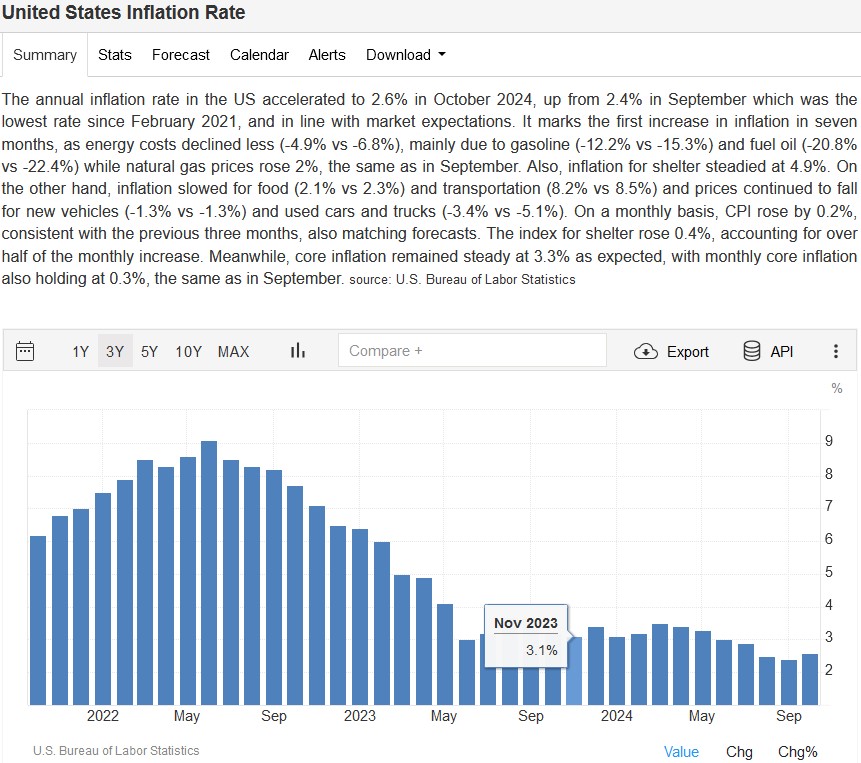
Even today, he does not appear to be inclined to check his assumptions about the Suez Canal's importance. Maybe you can help him and point out the de facto blockade's effect on inflation?

source https://tradingeconomics.com/united-states/inflation-cpi

(The current Red Sea Crisis began on 19 October 2023).


Long story short; those 99.9% of Americans who don't care according to him are correct to not care.

S O

defence_and_freedom@gmx.de

.