Showing posts sorted by relevance for query ultralight infantry. Sort by date Show all posts

2018/05/28

Ultralightweight infantry - a theoretical experiment

.
Longtime readers of this blog may remember that I argue in favour of agile infantry that break contact 2-4 minutes after being detected in order to avoid getting caught by aimed indirect fires (mortar, howitzers). (There's a link to related previous articles at the bottom.)

The background to this is that 60-95% of military personnel killed in 'high end' ("peer") warfare between well-equipped ground forces gets killed by indirect fires (artillery and mortars). Air attack, small arms, mines, AFV fires, hand grenades, anti-tank munitions and other causes of death are usually killing much less than artillery and mortars. This is very different in the quasi wars of occupation since 2002 where the opposing forces had few mortars and almost no artillery capabilities. Combat troops suffer a bit more from direct fire weapons than do non-combat troops, but indirect fires are their #1 killer in such wars as well.

Artillery even messes up main battle tanks if they get caught in the fires, so to up-armour infantry is simply no sufficient approach for their survivability against indirect fires. Some fragmentation-proofing can help a lot, but rather against weak and few fragments.

The way to survive artillery and mortar fires is to no be where they unfold their effect. Some opposing forces cannot call for such fires, some call fruitlessly, some get fire support after 10...15 minutes and the best armies can at least at times process a call for support so quickly that effects sometimes take place 2...4 minutes after the call for fires began.

Infantry should move in small groups to exploit what cover and concealment micro-terrain offers, they should stay in contact through (intra-squad) radios, and the teams should know about and support each other. Any one group of hostile infantry should be caught in a crossfire, and new teams should appear to continue the firefight while the previously engaged ones break contact and relocate to avoid getting shelled. (Another method to avoid getting shelled is to 'hug' the opposing force, getting so close that they could be caught by their own supporting fires. This is a troublesome approach because it's more difficult to break contact up close, the own teams risk entering a crossfire themselves and the hostile forces could relocate themselves in time to avoid their own support fires.)

So in the end my view of infantry in firefights outside of urban areas is that they need to break contact (if need be deploy smoke) and move a lot, often, rapidly and even while crouched.
This cannot be done with infantry that's fighting against the force of gravity of 30-40 kg of equipment per man. Their understandable tendency would be to seek cover in a firefight, deliver suppressive fires and wait for support fires to win the fight - as often done in Afghanistan.

this photo is famous for good reasons
So I decided to look if my idea of agile infantry is feasible at all with modern technology and a reasonable set of expectations regarding stealth, firepower and endurance. I ventured to see if a basic fighting load could be realised at a mass that allowed for the necessary battlefield performance with somewhat above average physically fit men. I created three profiles (rifleman/grenadier, fire team leader, light machinegunner), of which the light machinegunner kept being the most-laden one throughout the progress of the excel file. This mirrored other non-theoretical loadout lists of about the infantry's burdens (examples 1, 2).

This is the rifleman loadout:

As you can see, it ended up at 22.3 kg with a reasonable potential for further improvement to 21.6 kg (edit: figures are slightly changed due to tinkering with the list). I suppose there would be changes if one army really troops-tested such a loadout. The justified changes might add 2...3 kg. A well-respected rule of thumb is that the marching load should not exceed 30% of body weight, so 25.5 kg for a man of 85 kg.

My basic war weather fighting load list almost arrived at the maximum acceptable marching load despite ultralight ambitions and sacrifices, but a fighting load should be considerably less than the maximum acceptable marching load! Moreover, the additional mission-specific (or colder weather) equipment (demolition equipment, anti-MBT firepower, Minimore, assault ghillie etc.) would easily add another 4...8 kg.

My conclusion is thus that even the merely theoretical test of my thesis debunked the notion of agile infantry, at least the form of agile infantry that I was thinking about. Infantry won't and can't run often and quickly with an individual 21.6...33.3 kg burden.

© Commonwealth of Australia,
Department of Defence,
photo: CAPT Brendan Gilbert
There's one saving grace; the use of a non-powered load-bearing exoskeleton (example) from shoe sole to load-bearing belt could effectively reduce the burden at the hip by up to 80%, which is about 8 kg of about 10 kg (including munitions and water). This would reduce the effective burden (basic warm weather fighting load) to 13.8...17.5 kg for some activities (NOT climbing hills or stairs, or accelerating/slowing down in a run**).

- - - - -

There's a new challenge if and once one accepts an (unpowered) exoskeleton; where's the golden mean? What's the optimum basic load considering that an extension of the exoskeleton to the shoulders would take off burden from the shoulders as well? What about powered exoskeletons (once they are silent enough)? Will adding plate armour everywhere on the body become sensible again?

I don't consider infantry to be a decisive fighting force; it's more of a presence and cautioning force and the eyes (and ears) on the ground than a primary or secondary killing force. This would be different if I considered urban warfare as nearly as important as is still fashionable, but a look at Eastern Europe shows that there's no megacity and the only relevant million-plus city is Warsaw. So we don't need to pay terribly much attention to urban warfare for deterrence purposes or for any not utterly unlikely defence scenarios. Maybe the Poles should, but not the Germans, French, British, Italians or Spanish. We can indeed focus on agricultural areas, villages, wet areas and woodland.

My relatively low prioritization of infantry lethality and high prioritization of its survivability and persistence leads to the conclusion that the optimum for a basic fighting load is very close to the list and an unpowered exoskeleton from sole to hip.

related:


S O
defence_and_freedom@gmx.de

P.S.: It should be illegal to advertise products as "lightweight" or "ultralight" without actually mentioning the weight (NOT the mere area weight of the fabric used) accurately!

*: I'm aware that the rifle will probably not be good for more than 60 shots before the lightweight barrel with its small thermal capacity becomes hotter than it should in a normal firefight, but 60 shots in 2-4 minutes should be plenty since the rifleman should primarily add aimed single shots to the fire team effort, thus also the scope.
**: In fact, the added weight of the exoskeleton would require even more effort for the addition of  potential energy (climbing) and overcoming inertia (acceleration/deceleration), as the exoskeleton merely helps with resisting gravity.

edit: I don't find the link to edit the table any more, but I'd like to add the correction that the boots are a total of about 100 g heavier. The weight given was based on the smallest size (325 g per boot in smallest size, hence "GTX 325")
.

2018/04/19

Ultralight portable equipment

.
I have a weakness for minimalism, elegance. That's probably why my primary interest in military hardware these days is about the potential of ultralight equipment.
Many standard individual military equipment pieces is shockingly heavy. We don't even have to look at weapons, munitions or armour to find such shockingly heavy equipment: Things such as flashlights, jackets, entrenching tools and compasses often feel like lead-lined.

Fascinating dedication and interesting ultralight hardware solutions can be found in the ultralight backpacking/trekking community and their specialist stores.

They do put their pants on one leg at a time, though. Ultralight weight often comes with a price premium or (more troublesome) with poor durability.
I've come to terms with both. The costs would add up to less than 2,000 € per infantryman or scout, which is completely tolerable. The poor durability seems to be tolerable as well if one adapts the ways one uses the hardware:

The ultralight equipment should be in storage in the barracks and be used on one or two key exercises per year or in times of serious crisis. The ordinary equipment could be the more durable and clearly heavier equipment.

There are even ultralight firearms (not quite in trekking stores, at least not in Europe), such as a roughly 2 kg 5.56 mm NATO/407mm ultralight rifle loosely based on the AR-15 pattern and a roughly 4 kg 5.56 mm NATO/389mm (ultra)light machinegun.

I would expect the former to get real hot real quick, but that isn't much of a problem if you agree with my opinion that infantry should break contact within two (at most four) minutes of being detected by opposing forces (to dodge indirect fires). About two 30 rds mags would normally be spent in such an encounter, and three mags expended should be uncommon. This leads to a requirement that 60 rds/2 minutes should be within a tolerable dispersion and zero shift (such as enough to still hit a helmet-sized target at 200 m 90% of the time in otherwise optimum conditions) and 90 rds/2 minutes should not lead to relevant damage. The UL machinegun would have to rather consume 200/300 rds in that time while meeting expectations and avoiding relevant damage. 
The guns' durability until an armourer has to become involved would be acceptable as low as 1,000 rds for rifles and 3,000 rds for machineguns if really almost nothing fails (a few jams excluded) before those thresholds. Again, the training hardware could be heavier (same ergonomics and accessories, though) in order to achieve a better durability.


It takes some dedication (and for those not inclined to favour minimalism also a portion of self-discipline), but there appears to be a third path alternative to the current overloaded, partially armoured and partially digitised infantry on the one hand and exoskeleton-centric science fiction of fully armour plated and heavily armed infantry on the other hand: The agile ultralight infantrymen/scouts.
I really wish we would test this 3rd way alongside the current and mainstream prototype equipment.

S O
.

2016/11/21

Lightweight equipment

.
Much has been written about the infantryman's burden and the resulting tactical restrictions (and health problems) - including here.

I did a self-experiment over the last year or so: I attempted to compile - using open source intelligence only - a list of equipment that could fit budgets of most European states, serve the purpose (admittedly in the framework of my opinion of what needs be done) and is vastly more lightweight than the stuff in actual use.

The list of items both on my list and selected by the Bundeswehr didn't grow long:
  • LOWA mountain boots (not lightweight, but I didn't find as fantastic ones at lighter weight)
  • Panzerfaust 3-IT round (not lightweight at all, but its weight is excused by necessity)
  • Esbit solid fuel
  • flare gun (astonishingly I didn't find an as capable, yet more lightweight one than the old P2A1)
  • ID "dog tags" (you better not make them of anything other than a thin sheet of stainless steel, for aluminium alloys may melt and punching titanium alloy sheets might be more troublesome for marginal weight savings)
  • NYXUS Bird forward observer multi sensor
  • 5.56x45 mm calibre (with old-style not very heavy ball bullet)
  • ball pen (no kidding - it's more important than much else)
The list of problems is about as long; I didn't find really suitable items in the categories
  • short flak vest (with little overlap to some kind of frag belt)
  • multitool (with the right combination of tools - most multitools seem to be made for electricians)
  • backpack
  • "kleine Kampftasche" (large pouch attached on the belt in the rear) and pouches in general
  • cold weather gloves (I found a pair that is fine, but not rugged - on the other hand, I consider gloves as consumables anyway and there's not much weight-savings potential)
  • infantry hand/rifle grenade (I couldn't find an appropriate successor to the by now primitive Polyvalent MDF)
  • minimalistic NBC mask (not a full one, but one carried during a conflict when NBC attacks are possible, but most unlikely. It's meant to be fine for an hour and fold better and weigh less than a full one. Replacement by full NBC mask once NBC attacks become likely or confirmed.)*
The bags weren't found because I cannot tell if all items would fit in. No suitable flak vest was found because the fashion moved away from flak vests and I didn't find any vest that was short enough to complement a wide ballistic-rated carrier belt. The grenade and mask things weren't found because such concepts are simply not accepted widely.

I was also astonished that I couldn't find better night vision monoculars than the already quite aged PVS-14. It seems that development did hit a ceiling in this area and turned towards more performance** instead of towards lighter weight and less power consumption. Much of the PVS-14's weight and size seems to stem from the ruggedisation rather than from the night vision functionality anyway.

I noticed that in order to get lightweight equipment you seem to need to
  • not seek maximum performance (especially weapon range and protection, this also helps regarding costs)
  • use mostly less than 10 years old equipment (munition types are the oldest items on my list)
  • avoid wintertime

Wintertime is troublesome because of extra weight for extra insulation by clothes/sleeping bag/insulation mat. It may also disqualify fuel cells as main relief from battery weights (they don't work at less than -20°C), deep snow makes snowshoes and/or ski equipment necessary for much dismounted movement. Overall, essential individual winter equipment may easily weigh 5 kg more before adding a proper tent.
Summertime may also be somewhat more troublesome than spring or autumn because of how much more water you may need to carry.
_ _ _ _ _

Here are some of the lightweight items I settled on for the list

Rafael Spike SR - a standalone ATGM munition that needs no separate launcher, not even a bipod. Easy use. Weighs less than some unguided much shorter ranged munitions. It can be trusted against AFVs other than modern MBTs (especially in their frontal 60°).
under 10 kg

M4 Carl Gustaf - the 4th iteration finally is lightweight. The weight of rounds is light compared to bazooka-style weapons of comparable warhead weight and lesser range. The fire control accessory should be the Aimpoint FCS 12, the de facto successor to Simrad's IS 2000 sight. This sight weighs half as much as one round, so it's a great investment if you miss less often with it.
about 6.7 kg + FCS about 1.6  kg

Ultimax 100 Mk 8 (light) machinegun with its proprietary 100 rds drum and quick change barrel - a LMG doesn't get lighter, and the drum is fine if only every squad gets a tool to assist with reloading the drums. The proprietary drum weighs about 720 gram; three drums for 300 rds weigh 2,160 grams while ten 30 rds magazines for 300 rds would weigh minimum 3,500 grams. (The company's own marketing brochure is about older, less improved versions.)
4.9 kg without optical and night sights or a spare barrel + its pouch

ArmorSource LJD Aire (regular cut) - a helmet with NIJ level IIIA protection rating and full coverage at record light weight. It grows about twice as heavy with night vision adapter and night vision monoculars, of course.
850 grams without external accessories

Therm-a-Rest NeoAir Xtherm Large sleeping pad (can be reduced to little over one litre size)
570 grams

Mountain Hardware Hyperlamina Flame sleeping bag - synthetic filling that doesn't lose much effectiveness when damp, not suitable for deep frost without extra layers of insulation (straw, additional textile covers, tent).
1,110 grams

Esbit ultralight folding titanium stove The normal solid fuel folding stove weighs almost 100 grams. Individual solid fuel tablets weigh 4 grams. 
11 grams. This weight was no typo.

Esbit 750 ml Ultralight Titanium Cooking Pot The FireLite SUL-1100 is bigger and weighs 20 g less, but this one appears to be more practical and fits to the stove for certain.
106 grams

Esbit ultra lightweight titanium cutlery set 
42 grams

Sawyer MINI water filter - filters almost 100% of bacteria/protozoa issues out and is suitable for filtering water for storage in containers. This should reduce the need for water resupply or boiling of poorly filtered water.
57 grams

Surefire G2X-D Pro flashlight - lower output power setting for map reading, low power consumption due to LED technology. Military flashlights should NOT be attached to weapons.
125 grams with batteries

Getac V110 ruggedized notebook
1,980 grams

Nikon COOLPIX AW120 ruggedized digital camera with integral GPS and digital magnetic compass (for documentation purposes, not reconnaissance. It is discontinued already; the AW130 is the current successor model. Downside; temperature range ends at -10°C.)
213 grams

Steiner Safari UltraSharp 10x26 binoculars (small, affordable and lightweight, but better than many old military binoculars. I mean this to be issued to every army NCO and officer, and to be handed over to soldiers on security duty. Needs laser filter in front of objective lens for military use. Downside; temperature range ends at -20°C.)
297 grams without laser filter

Zeiss Victory 10x45 T* RF (high quality binoculars with laser rangefinder. For infantry platoon leaders. Needs laser filter in front of objective lens for military use.)
995 grams with battery, but without laser filter

NYXUS Bird MR with tripod (forward observer sensor; thermal camera, laser rangefinder, digital magnetic compass & military GPS in one. One per infantry platoon or scout squad).
1,600 grams with battery

Redfield Rampage 20–60x60mm Spotting Scope with tripod (non-angular design, relatively cheap and lightweight. Needs laser filter in front of objective lens for military use. There are better ones, but the quality difference is less relevant than how widely such spotter scopes are used at all. Every infantry platoon should have one.)
1,055 grams without tripod or laser filter


Compare this with what your country uses instead. The items listed here will almost always be substantially more lightweight, often times at superior performance compared to the legacy equipment.


So it IS possible to reduce the soldier's load by much if you don't use old equipment and muster the self-discipline needed to be satisfied with 80-90% performance.

It was confirmed in this research that technological advances often were exploited for increased performance instead of first and foremost for decreased weight. It's no wonder that after hundreds of years of technical progress we still burden the infantry to the limit. Agility, speed and endurance are biological, not technical - and not considered as output (performance) of equipment worn. Those items which were developed for minimum weight were not used widely.

I think it's similar with motor vehicles; you COULD standardise and achieve great ranges (500 km off-road) if you really wanted to, but different trade-offs are preferred.

S O
defence_and_freedom@gmx.de

*: The ER 2000 comes close, but is still much too bulky. I think of a transparent plastic film hood with filter and a snorkel-like mouthpiece which includes the exit valve. A separate nose clip and the use of external dust goggles to prevent fogging of the hood in the field of view complete it. The dust goggles solution may not work with some flat face shapes (common among East Asians) because the plastic film would there be pressed on the eye. The filter size would be minimalistic for at most 1 hour duration at little physical effort (120 kg man + equipment, walking with occasional 50 m jogs).
**: Wide field of view installations, thermal vision, combined nightsight/thermal vision, night colour vision.
.

2018/06/16

Eurosatory 2018

.
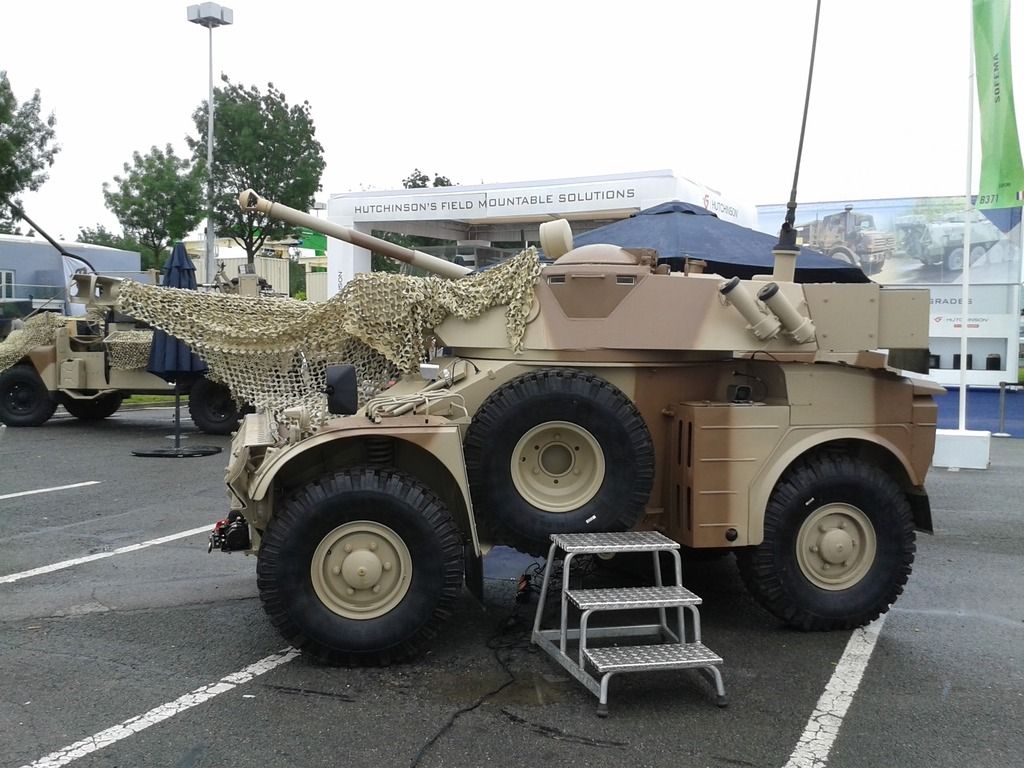
Generally speaking, the Eurosatory 2018 was a disappointment to me because I hoped for much more novelties than were shown. I recognised most portable equipment and even many of the vehicles from Eurosatory 2008.

This is kinda representing the spirit of innovation there
 
Here's a photo album of 300+ photos from Monday and Tuesday:

Sorry about the many early blurred photos. Lots of indoor photos are blurred but almost all outdoor photos are clear despite the wind. I suspect the brochures bag that often dangled from my left arm caused the blurring.

Many photos of hardware have some related context photo (designation, often specs) very nearby. Often times there was simply no such thing to make a photo of.
I used a cheap, old type smartphone with a 5 MP camera. Many photos were repeated because I didn't trust the 1st try. Photobucket failed to upload some photo files and I don't know why.

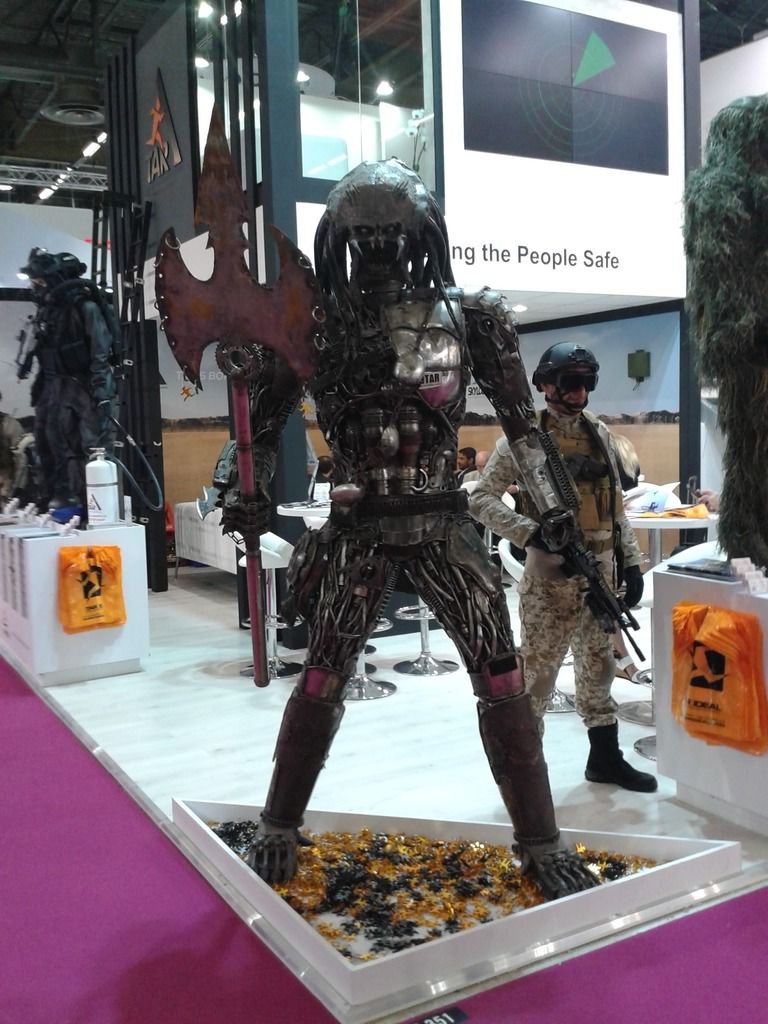
Someone got creative in the quest for attention.
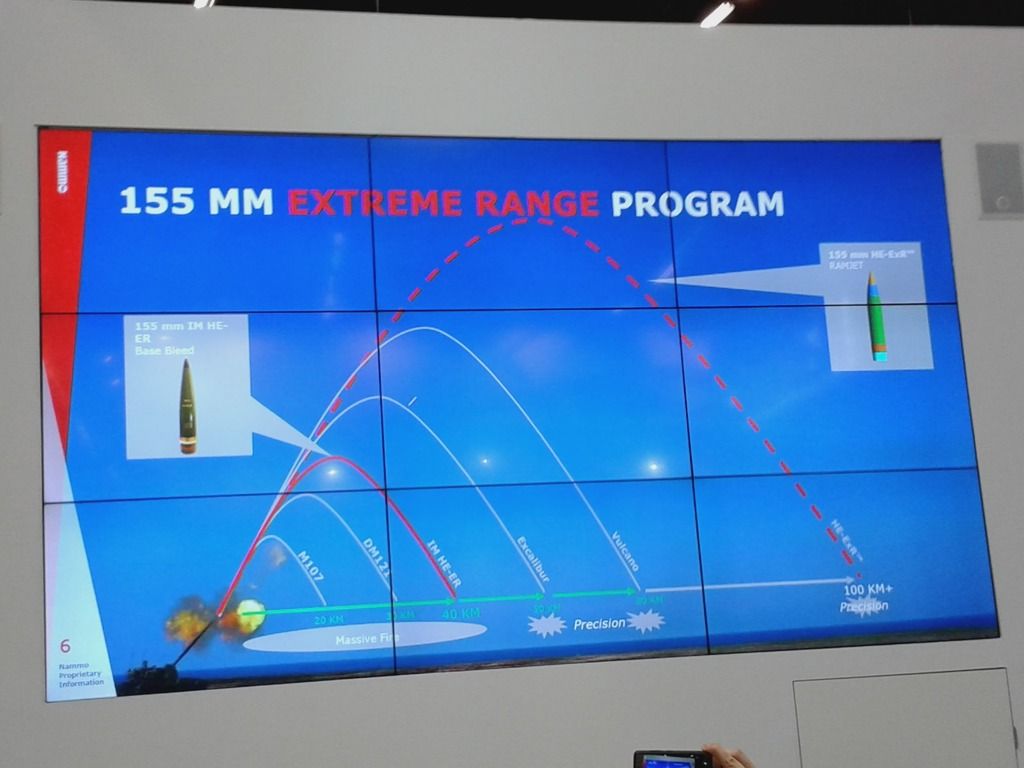
The #1 hardware novelty was almost certainly Nammo's design for a ramjet 155 mm shell that's supposed to fly 100 km far with a decent payload (there's a lengthy presentation in the photo album about it). They clearly hope to exceed what Leonardo offers with its 155 Volcano design. A question remains; why put so much effort into teaching 155 mm to fly far with good or great precision if it's much easier to pull off with a fin-stabilised guided rocket launched from a multiple rocket launcher or even a plain box?


The #1 software novelty was likely Rafael's Fire Weave (though there's also some dedicated hardware involved). I talked a lot to a Rafael representative, and will likely write more about it later.

Nexter showed off some Leopard 2 hull / Leclerq turret hybrid (which I utterly ignored as I only paid attention to the turret), and its stupidity. They seriously showed off vehicles and guns to the public at a trade fair, but also spent on having almost one guard per project who angrily pointed at tiny 'no photographs' signs.

Oops!
Even more hilariously stupid, some other exhibitors posted 'no photographs of vehicle underside' signs at indoor vehicles. I can't tell if they were serious (stupid) or actually trying to redirect attention to the belly.

The displayed drones were unimaginative, and thus I didn't pay much attention to them.

There was a weird, near-total absence of infrared-only ILLUM and multispectral smoke products on the trade fair.

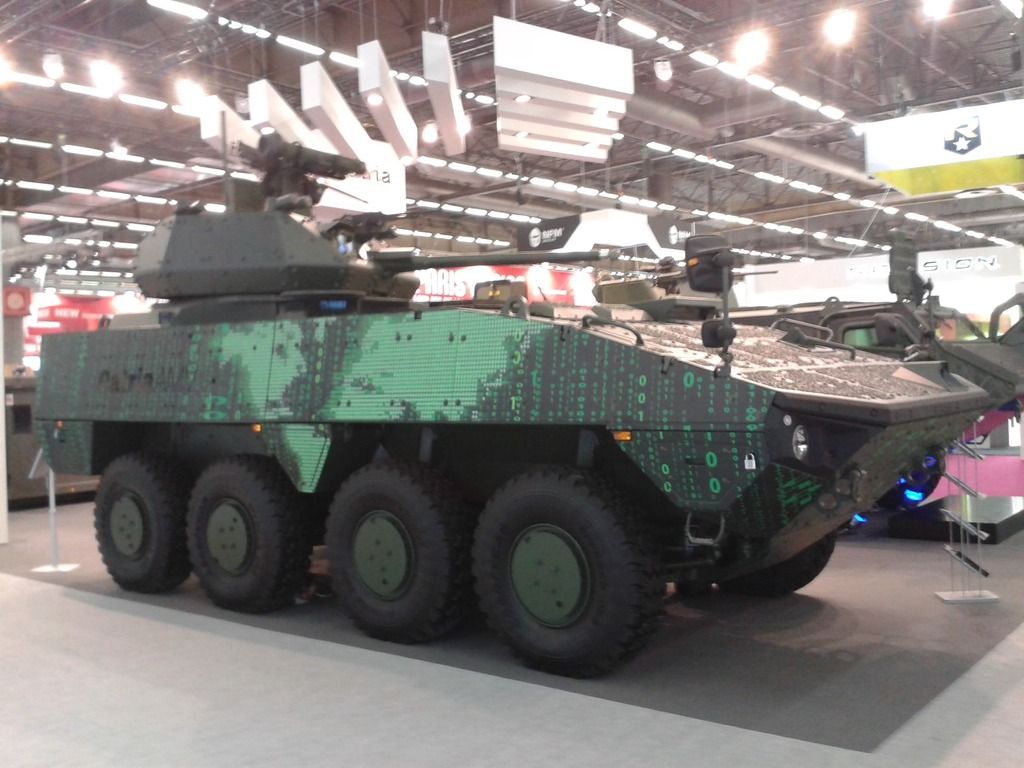
I call this "the Matrix camouflage pattern".
Noptel and Junghans: I asked them about their old optical fuse design. Noptel (original inventors, now a subsidiary of FNH) hinted that it was too expensive, Junghans flat-out claimed that it never worked (mistook clouds for the ground), but admitted that it might be about time to look at the jamming-proof concept again since technology advanced. Well, at least the representative admitted this after I pointed out that one could simply couple the proximity fuse with an electronic timer that is programmed to activate the fuse only for the last 50 or 100 metres and the Shortstop fuse jammers had evolved into many rather widespread IED jammers, proliferating the concept. The Junghans rep did express extreme confidence in their RF fuses' ECCM at first, though.

I asked a representative of a well-known small arms red dot sights and night vision sights producer about the NATO (accessory) rail and especially what's going on regarding a powered NATO rail, since the products were marketed as Picatinny rail-compatible (NATO rail is backwards compatible to this, but Picatinny rail is inferior). He know nothing about either, and after some explanations he finally got the idea why a powered rail with a central battery in the grip and potentially even data transfer between accessories may be a fascinating idea. Seriously; he was supposed to be the expert.

A representative of a big armoured glass producer knew nothing about some old basic research into non-shattering armoured glass. I showed him some infos, he's going to look it up. Flabbergasting.

Lots of other reps answered my questions by telling me exactly what I had already guessed based on incomplete info. 

I noticed something for the very first time about the Ultimax 100; the (drum) magazine is too close to the trigger for resting my index finger straightly. That's uncomfortable and bad for trigger discipline. I compared this to some other displayer LMGs and the problem didn't exist anywhere else, so this isn't my index finger's fault.

The M4 Carl Gustav feels incredibly light on the shoulder, likely because the centre of gravity (unloaded) is only about 15-20 cm in front of the shoulder. The SAAB rep couldn't tell whether the USMC would buy many more M4 to get enough for its new infantry squad TO&E, as customers apparently often buy old CG versions even when a newer, better one is available. BTW, SAAB guarantees a life of 1,000 shots with SAAB munition for the M4. The rep signalled no interest in a slip ring version of the HEAT munitions, even though it could eliminate spin almost entirely and thus increase armour penetration.

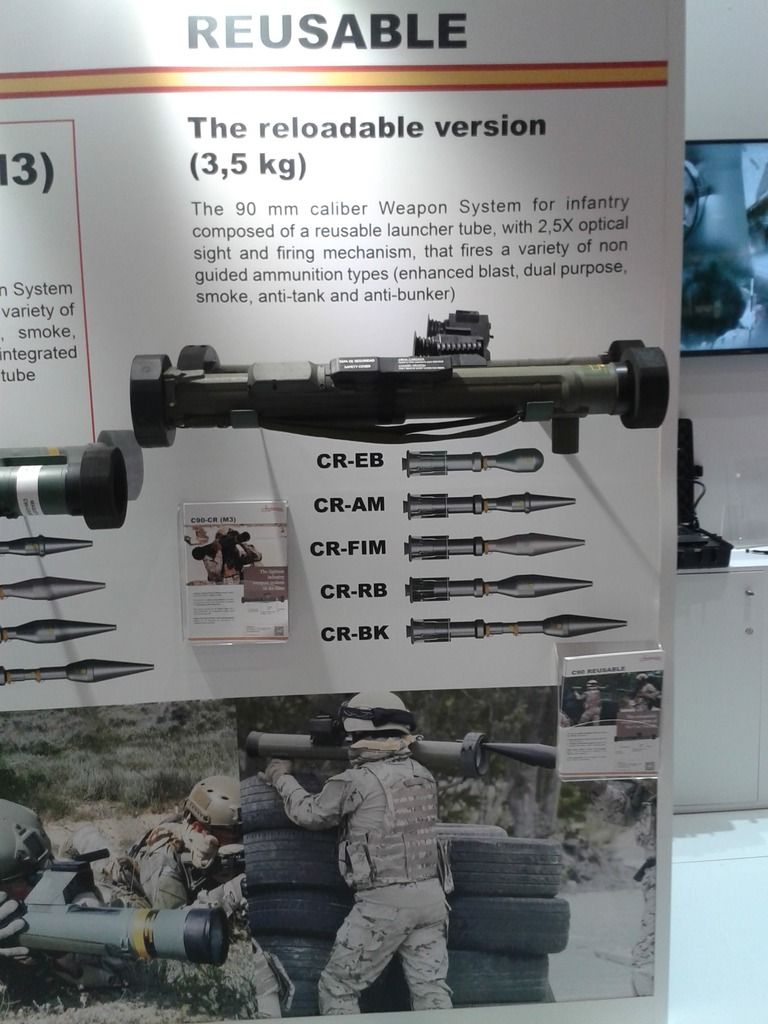
A reusable Instalaza C90 - I didn't have this on my radar before. It blows the M4 CG out of the water with its weapon weight (3.5 kg, about half that of the M4 CG), but munition weights and calibre are extremely close. It's a choice for land forces that do not insist on the smaller dispersion of the CG's HE shells at longer distances, I suppose. (The C90's barrel is smoothbore, while the M4 CG's is rifled.)

That Dragon C thermal sight that I had in the list for ultralight infantry is actually available in a 640x480 pixel version with the same weight already.

Spike SR is confirmed to lack top attack mode due its lack of a movable IIR sensor (it cannot look at a sufficient off-boresight angle for a top attack flight profile; it would lose the lock-on). It can supposedly fly to 2,000 m (Rafael first claimed 800 m effective range, then 1,500, then 1,800, now again 1,500. Supposedly, they do now market is as having 1,500 m range to not chip away at the case for Spike MR). 1,500 m is apparently its tank ID distance ("ID" as the user can tell a tank from a car at that distance - identification is likely the main argument in favour of the heavy command launch unit used with Spike MR).

Those Cockerill 105 mm turrets with 42° maximum elevation have the potential for indirect fire, but aren't really prepared for it in any way other than their huge maximum elevation. Indirect cannon (cannon ~ fixed cartridge case) fire is a capability that customers could demand and get with little additional development work. There's no fire control for indirect fires, no dedicated munition types, no preparations for manipulating the propellant power (the easiest method would be semi-fixed cartridge cases that allow to add or remove propellant charge modules).

I discussed ballistic helmets with a rep, but got no answer for my question why nobody tries to bring a soft, foldable helmet (that could conveniently be stored close to the hip) into the market. I suppose it might work with soft body armour textile layers and foam trauma pads, at least up to a frag protection rating equivalent to what the 1...1.1 mm thin steel helmets offered (enough to protect against falling bullets and fragments from distant explosions in the air). I suppose that such a soft helmet / ballistic hat might be carried along by troops who would otherwise just use a hat for convenience.

Some brochure photos:

just a Brahmos anti-ship missile brochure

backpack radio jammer (mobile phones and tactical radios),
RF fuse jammers look similar (see the classic 90's Shortstop)

Some (apparent start-up) passive exoskeleton, not yet optimised for low own weight

Slovakian LORANA FOG missile equivalent.
The drawing is extremely similar to a drawing in an ALAS brochure.

ultralight thermal sight (clip-on or stand-alone with digital zoom)
all-round through-armour vision system

Apparently, there are three ways how to provide an AFV crew with all-round under armour vision.
#1 is to do what was done in the AH-64  ages ago; single sensor that turns to look the same direction as the (one) user. Nobody seems to pursue this approach any more.
#2 is to have a box on top with multiple staring cameras that provide 360° vision, even to a helmet-mounted display of multiple crewmembers.
#3 is to have distributed sensors, but they provide no seamless vision to helmet-mounted displays. They can rather feed screens only, and are thus similar to panoramic mirrors.

I suppose #2 will be the preferred retrofit solution, while #3 makes more sense for new AFV designs where you can integrate the sensors into the outside, rather than occupy the roof with yet another pole and box that provokes sniping.

still the same Sentinel product


some data on Sentinel
lighter than M4 Carl Gustav, but lacks the rifling


The representative gave me this without me wanting it. Well, have a look at the maximum target velocity: Mach 2
Fast-moving warheads don't expel their fragments exactly to the sides; the combination of outward fragment velocity and forward velocity leads to a cone-shapes fragmentation pattern (or continuous rod pattern). This is important, as you need to get the timing right against targets that approach very fast from the front. You might miss those if the fuse acts too late. The FREMEN fuse appears to do just that against faster than Mach 2 missiles. I don't quite understand why they push this info with a marketing brochure.

SPACIDO, a very promising fuse for 155 mm HE shells.
Some South Korean very light personal role radio (intrasquad radio)

Intrasquad radios are likely the biggest improvement of infantry in the past 30 years. The in-service models are anything but small or lightweight, though. I don't think that the South Koreans are technology leaders, but these brochure photos can give you an idea about how capable, small and lightweight such radios can be.

a bit heavier, thus a bit more capable


This would be rather for fire team or section leaders.


Laser module for burning small drones.
Have a look at the operating temperature range if you like that idea.


Flexible ballistic neck protection. Better than to use your hands for it when prone.

One of the most important army items.

Some digital press kits:


S O
defence_and_freedom@gmx.de

P.S.: I'm visible on one of the photos; the good-looking dude with the camera. :-)
.