Showing posts with label Exotic. Show all posts

2023/09/02

Exotic ancient weapons: (X) The sasumata

.

I did consider to continue the series with the sasumata or the (not terribly exotic or ancient) boar sword, but did put this off for a long time because the sasumata seemed too impractical, too weird to me. I saw a lot of weird weapons from the Indian subcontinent and the Philippines, but the sasumata seemed too weird.

Yet I saw it's actually still in use. That blew my mind. It's one of those things that are truly alien in some other part of the world.

facebook.com/watch/?v=712413385991462


It's even worse; this to me totally alien concept of a weapon/police tool was actually also a thing in Europe: en.wikipedia.org/wiki/Man_catcher

It would (in a non-thorny version) probably be useful in the UK, where many suspects are armed with a knife.

S O

defence_and_freedom@gmx.de

.

2018/09/22

Exotic ancient weapons: (IX) Penobscot double bow

.
First, an engineering view of the double bow.

The Penobscot bow / Wabanaki bow / Mi'kmaq (double) bow is an advanced version of a cable-backed bow with very different mechanics. It's different in its performance from bows that simply use wider or thicker limbs or more limbs.

photo uploaded by "Judson"/"Judson127", taken from here

Mechanical engineers learn that everything can be considered to be a spring; even a solid block of steel is a spring. We can apply a force to it and it will either compress or elongate. We usually cannot see the tiny change in its dimensions, but it happens. Its spring constant simply requires a powerful force for very little change of its dimensions. Spring steels in coil spring shape make it much easier to experience how steel yields to mechanical forces.

A bow can be considered a spring as well - you pull harder, it yields more - and just like a spring, it stores energy in the process. This energy can be released for the purpose of accelerating the arrow (or with an arrow guide, the dart).

Bows (and many other spring arrangements) have no spring constant, though; the amount of force required to pull the arrow back by one more centimetre depends on how far you already pulled it back. The bow design doesn't simply compress or elongate, but changes its shape as it yields to the pulling force (the string notches approach each other).
The ideal bow design would accelerate the arrow with about the same force regardless of how far it's still drawn (but that's not feasible). The force must not be excessive (or the user couldn't draw and hold the drawn bow well or at all) and should not be low (for the sake of accelerating the arrow well).
This cannot be done with a single spring; you need a set of springs (or a more complicated design such as the recurve or composite bows) to approximate this ideal.

Springs of different spring characteristics can be arranged to  create a non-linear spring curve; this way compressing or elongating by a certain distance doesn't require the addition of the same force regardless of how much the spring system has already been manipulated.

The double bow is such a two-spring-ish system in spirit. The small front bow is not just an overly elaborate way of making the bow stiffer; it actually modifies the spring curve (requires more force to draw at first, thus also accelerates the arrow more) as a parallel spring, and by consensus of double bow users, it does so in an advantageous way compared to a self bow of equivalent technology. You get more performance out of such a bow for the same maximum (28" draw) draw 'weight' than with an otherwise equivalent technology self bow.

That, by the way, is the reason why people who create double bows with the front bow almost as long as the main bow either didn't get what the design is meant to accomplish or are merely trying to create a bow that can make do with poor material (poorly suitable woods). A proper performance double bow has a short front bow that gets fully drawn fairly soon in the drawing motion.

(BTW, the Penobscot double bow is supposedly not really "ancient", supposedly it's just over a hundred years old - I doubt this, but don't have sources that mention it earlier.)
  
edit: I decided to add this link, asthe author there actually shows a diagram with force-draw curves. The Penebscot double bow design essentially leads to a quicker rise in draw strength on the first centimetres (inches) of draw. During the shot, the arrow gets accelerated with more force when it's forward that much again. / I also cleaned up the text above a bit.

- - - - -

Second, this video on African martial arts (unrelated to double bows):


- - - - -
Third, some general remarks on non-firearm weapons:

It's amazing how after some study one becomes mostly able to tell the way a weapon was meant to be used by merely looking at it, including some requirements for the associated armour.

The hilt of a blade weapon in itself can be formed to almost force the user to use a certain motion for slashing. This particular hilt design alone tells the observer that the blade will be very curved sabre's blade.

Curved blades typically require a relatively high quality material because they almost never have two edges, and one edge could quickly become dull in an extended battle. Curved blades are especially meant for cutting, so holding a good blade is important (harder edge allows for a sharper edge) and difficult (harder edge ~ more brittle edge).
The one exception I'm aware of are the bronze age sickle swords, and their users were probably prepared to sharpen their weapon with a grindstone on their own as in agricultural use of sickles.

Curved blades are never made for thrusting into the body; they are made for cuts and slashing motions. The cutting motions may include a pushing and pulling motion, but only to cut along the side of the target. The pushing cut isn't really an option with forward-curved blades such as sickles, romphaia or falx.

Straight blades can be built for thrusting into organs, but don't necessarily have the point for it (Celtic swords were largely limited to slashing, as the point was often dull). Very fine points give away the intent to penetrate an armour type that's not very good against thrusting attacks (typically mail), and are thus uncommon in areas where such armours that are vulnerable to thrusting attacks are rare (example East and South Asia).

An extreme case are the smallswords and the like - straight sword-like blade weapons meant exclusively for thrusting with the point, without a shard edge. These continued to be in use after mail armour fell out of fashion in almost all of Europe (Balkans excluded). Frankly, my suspicion is that they were optimised for light weight, as respectable sidearms that aren't too much of a burden on their user.

Large handguards tend to be associated with no use of shields, or use of shields very unwieldy (pavise) or very small (buckler). Handguards can then help protect the hand when you cannot do it with a shield. An exception is the customary retention of large handguards along with late medieval plate armour, but one should keep in mind that swords were sidearms and thus also (if not primarily) used when the wearer wasn't fully geared up.
Blunt weapons such as maces and hammers (also hammer components in weapons such as the pollaxe) were either an extreme budget solution (clubs) or a response to very effective armour. Blunt force can even be effective against plate armour and equivalent helmets when blades and pointy weapons fail. The latter are usually built to be nimble in their use and thus quite lightweight. Axes and blunt weapons require a lot of mass where it matters the most; at the end of a pole or short shaft.

Single-handed weapons that are quite long among their kind (mace, sword, sabre) tend to be cavalry arms. Their increased length compensates for poor riding skills* or a loss of dexterity caused by the user's armour.

Lances and pikes were usually held low, while spears were held high (if used single-handedly) for a greater choice of movements.
Polearms with oval pole cross section and/or dedicated axe head, spike or blade elements (examples pollaxes, halberds, naginatas) were meant for slashing and/or swiping movements. This in turn indicates that they were meant for two-handed use, and thus lead to an emphasis on good armour protection for the user, since shields would be quite impractical.**

Javelins are particularly interesting; the very light ones were used in great quantity by dedicated skirmishers and cavalry, while the more elaborate ones such as the famous Roman pilum (no doubt the most advanced and most capable javelin design ever despite lacking an amentum or spear thrower) were carried in small quantity (one or two per legionary; that's still up for debate). The pilum's purpose was threefold; a demoralising/shocking salvo, disabling shields by sticking to them (making them unwieldy and enabling the enemy to push the shield sideways) and finally an emergency use as a spear, particularly against cavalry.***

Spears are capable weapons for one-on-one situations unless the enemy has good armour. Their use was typically rooted in at least one of three motives; poverty (spears as versatile budget option), horsemen threat (spears as anti-horseman weapon,**** obviously not helpful against missile horsemen) and third, disciplined forces employing closed order tactics (example Greek phalanx).

As with swords, the width of the spear tip usually indicates whether a spear was meant for use against armoured opponents or not. A wide, leaf-shaped spear tip would be for use against unarmoured opposition (example iklwa), or for the hunt. Boar spears and some other spears had some guards to limit penetration.

Particularly short stabbing blade weapons such as the Spartan short xiphos versions or Germanic seax were associated with very restricted close quarters combat, such as fighting in a phalanx or shield wall where the gaps between shields and the air above could be used for very short stabbing motions. Another use for such short sidearms was on board of warships (for boarding actions), usually with a blade that's well-suited to slashing (which makes it useful for cutting tows).

Likewise, the design of shields allows conclusions about their use.


S O
defence_and_freedom@gmx.de

*: Not all horsemen were good at horsemanship games and thus capable of picking stuff up from the ground while riding, so they needed longer weapons to strike targets lying on the ground. That in turn is important because to simply lie on the ground is a reasonable approach to protect oneself from a cavalry charge; horses will avoid to step on such irregularities to avoid injury.
**: This requirement finds in exception of the very late halberd-ish weapons such as partisans of the firearms era, about 17th and first half of 18th centuries. The same applies to bayonets. The requirement may not be met because of economical reasons, but two-handed polearms were rare when good body armour was unaffordable unless the use of powerful halberd-like weapons made it quite pointless anyway (example Japanese warrior monks with Naginatas).
***: The pilum slowly fell out of use when the longer spatha sword gradually replaced the gladius sword. The disciplined Roman infantry (even auxiliary infantry) was able to resist shock cavalry with disciplined closed order formations (horses don't run into spear tips, but the don't run into shield walls either) and a longer sword made the need for some spear-ish weapon against cavalry less pressing. There may thus have been such a relation between the rise of the spatha and the decline of the pilum (in favour of plumbata and cheaper simple javelins). Alternatively, the increased use of light javelins by horsemen may have led to a better opinion about them, eroding the pilum's role. Last but not least, the late imperial Western Roman infantry faced much more cavalry and actual spears became much more common in service again. Spears and pila don't go well along because spearmen tend to keep close formation, whereas pila require some more space for the user to throw. In the end, the pilum+gladius combination was unique to late Republican and early Imperial Rome, and a hugely successful approach that seemed to have been suboptimal in other times and places.
****: Long straight swords could be used to deter cavalry as well (Pallasch weapons were used by cuirassiers of the 18th century almost as if they were spears).
.

2016/04/23

Exotic Ancient Weapons VIII: African throwing blades

.
Most rotating throwing weapons (throwing knifes, throwing daggers, throwing axes such as Tomahawk or Francisca) share the same problem: They are fine for a trained user at a specific distance, and little good at a shorter or longer distance. The correct window may be as small as between eight and nine metres distance. It sure was difficult to get that right in a stressful combat situation, and even more so during an infantry charge.

This small window is a consequence of having but one sharp edge (axes) or point (knives) that does much damage. If you throw at full power from the wrong distance the rotation may be 30° too much or 30° too little and the edge or point doesn't hit, resulting in little more effect than with a thrown wooden stick. 

A possible solution was the South Asian Chakram or Chalikar - a ring with a 360° edge. This introduced a different problem, though - a direct, rather blunt hit would do rather little damage because even though the edge was sharp, the ratio of surface are in contact to momentum wasn't all that impressive. It was nothing like a knife's point or an axehead's edge.

A different solution was pursued in Africa, apparently first in Sudan: Throwing knifes with multiple points and sharp edges, making it much less important by how many degrees the missile rotated before impact. It would usually be nasty unless stopped by a shield or armour.

A collection of African throwing weapons (c) geni, see here
The photo shows it; these throwing weapons were mostly suitable for melee as well, not exactly standardised and (in my opinion) rather not optimised. It's almost as if a scary appearance was an important requirement of their design.

There are many names for these African weapons (or munitions), seemingly varying regionally as much as functionally;
Kulbeda, Pinga, Trombash, Shongo, Shango, Kpinga, Sapa ... by now it's likely clear why for once I didn't write the name into the title of the exotic ancient weapons post!

Of course, the widely known Shuriken of Japanese origin with its four or more points and no handle makes it almost entirely irrelevant how much it rotates before impact. The difference is at most between one point penetrating somewhat deep and multiple points doing more shallow penetrations. Shurikens are also more compact, but they have one severe shortcoming: They have no handle unlike throwing axes, those African throwing weapons and so on. The grip can thus be not as firm (limiting power), and there's no substantial lever, since the hand grips the missile very close to its centre of gravity. There's not necessarily a rotaton involved (and thus no rotation energy) in shuriken throws.
In case you don't quite get what I mean here, look at Atlatl and Woomera, two weapons meant to exploit a long lever for more throwing power (see here or here). The Ancient Mediterranean world used small slings attached to javelins for the same purpose.
_ _ _ _ _

Throwing weapons are among the more confusing historical weapons in my opinion, since their range was typically only 9-45 m depending on design (Plumbata possibly more), and the used had to switch to a melee weapon in a few seconds after the throw in order to be ready for melee in time. The throwing motion also fits poorly into the dense formations fo closed order tactics, which makes the great popularity of javelins in the Roman armies even more confusing, and the issue with range sensitivity makes the supposedly well-documented use of Francisca throwing axes by the migration period Franks (during a charge!) almost unbelievable.
The one exception are peltasts in Ancient Greece, especially when facing a relatively rigid phalanx as target. I just don't understand why they used the small slings attached to javelins instead of using a kind of Atlatl that can double as a battle axe with the other business end.

These African throwing weapons required a great smithing effort required and are thus rather confusing as well. Their shapes were also apparently never optimised into one dominant design. Most throwing axes look alike, most throwing knifes look alike, most javelins look alike (save for the possibly overengineed pila), but the Africans never agreed on one dominant design. They're challenging an otherwise widely observable pattern in military (weapons) history.

S O
.

2015/10/12

Exotic Ancient Weapons VII: Patta

.
A sword is often said to be an extension of the fighter's arm . It isn't. It's more like a huge thumb enlargement, but we got used to not think about it this way. That's because in Europe blade weapons tend to have grip and blade on the same axis. A modern exception from this pattern is the (blunt) tonfa, a stick popular with German police, for example. Rifles and pistols tend to have grip and barrel non-aligned as well, though especially the early pistols of the 17th century had a barely angled grip.
Many European rapiers - weapons meant almost entirely for a piercing thrust attack - had two finger rings behind the handguard which allowed the fencer to come close to gripping the weapon oblique to the blade.

The patta or pata was an Indian sword type which did not align the grip with the blade. It's got a straight blade, unlike most other "Eastern" blade weapon types:

18th century patta (c) Alicia Cicon Mumford
The weapon is interesting both mechanically and regarding training:

Mechanically it does not allow to use wrist movements, which should reduce its speed and thus power of impact in slashing movements. On the other hand, it allows for a much stronger parry, and it transfers the (not very great) kinetic energy of the moving forearm during a slashing attack.

The negligible role of the wrist in the use of this weapon allows someone with an untrained (weak) or simply wounded or stiff wrist to use this weapon much easier and likely more effectively than a more typical blade weapon. A quickly trainer soldier would typically have been equipped with a shorter and cheaper weapon such as a falchion or cutlass, though.


The Katar is a type of dagger that's similar in principle, albeit without really locking the blade axis to the forearm axis that well.

S O
.

2014/04/25

Exotic Ancient Weapons VI: Chu-ke-nu (repeating crossbow)

.

If anyone needs evidence that crossbows require less training than bows, the repeating crossbow provides it. You didn't even need to fumble with bolts in mid-battle.
This East Asian development had no parallel as a one-man portable weapon. The heavier versions had parallels in some repeating bolt-firing weapons for sieges and shipboard use in ancient Mediterranean history.

The simplicity and elegance of the design is almost astonishing. Accuracy and power were poor, though. It wasn't able to exploit torsion for greater power, as the expensive late medieval hand crank heavy crossbows did.

The value of a repeating crossbow was probably in the morale effect of hundreds of bolts fired within seconds by a few dozen men, and increased by poisoned tips.
I suppose the poison didn't need to be very deadly; humans had good reasons to fear even small wounds before the introduction of penicillin. A small wound with some kind of poison - even if it's only guaranteeing an inflammation - was something to fear, and causing fear is the morale effect of weapons.

The high volume of bolts fired may also have been useful against light cavalry, as the horses could panic after sustaining several wounds and the horsemen might want to avoid getting their horses wounded like that.


link: a description

S O
.

2012/08/31

Exotic ancient weapons: (V) Shark tooth weapons

.
Try to recall how you imagined "Friday" and the other savages when you read "Robinson Crusoe".
Half 100% naked as on the painting on the right, probably?

Well, warriors of the Pacific Ocean were a lot more awesome, that's for sure.


For starters, there's a simply awesome weapon, better than a horror movie author could imagine it: The shark tooth sword.

Iron, tin and copper, Obsidian and even flint stones were unavailable on the Pacific Islands, but one sharp,  hard object was available in abundance: Teeth. Shark teeth were best-suited for a slashing weapon, obviously.

Voilà, the shark tooth sword!
source
No really, these things exist and were in use!

There were apparently kinda Nagamaki-like shark tooth 'lances' or rather polearms  ("Trunun"?), Macuahuitl-like shark tooth swords ("Tetoanfa"?), shark tooth short swords/clubs and finally shark tooth-armed gauntlets.

The longer weapons are most awesome in my opinion.

I may begin to sound a bit as the obnoxious "Future weapons!!!" guy, but I think this topic is really close to what by genetic design men are programmed to think is awesome.

- - - - -

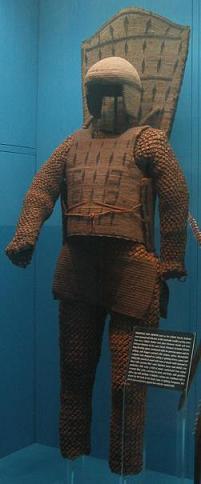
A vicious slashing weapon such as a shark tooth sword does of course provoke a countermeasure. We're seeing countermeasures everywhere in mankind's warfare, so there had to be one on those Pacific islands as well. Again, few materials were available - no iron, no tin and copper, no silk, no leather, few large bones, poor wood - one thing was available in abundance, though: Coconuts.
source
Last year I bought one for Christmas time. That thing was really tough, I finally resorted to using an electric borer to create two holes in order to get the liquid out of it. The primary idea was to eat the white stuff, though. To open this tough (pseudo-)nut was tough. Finally, I left the house and decided to simply throw it at the wall (this worked). Obviously, I never cared to learn how others open these tough things in a more civilized manner.

The toughness of the shell stems in large part from the fibres embedded in the shell. They're quite durable and decompose very slowly. They were apparently fine enough for woven armour - armour unlike most if not all types of armour used elsewhere.

Sword, knife and vest source

source
Oh, there was another thing available in abundance: Fish. Guess what, you can make a helmet out of some porcupine fish. Again, no kidding!

So there it is; a fully equipped warrior from the Gilbert Islands.

source


source


Obviously, a couple images say more than a thousand words, so I did largely shut up this time. I gotta say that this kind of equipment is really interesting, though. Humans really, really go inventive and to great lengths in order to have an advantage over others when it comes to deadly violence (or to at least not be disadvantaged).

Btw, elsewhere I found the words "Tebutje" and "Pacho" as designations of a shark tooth sword and a shorter shark tooth sword. Both sound rather Spanish to me, so I guess it's not indigenous language.


The other "exotic weapons" posts can be found under the label Exotic (on the left side of the blog).


P.S.: I have absolutely no idea why everyone calls them "shark tooth" weapons instead of "shark teeth" weapons.
.

2011/05/21

Exotic ancient weapons: (IV) Macuahuitl

 .
The Native American civilizations have shown us how advanced "stone age" can actually be (and likely was in many part of Europe as well) - better than the few lasting traces of stone-age populations in Europe did.


The Central American populations used a quite advanced weapon with remarkable characteristics; a nightmare of a sword.
The Macuahuitl was basically a club with sharp obsidian stones as saw-like blades. A modern chainsaw is loud, but probably not much more frightening than a new Macuahuitl.


The Macuahuitl was basically a heavy, about one metre long scalpel sword - and it was wielded against warriors who had no metal armour. The club itself was already frightening, the sharpness was incredible, but the effect of a sawing motion slashing attack was certainly so brutal that we won't see a realistic Aztec battle in a movie anytime soon.


The obsidian stones lost their sharpness after some blows, of course. This did most likely require some economic and logistical effort because an army needed to be supplied with fresh stones and the means to fix them onto the wooden club (no clue how that was done).
.

2011/05/10

Exotic ancient weapons: (III) The sling

.
Granted, this one is not very exotic, but at least it's not well known and well-understood any more, since the bow has absorbed the sling's place as ancient ranged weapon in our memories.

The sling was used in many parts of the world, but the Rhodian and Balearic mercenaries were most feared in the ancient Mediterranean world because of their expertise in employing slings (as were the Cretes due to their bow skills and the Spartans due to their heavy infantry skills). The construction of a sling does not require much (it's a piece of natural rope with sometimes a piece of leather to fix the projectile). It could be worn as a head band, around the waist, around the neck, in pouches - everywhere. It's most probably the lightest but successful weapon ever. Its dangerousness exceeded that of most ancient Mediterranean bows, but it depended a lot on its projectiles. You could just carry the sling with yourself and pick up stones on the battlefield, but then you'd have a rather limited performance. Still nasty, but not exceptional. Using well-shaped and well-sized stones yields better results. Dedicated lead projectiles as they were used by mercenaries whenever possible were extremely deadly. Anyone who uses a sling as recreational activity today is strongly advised not to use golf balls - it's simply too dangerous.

The late Roman empire's author Vegetius advised the Roman emperor to have this cheap, lightweight weapon as standard (alternative) weapon for all soldiers - its usefulness easily exceeded the effort of carrying it and exercising with it:

Recruits are to be taught the art of throwing stones both with the hand and sling. The inhabitants of the Balearic Islands are said to have been the inventors of slings, and to have managed them with surprising dexterity, owing to the manner of bringing up their children. The children were not allowed to have their food by their mothers till they had first struck it with their sling. Soldiers, notwithstanding their defensive armor, are often more annoyed by the round stones from the sling than by all the arrows of the enemy. Stones kill without mangling the body, and the contusion is mortal without loss of blood. It is universally known the ancients employed slingers in all their engagements. There is the greater reason for instructing all troops, without exception, in this exercise, as the sling cannot be reckoned any incumbrance, and often is of the greatest service, especially when they are obliged to engage in stony places, to defend a mountain or an eminence, or to repulse an enemy at the attack of a castle or city.

The sling is probably the oldest weapon still used in modern warfare, as it's in use with Palestinians and other low combat intensity fighters (the dagger is about as old if you consider flintstone daggers). Back in ancient times, it was always a wise choice to carry a sling simply because it was no real burden at all, but quite useful at times.

S O
.

2011/05/03

Exotic ancient weapons: (II) Nagamaki

.
The Nagamaki ("long-wrapped handle", also known as Nagakami) is a medieval type of Japanese polearm (it can also be considered a sword - its handling art is more sword-like).

European medieval polearms were usually spears with axeheads (halberd), while Japanese ones were usually swords with much lengthened shafts/grips. Europeans also had the latter (glaive), but the importance of both categories was reversed.

The most important and most famous Japanese polearm is surely the Naginata, which is similar to a Katana blade on a very long shaft.
Nagamaki with scabbard
An early rival to the Naginata was the Nagamaki. Unlike the Naginata, it had about as much shaft length as blade length. At least some Nagamakis blades were furthermore straight instead of curved (still one-edged, though) and thus better usable as spears at the small expense of lesser slashing and cutting qualities.

The Nagamaki first attracted my interest because of its look, but it's also an interesting example of a weapon being optimised for a niche.

The long shaft offered some stand-off in melee, while the long blade made it easier to hit difficult targets in slashing movements. Target such as horse legs, for example - a target that was supposedly an important one for Nagamaki wielder in the 12th to 14th century. It did fit the same purpose as the Chinese Zhanmadao, a curved sword with very long blade. The Japanese also followed this path with the Nodachi. The Nagamaki apparently lost relevance when mounted combat lost relevance in Japanese warfare. ("Das Lexikon der Kampfkünste", Werner Lind).

Cost-wise, Nagamakis were more expensive than Naginatas because of the longer blade, but less expensive than the likewise rare Nodachis. Many Nagamakis were probably modified to swords with normal grip length during the 15th and 16th centuries, and it appears as if in part for this reason no extant medieval copies are known.

Two-handed weapons like this had a very different history in Europe than in East Asia.
European two-handed weapons were either spears for close-order tactics (hoplites, Landsknechte), used before body armour was commonly affordable (Germanic frame) or used after body armour became so extremely good that shields became unnecessary (halberds, glaives; late medieval age till 17th century). The European development ended in the bayonet.
The Japanese did use two-hand weapons extensively in the medieval age without fitting into these categories well. Especially the Japanese warrior-monks with their Naginatas left an impression.

Two-hand weapons (especially spears) were also most important in Chinese military history, most likely because of the threat of mounted steppe warriors.
Eventually, East Asia adopted the bayonet as well for a few decades and the northern hemisphere was finally united in regard to two-handed melee weapons. Until then, there were both similarities and differences in two-hand melee weapon development - and the Nagamaki is as far as I know without a close Western counterpart.

S O

edit 2016:


.

2011/04/08

Exotic ancient weapons: (I) Majra

.
One ancient weapon fascinated me more than all others lately; the simple, yet tricky majra.

A majra (Turkish and Arabic word for it) is an arrow-guide for use with a bow, dominantly with a Turkish composite recurve bow, the most advanced of all ancient bows (only modern bows with non-natural materials and rollers surpassed its quality). There floats also the designation "nawak", I think that means the majra-equipped bow.

The Turkish composite recurve bow was made of wood, horn, natural glue and sinew and both fascinating in its exploitation of material properties and mechanics. Forget the crude English longbow, it was crap by comparison. Longbows are most of the time not ready for combat because the permanent stretching by the sinew would quickly degrade the wood. A composite recurve bow could be held ready for combat for days if need be.
Turkish composite recurve bow
The production and maintenance of a composite recurve bow was never really accomplished by European armies (even though in antiquity the people of Cretes used recurve bows and the Turks were able to maintain the Turkish composite recurve bow in the Balkans). The standard excuse was that it wasn't good in more wet climates, while the real reason was more likely the advanced construction and especially the production of a suitable natural glue.

An arrow guide like the majra turned such a Turkish composite recurve bow into an even more refined weapon. This add-on part (not permanently attached) allows to shoot darts instead of arrows. A dart is smaller, lighter - yet gets about the same stored energy from the bow. The result is a faster projectile that has a much straightened trajectory. The projectile was hardly visible in flight - dodging it was in practice impossible even at long range and hidden shooters could avoid detection at times.

An enemy without majra and without crossbows couldn't pick up darts and shoot them back, too.
The dart's small size was furthermore an advantage in itself: It was possible to carry about twice as many darts as arrows in a container of identical weight and bulk.

Turkish warrior with bow and majra

There was also a significant flexibility advantage in a bow with a majra: Crossbows were rather impractical for mounted troops, and had a disadvantageously slow rate of fire for dismounted troops on a battlefield. A majra user had the best of both worlds; crossbow ballistics, ability to use all battlefield pick-up ammunition and both dismounted and mounted utility.

A disadvantage of the majra was that accidents could happen if the arrow left the guide rail. Bows of all kinds were more training-intensive than crossbows and the latter were more demanding than firearms (a heavy crossbow was much more expensive than a an arquebus because of its mechanics). That's likely the main reason why the first crude and terribly inaccurate firearms were adopted over bows and crossbows (the scary noise being another great reason).

A true light crossbow has an arrow guide permanently attached and uses a bow for storing energy (unlike heavy crossbows, which use the principle of torsion). It's more bulky and heavier than a bow with majra, less multi-role and its only great advantage was the use of a trigger mechanism (in addition to safety of use). This allowed to wait or aim slowly without tiring the arms. This advantage was most pronounced in sieges when siege troops and besieged troops were waiting for an opportunity to hit someone careless. The more powerful and expensive heavy crossbows were preferred for this over light crossbows, though.

Coming soon: Exotic ancient weapons: (II) Nagamaki

S O

edit 2014-05:
.
edit 2018: Apparently, the Byzantines called their equivalent to (copy of ) the majra "solenarion".
About picking up munitions; arrows need to be matched to bows for accuracy, of course. So battlefield pick-up arrows are poor quality arrows even if undamaged. The shorter arrows or darts for the majra did likely not require all that optimisation, and probably no skilled fletcher; they were too stubby to bend much during the shot anyway. This and the inability to dodge or actively block single shots (which was a real thing with bow arrows) may have been the most important reasons for the majra's existence.