Showing posts with label Afghanistan War. Show all posts

2022/02/24

A messed-up international disorder


So, looking at the mess in Ukraine, what's my take?

The upside: Putin is apparently not the type for strategic surprise attacks. This calms my fears for NATO, as Russia could only hope to succeed with an aggression in the Baltic if it attacks by surprise. I am very pleasantly surprised about this.

Why did Western policy fail in Ukraine? In short; it was half-assed. No great power signed and ratified a bilateral alliance treaty with Ukraine to cover it until a much longer (and more overt from the beginning) NATO accession process could be concluded. Either draw Ukraine into the West or don't, half-assed measures are prone to disappoint.

So what did Russia do? The Russian Federation with Putin as de facto dictator (voting him out of office is not really an option for Russians) violated international law (Charter of the United Nations and more) by becoming aggressive against Ukraine in 2014 and occupying parts of its territory. It's thus an aggressor and occupier comparable to Iraq 90/91, Israel since 1967, Turkey since 1974 (a NATO member and I don't see any sanctions), Morocco since 1975, the U.S., UK and Poland in 2003 for a difficult to determine duration.

As you might have spotted, only one country on that list was beaten up (repeatedly) for the offence. All others officially got away, typically due to protection courtesy by the UNSC veto feature.

This is the problem: The West routinely expects non-Western countries (especially governments it doesn't like) to adhere to international law and paints them as evil when they don't (and often does so even only because there are expectations such as Iran never having violated the NPT, but still being assailed constantly). Yet International Law doesn't seem to feel all that binding and imperative to Western great power policy, or even only to its proxies.

Do as I say, not as I do.

A great attempt was made to build a world based on international law and order in 1944 with the founding of the United Nations. The 1991 war to hand back Kuwait to its kleptocrat-tyrant was widely perceived as a most promising effort to enforce such a rule of international law in the post-Cold War era. 

Yet the Americans did not scale back their (since the trigger-happiness of Reagan in the 1980's) habitual aggressions; they bombed Afghanistan, Bosnian Serbs (with Brits and Frenchmen), Sudan and Iraq (repeatedly, but with little munitions) in the short 1992-1998 time frame. None of this was legal under international law, and there wasn't even the slightest hint of fig leaf legality in the bombing of the Bosnian Serbs around Sarajevo.

Meanwhile, the NATO bureaucrats and allied politicians worked hard to keep NATO "relevant" after its original purpose became obsolete; a defensive alliance was re-worked into an intervention/war adventure club.

Then came the 1999 Kosovo Air War, preceded by a multinational campaign of lies. There was no genocide, period. The Kosovars' intent to become independent was legitimate, but the Serbs-run governments' police, paramilitary and military actions against the violent independence movement were legal under international law and an ordinary response. The conflict happened in the context of the earlier genocidal massacre committed by Serbs at Srebrenica in Bosnia and thus the Western public was fairly easily convinced and swayed by the lie of an alleged ethnic cleansing/genocide in Kosovo (I was fooled back then as well, and never again since).

Almost all Western powers of note participated in this aggression against Yugoslavia, which was blatantly against international law. The recognition of Kosovo's independence years later and ongoing Western troops presence to keep it that way provided blueprints that were later used by Russia.

West Germany/Reunited Germany had its original sin with this Kosovo affair and our federal constitutional court threw officers under the bus who had correctly and valiantly refused orders to participate in this aggression.

Afghanistan was invaded in 2001. It was no a clean self-defence by a long shot, as the Taleban were never killing anyone outside of Afghanistan and Pakistan, but most if not all countries kinda understood and tolerated the American rage.

Once more, NATO was brought into the conflict for absolutely no need, and very contrary to the North Atlantic Treaty, but by this point nobody seemed to care about the treaty any more. The idea of what NATO is or should be had been warped beyond recognition. The craze about the Taleban who had merely granted hospitality to UBL who helped them in their civil war lasted for two decades and very recently the U.S. government stole billions of dollars owned by the Afghan government. It appears as if they are bound to multi-generational anger about Afghanistan comparable to how they still hate Iran's government for the 1979 embassy crisis.

The Kosovo Air War blueprint of massive campaign of lies, deception and vilification was replayed by the Neocons to lie the U.S. (and the UK under the fool Blair, plus Poland) into a completely unjustified war of aggression against Iraq in 2003 (this time I didn't fall for it at all). Again, they got away with it in the UNSC, but this time the Iraqis made it very expensive for them. The American wars in the Mid East including Afghanistan total exceeds USD 6.5 trillion expenses including long-term costs.

The lying moron did "cruise missile diplomacy" (an aggression) against Syria, and most Americans seem to think he was a peacenik who abstained from aggressions. That's how badly their perception of what constitutes aggression was warped.

Now let's skip the South Ossetia War of 2008 (the Russian Federation was and is an aggressor in both South Ossetia and Abchasia, similar to what the West did in Kosovo), and look at the Russia-Ukraine conflict:

By international law, Ukraine is a sovereign country, including Donezk, Lugansk, Crimea. Its government is legal and legitimate, but that's not even of importance. Even dictatorships are sovereign countries and shall not be attacked under international law.

By international law, Russia is waging a (most of the time limited, as for example no air power was used until 2022) war of aggression against Ukraine.

The outrage is huge in the West.

How could Russia do this? Russia is evil! 


Sure, it's evil, but so are we Westerners.  

The problem is that the West did not only fail to bolster International law, it systematically disregarded it and preferred "might makes right" for itself.

The U.S. and UK are just as evil as Russia.*

Other European countries stood by, supported or tolerated or sometimes called for the aggressions of the U.S. and UK. Most of "the West" is guilty by association, as much as Germany was involved in starting the First World War by giving the aggressive Austria-Hungary a "blank cheque" that it'll support it in the summer 1914 crisis. Austria-Hungary's behaviour in summer of 1914 was accurately replayed by the Neocons in 2002/2003. All those politicians who like to give speeches about learning from history are cherry pickers.


Now we live in a world where Westerners understand that they aren't the only ones who can exploit such international lawlessness and play "might makes right".

This is a failure of Western foreign policy, and a well-deserved disgrace on the Western world. Putin would have had much more to fear if he ruled Russia in a world that had become accustomed to international law being followed by great powers for three decades. Now instead, he can rest assured that Western hypocrisy has dulled the blade of international law and his aggression will be tolerated by most of the world just as were Western aggressions.

Maybe we can push back the warmongers and launch another push for international law (for real), but it will be too late for Ukraine. Russia will at the very least (in my opinion) keep parts of Ukraine occupied and an open wound that very much prevents its accession into NATO, similar to what it does to Georgia.

It's much more likely that the warmongers who in large part got us into this messy, lawless world will feel an updraft and there will be more interventions and more military spending.

I hate warmongers and defense with an "s" hawks.

S O

defence_and_freedom@gmx.de


*: France is a trickier case, and I dismiss Poland's participation in the war of aggression against Iraq as a one-off.

2021/08/15

Fall of Kabul imminent

.

Now with the Fall of Kabul imminent I'd like to explain it so far as I can (and there's always a chance that I'm wrong). I can simply quote a comment I wrote here a month ago to answer a question:

"The Taleban collapsed in 2001 not because of bombs but because of a cascade of desertions, local groups changing sides. The expectation was that at the very least the foreigners would take over the cities and the ring road like the Soviets did.
This is very likely what's happening now. The previously West-supported central government (basically the non-Pashtu factions) is likely collapsing without giving much of a fight because local allegiances switch again. Their troops were motivated by the foreign money, not by patriotism, faith or ideology.

This local allegiance thing is the whole reason for all that[junior officer]-level diplomacy that was done for decades with the elders of villages and such. The foreigners were trying to have such local factions on their side, and this effort has ended with obvious consequences.

Those few anti-Taleban forces that won't collapse (basically some narco warlord armies) will probably withdraw to some defensible section (IIRC they held a Northeastern valley by 2001) or to neighbouring countries other than Pakistan.

The mobile Taleban troops are very, very few compared to the astonishingly large population, but the very much armed population doesn't fight for its freedom from pseudo-theocrats, so they will lose it."

Was it wrong to withdraw? No. It's not our job to fight and pay for their freedom. The Taleban number about 0.1% of the Afghan population. It was easy-peazy to fight them off, if only the Afghans had attempted to. The Afghan society is dysfunctional and unable to maintain freedom, thus it's not going to live in freedom. (And "freedom" is really a loaded and perspective-dependent word anyway.)

You care about people being oppressed? Fine, tell me how many hours of the year you are exasperated about the hellhole dictatorship otherwise known as Eritrea!


The West sent troops into Afghanistan because there were some Pashtu-nationalist/pseudo-theocrats in power who maintained hospitality for a guy (died a decade ago) who paid and motivated some dudes (mostly Saudis) to kill Americans.

By all historical normal standards nothing more than a punitive expedition was inevitable. Toppling the Pashtu-nationalist/pseudo-theocrat regime was still within the range of normal. Establishing a government that was more friendly before leaving was also within the range of normalcy in the post-colonialism era. 

Staying there and declaring that nothing but the total elimination of the former hospitality-granters would suffice was deranged.

To keep doing it for two decades was total batshit crazy.

And now remember; elimination of the Taleban was impossible all along because they also existed in Pakistan, and Pakistan wasn't even put under serious pressure, ever. How could it be? It's de facto allied with the PRC (a UNSC veto power) and a nuclear-armed power itself.


So the sane thing would have been to leave Afghanistan by summer 2002 at the latest, and leaving the defence of the government to the warlord militias (which were worth a lot more than this 20-years-Western-trained Western-subsidised piece of shit racket known as Afghan National Army).

Now there's at least hope that Afghanistan will find peace after four decades of civil wars, albeit under the rules of Pashto tribal customs. So let's welcome the rapid fall of Kabul. The longer it takes to fall, the more the people of Kabul will suffer.


related (I consistently opposed the Afghanistan occupation bullshit):

/2008/10/times-online-british-envoy-says-mission.html

/2009/02/afghanistan-nightmare-scenario-nonsense.html

/2009/11/extremist-warfare.html

/2010/07/withdrawal-deadlines-it-depends-on.html

/2011/05/comment.html

/2013/11/extremist-rebels.html

S O

defence_and_freedom@gmx.de

.

2016/07/07

If John McCain was No.44 ...

.
... the United States would likely have

- perpetuated the war participation in Iraq with ten thousands of American troops there till today
- done and sustained a bigger "surge" in Afghanistan
- invaded Libya
- entered ground war in Syria
- escalated the Ukraine conflict to a major proxy war
- developed the civil war in Yemen into a proxy war instead of sitting it out largely
- spent an additional USD 1-5 trillion on the military for almost no benefit (incl. discounted long-term costs)
- suffered an additional 1,000-6,000 KIA


I do not see any benefits in warmonger policies.


On the other hand, the torturers MIGHT have been sent to jail. This is a capital letters "might" because those who bear the most responsibility were GWB and Cheney, and it's questionable whether they would have been prosecuted under a (R) POTUS.

S O
.

2013/11/01

Extremist rebels

.
Imagine your country's state is completely corrupt - from lowly policemen who rape and extort up to the head of state.
You go to vote, but even if you are not impressed by "irregularities" before the elections, you see how the elections are stolen with bribery and obvious fraud.
The organized crime makes up a huge portion of your country's economy.
Foreign - really, really foreign - troops back your government. They assassinate opposition leaders, sprawl the country with bases and pour a flood of money into their helpers and into corrupt officials.
They promise to help your countrymen, but their "help" efforts are dwarfed even by their fuel bill, probably even by their ammunition bill.

Now maybe - just maybe, since all peaceful alternatives for real change to the better are exhausted - maybe you're ready to oppose the corrupt clique and its backers? Maybe even violently?

You thought "no"?  Wimp.
You thought "yes"? So you would be a Taliban if you were born as Pashtun in Afghanistan.

What's your complaint? I didn't mention religious zealots, thus no Taliban?

Well, that's the tragedy. There's not so much of a choice.
It's utterly, utterly typical in military history that extreme guerilla organizations - be them left wing, right wing or religious - are composed of extremists and moderates.
Castro's Cuban revolutionaries weren't all reds either. The Vietcong weren't necessarily much into communism.
The moderates usually play a minor role in the leadership  in comparison to revolutionary zealots and are quickly discarded once the struggle is either successful or becomes marginalized. 
There are rarely "moderate" guerilla groups, you know?


Guerilla organizations tend to be more ideologically homogeneous (as in Yugoslavia in WW2) when there are several truly competing resistance organizations. 'Truly competing' means that a man has a choice - which is not really the case if said organizations have clearly defined territories.
Sadly, the latter is an approximation for the situation in Afghanistan, where the parallel guerilla organizations are even loosely allied (there's more than one kind of "Taliban").


It's a great tragedy and an expression of strategic incompetence that the Western meddlers in Afghanistan allowed the Taliban to become the only really active and highly visible opposition to the corrupt mayor of Kabul. This failure channelled the guerilla recruits into the arms of the Taliban groups. A real lasting defeat of the Taliban could have been attempted by allowing a non-religious Pashtu opposition group to rise to prominence. Who knows? Maybe it could even have been a non-violent, political opposition group. The only requirement was that it needed to be effective. It needed to be able to challenge the government, even the system. Oops, that was beyond the grasp of short-sighted meddlers.


Then again - who cares? So we messed up the thing with the Taliban. It's really not our problem. The Taliban aren't the enemy, but merely the former hosts of the enemy. The Afghani Taliban are even proved to be unessential for AQ, as they have long since scattered. We just forgot about that unimportant detail.
Darned mission creep!


Sven O

P.S.: Written in 2011, published only with great delay. It became a bit more interesting with the discussion of extremists among Syrian rebels in the background.
.

2013/05/07

Offiziere.ch: "Americans, Afghans and Battlefield Agility"

 
The Afghan soldiers sprint ahead, exposed to any bombs but unafraid. U.S. squad leader Sgt. Mason Mullins yells to them to slow down. “We don’t move that fast!”
Time and again this happens: the Afghans outpace the Americans and the Americans must reel them back in. The pace of the raid slows even further when the combined patrol rounds up several Afghan villagers and must enroll them in a biometric database using wireless devices that take 20 minutes to boot up.
By the time they surround Mohammad’s brother’s compound, the Taliban commander and his host are long gone — apparently having fled on a motorbike.
Offiziere.ch

This happens when troops know that the war is not worth their sacrifice (or much else).

The real problem isn't mission failure in an unimportant land-locked country far, far away. The real problem is that a generation of Western army troops and in other ways also Western combat aviation have become used to such a mode of warfare. A mode they won't see again when sometime in the -hopefully distant- future there's a war that can actually remind us why a great part of the peacetime budgets and peacetime efforts for improvement, improvement, improvement* were justified.


S O

*: (or at least matching the levels of performance demonstrated by ancestors)

2013/05/05

Investment priorities and a cleared-up view at military affairs

.
It's been said that Afghanistan is easy to invade, but difficult to occupy. The events since about 1979 have seemingly reinforced this insight which originated from military history of Alexander the Great's era up to the 19th century.
The difficulties of occupation aren't actually that big, though. Even the not very lethal French Résistance was a much, much more lethal foe than the Afghan tribes or more specifically Pashtuns are or have been.

The frustrations are rather two-fold: 

Occupation has little lasting impact. The Soviets' impact on society did not leave many socialist-secularist-European features intact in the Afghan society of the late 90's. I suppose the Western occupation and corruption of the country is not going to leave many desirable features left by 2020.

The other frustration is that Afghanistan is basically not worth it. There's nothing to be gained in this country. The British efforts of the 19th century paid negligible dividends. The Soviet efforts are widely considered to have accelerated the downfall of the Soviet system by their costs and demoralising effects. The Western efforts since 2002 have delivered about nothing. Some people talk about some paper tiger project of some pipeline and some mining operations, but those would be dwarfed by the occupation's expenses even if it had been in full operation all the time.


The Western military bureaucracies, military-related think tanks, authors and pundits have not addressed these fundamental issues much. Instead, they looked for some magic policy or strategy, often even tactics, to make Western troops more effective in such occupations. I don't doubt that defeating the Taliban is possible politically and at least temporarily also militarily. Their defeat wouldn't change the two aforementioned troubles, though.


The whole issue is symptomatic of small wars in general: The benefits are negligible, the costs of the operations vary, but maintaining the capability to play in such small wars without a dominance of improvisation is very expensive.

This could be considered a preferences-justified luxury if Western societies had a lot of excess energy.
Fact is, they are rather mature instead. The cake was already 100% distributed, almost all governments have net debts and many Western countries don't have enough capital investments to grow their capital stock (and thus their economic capacity) adequately. We are playing with camouflaged toys in marginal-dividend political games and neglect our investments in our future. 
We shouldn't only invest more in our future - we should grow reserves to meet unexpected challenges. You know, back in the 18th century many governments were wise enough to have a state/royal treasure instead of a net debtor position. The only modern Western country with such a thing is Norway as far as I know.


For years I've faced people who wank off on fantasies about nuclear weapons, military or military budget sizes, big tanks, fancy combat aircraft, many warships, big warships, the ability to bully about anyone et cetera.
I did not meet or discuss many people who thought of the military as something that is easily justified up to the point of actual defence (preparations) and 100% subject to cost-benefit considerations beyond.* In fact, many, many people can't even tell that what they consider "defense" is actually strategic offensive action or capability. They mistake bullying, invading and occupying with defence. This confusion is a product of governments, of course. There are no war departments and more, but defense departments.

I propose (totally in vain, of course) to separate the discussions:

(1) Collective security topics
These would be about the deterrence or at worst repelling of overt aggression against our alliance only.

(2) Great power gaming topics
This would be about the excess military capabilities and their use. That's the bully, invade and occupy part. Anybody who muddles the water by calling this "defense" should be called out and rebuked.


This is 100% not going to happen, and that's a pity if not doomed to end in tragedy.

S O

* Andrew  Bacevich is a prolific author and commentator who gets this right.
.

2011/11/28

A minor border incident

.
The Islamic Republic of Iran appears unimpressed by U.S. complaints about a minor incident at the U.S.-Mexican border. 25 U.S. soldiers were reportedly killed and 14 more wounded when Iranian attack helicopters opened fire on U.S. soldiers in a Texan border village a few days ago.

The Iranians have helped the Mexican government to suppress the rising drug cartels in a decade-long civil war. There are repeatedly complaints about how little the U.S. does about its huge pool of drug abusers who create the world's greatest demand for drugs and pull Mexico deeper and deeper into drug crime-driven chaos.

U.S. officials complain that the attack on the border post was unprovoked and dozens of other U.S. troops have supposedly already been killed by such attacks since summer, but the media in Iran and the entire Muslim world dismiss this as typical propaganda claim of a government that isn't trustworthy due to its tolerance of drug demand and the overt corruption of its political elite.

Iranian representatives declare that they will investigate the incident.
A report is expected to be finished once nobody cares any more.


edit: Astonishingly, I appear to need to point out satire when I use it even when I think it's totally obvious.

edit2:  Apparently the 'opposite' to this satire isn't big in the news in all Western countries. Now who would have guessed that? It may explain some of the comments (which I blocked because the writers might feel embarrassed.)
.

2011/05/12

On 'successful' occupations

.
I think I remember two typical patterns for successful occupations in history:

(A) The occupied country has at least a similar wealth as the occupier itself.
This allows the occupiers to press enough contributions out of the suppressed to make the occupation pay for itself. France 1940-1944 is an extreme example for a 'profitable' occupation.

(B) The occupation lasts very long (generations).
Only officers, non-commissioned officers, clerks, technical specialists and elite troops are foreigners; the majority of the occupation forces are indigenous troops. This model usually exploits rifts in the occupied society (classes, religions, tribes) and recruits its indigenous troops only from one group. The European colonial powers and their colonies are a good example for this.

- - - - -

Afghanistan looks very differently. It's ridiculously poor in comparison to the involved foreigners and the indigenous forces are neither under control of foreign leaders and specialists nor were they recruited from only one group.


This violation of the well-established patterns may contribute to the explanation of the failure to force central control, peace and order onto Afghanistan so far.


Sadly, neither pattern really helps a country to reduce the risk of becoming occupied. Even the melding of internal rifts wouldn't help much against a multi-year occupation by a peer country.


S O
.

2011/05/02

Comment

.
UBL dead:

This is a great opportunity to declare victory and get out of the mess without losing (much) face.

S O
.

2011/04/12

COINdinistas losing confidence

.
The new fighting season in Afghanistan is beginning and the COINdinistas are losing confidence both in the troops increase and the strategy / doctrine.

Here is a blog text that comes close to representing the mood. It also shows the basic errors between its lines.

First, the author looks at the worst case scenario, then he writes about how there's no obvious way how to influence that outcome decisively (allowing the antagonists no influence on the outcome) and then he's kind of depressed.


The basic - and extremely widespread- errors are

Pessimism

The focus on 'worst' case scenarios leads to wrong reasoning. A fixation on the 'worst' case doesn't allow you to hope for a good outcome and thus keeps you from attempting something risky. After all, you're a pessimist and only care about the risk, not the promise, of a risky approach.
This forces you into a dilemma, for there is usually no risk-free approach offering total success.

Greed

Many people have never learnt to be satisfied with their country having some influence on outcomes. They want it to define the outcome by itself, favourably. This greedy behaviour leads to an inability to let the things just flow, to allow others to intervene somewhat in their best interests, which are often rather advantageous for many nations.
This greed for decisive influence leads to terribly expensive policies. because it's so damn difficult to force your will on others


The COINdinistas are in my opinion mostly people with a 'we need to win and it's my job to push for victory' fixation. They lost sight of what's important in the greater picture due to this fixation, but eventually the crushing depression of many years with no real success is exacting its toll. We've been almost a decade in Afghanistan, but the situation is worse now than nine years ago.


S O
.

2011/01/19

"...all they have to do is wait."

.

"I think we are on the timeline this year to have some real good news and make some significant progress," the Florida Republican said Monday in a conference call with reporters from Kabul. "But I think if you attach a date to it … you are really creating a difficult situation. The bad guys, the Taliban and even al-Qaida, must know all they have to do is wait."

I wonder whether these contra-timeline people ever think.

We want them to wait! Nothing could be more advantageous for the mission of ISAF than a Taliban force that's just waiting and thinking that waiting is all it needs to do to win!

So no, this is not at all about waiting or not. Maybe it's about confidence?

The Western-centric views of pundits, politicians and loudmouths blind them to an obvious fact: The Western troops are not the only enemies of the Taliban. They're probably not even their main enemy!

It's obvious that Western troops won't stay in substantial numbers in Afghanistan for decades; Afghanistan is simply too irrelevant and the 9/11 craze and thirst for revenge wears off even in the U.S..
The Afghans have no clue why Western troops in Afghanistan (almost none of them know about 9/11 according to polling) and North Americans/Europeans have no clue either (the majority seems to perceive the TB as the enemy when in fact the TB are merely the former hosts of the real enemy!).
The Western troops are going to leave eventually, and the Pashtu Taliban leadership surely understands that they will eventually need to prove their superiority over their Afghan opponents (Uzbeks, Tajiks) in order to regain official power.

The Western troops will most likely not win directly while they're in-country: The Taliban can tune their activity to a sustainable level, no matter how low or high. They can do it, we can at most force them to lower the level - an eradication or political victory is extremely unlikely.

The Western troops in AFG are primarily attempting to delay the almost inevitable showdown between indigenous factions till the supposedly pro-Western forces in the country are superior to the Taliban.
That looks like a stupid idea to me because both sides seem to become more powerful and the whole delay does primarily increase the odds that the showdown will be really, really brutal. The Afghan officials have furthermore no net incentive to work towards being officially "ready" to take on the Taliban on their own. Their insufficiency is the cause of a huge $$$ influx, after all!


In the end it's likely not about whether the Taliban are confident or not; it's about whether we get the conditions and timing of the showdown right.


The simplistic contra-timeline AND the simplistic pro-timeline people annoy the heck out of me with their primitive approaches to a conflict that's obviously well beyond their horizon.

S O
.

2011/01/13

Article about the militarization of foreign policy

.

Christopher J. Coyne
George Mason University - Department of Economics

January 7, 2011

This paper analyzes the political economy of the creeping militarization of U.S. foreign policy. The core argument is that in integrating the “3Ds” – defense, development, and diplomacy – policymakers have assigned responsibilities to military personnel which go well beyond their comparative advantage, requiring them to become social engineers tasked with constructing entire societies. Evidence from The U.S. Army Stability Operations Field Manual is presented to illustrate these excessive ambitions, and the tools of political economy are used to analyze some of the implications.


This can also be applied to ISAF participants in general.

S O
.

2011/01/12

Observations on a stand-alone grenade launcher

.
Have a look at the beginning of this video (I won't go into details about the room for tactical improvements).


The camera man needed 18 (!) seconds to ready his AG36 (M320) stand-alone grenade launcher (0:25-0:43) - and he was one of the few who were still functioning under stress at all !

I didn't see a better argument for under-barrel grenade launchers with other than iron sights yet. Likewise, this anecdote can be understood as an argument in favour of stand-alone grenade weapons that merit being treated as a primary weapon, such as a GM-94.
.

2010/11/19

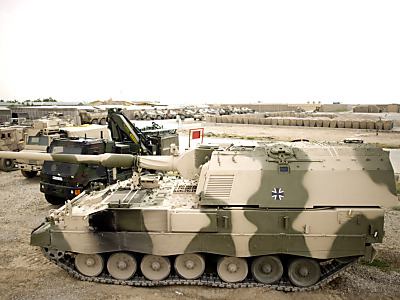
Camouflage is no end in itself

.
These photos of a German self-propelled howitzer in Afghanistan show its camouflage paint coating (the photos are several months old):


The camo looks appropriate in that region, doesn't it?


The only problem is that camouflage makes almost no sense for large vehicles over there. It's extremely unlikely that vehicles there will ever avoid being penetrated just because they used camouflage. It would take a lot of dust from vehicles driving ahead or a very partial exposure to allow the vehicle (crew) to avoid detection or to avert good aiming by the enemy.

The SPG will probably not even move much outside of the camp, for its range is about 40 km. It might leave the camp in support of more distant actions, but then it would most likely be stationary for most of the time and easily spotted and observed anyway simply because it's a huge tracked vehicle and not well-suited to running around much on a deployment that's going to last months or years.

I assert that this camouflage was applied without much thought - it was applied because it's what you do. Camo has become an end in itself for some.

I noted a similar phenomenon with Camouflage for choppers in Afghanistan a year ago.

What shall this howitzer do? It shall provide superior firepower and scare the enemy away (or kill him).
Imagine an impressive paint coating and a few life fire demonstrations - the whole province shall know the beasts. Give them a paint coating that means every child is going to remember them.
Don't give it a paint coating that looks as if you attempt to hide the SPG. Make it look fearsome, notorious, commanding respect. Tiger stripes maybe. Black-red-gold. Gold. Chrome. Paint a lion face on its glacis.

Whatever - just don't fall into mindless routine and give it a futile camo paint coating only because that's what's usually being done.


I am a huge fan of even extreme forms of camouflage (search for "camouflage" in the search box if in doubt), but camouflage is great because it's often an effective means to an end. There can be superior alternatives in some cases, and officers get paid to think about what shall be done. They should in my opinion arrive at the conclusion that this is such an exception.

S O
.

"Sgt. Giunta's fair fight"

.
By Robert H. Scales and Paul van Riper

Scales and van Riper do correctly point out that peacetime efforts of armies are supposed to give an unfair advantage over the enemy in wartime. They complain that this was not done for modern infantry, as evidenced by (in their opinion) fair infantry combat in Afghanistan.

- - - - -

I would like to point out several problems in this article:

(1)

Is infantry combat in Afghanistan really "fair"? They appear to have very high expectations, for I would count bulletproof vest plates, marksmanship training, indirect fire support and air support in the available quantity already as very unfair.

(2)

They appear to have believed in the Revolutions in Military Affairs (RMA) fashion's promises, have observed how RMA largely failed in Iraq and Afghanistan and now they aren't irritated by the failure the slightest bit. Instead, they demand a greater push for RMA (for perfect situational awareness thanks to robotic eyes in the sky). This appears to be a 'little bit' inflexible. 
Granted, they also point out movement mistakes (not securing the high ground), but those movement mistakes are a result of the addition of heavy hard body armour.

(3)

"Yet as a proportion of total combat deaths, infantry deaths have increased from 71 percent in World War II to 81 percent in wars fought since."
This doesn't seem to be a proper remark because this statistic is dominated by  the wars in Korea and Vietnam, not by the two 2000's wars. The infantry's share of losses has in fact dropped to a low recently because the enemies target everyone who's on the road, not just and not primarily infantry. Non-infantry units had to serve as auxiliary infantry and had casualties in those missions as well.

(4)

How exactly do these two quotes fit together without a serious dissonance?

Too often defense gurus inside the Beltway still view war as a science project.

After nine years of war, no small unit in such peril should ever cede the high ground to the enemy, particularly when unmanned vehicles are capable of monitoring constantly overhead and transmitting clear pictures of the surrounding terrain.

Ortmann to Scales and van Riper: You should not blame technology whores and then propose a high tech fix yourself!

(5) 

They should be asking why the richest nation on Earth could not have done more to help this small infantry unit spot the enemy ambush from the air and defeat them with overwhelming killing power.
Did they seriously suggest that the U.S. should spend more on the military? The quote certainly sounds as if they blame the civilian world for the infantry's woes. This sounds ridiculous with the incredible spending levels in the background. They should rather blame the dysfunctional procurement system and the military service itself - than the nation.

- - - - -

Here are my proposals for fixing the problem:

(I)

Don't fight stupid, useless wars of choice.

- - - - -


OK, maybe readers would want to read alternatives just in case
someone really believes the occupation_war_against_the_guys_
who_gave_customary_hospitality_to_the_guy_who_financed_
the_guys_who actually_attacked_the_U.S._many_years_ago (and
died in the process) is a war of necessity even many years after
they lost power:

(a)

Don't red tape them with excessive force protection requirements (armoured vehicles which cannot leave the 'roads', heavy body armour plates, airspace deconfliction).

(b)

Don't force them into stupid behaviour (commute to war, predictable patrols).

(c)

Re-structure the ground forces if you're in a multi-year fight in order to meet the demand for military police and infantry troops (instead of retaining the peacetime all-round structure).

(d)

Re-think the American Way of War, which fared poorly every time it faced infantry-centric forces which were neither trapped on small islands nor composed of elderly and boys. Produce something different than the extreme caricature of this way of war that is known as "RMA".

(e)

Think about diversifying infantry into light and heavy again - for combined operations, not for very different battles. The fight for hill and mountain tops was the job of lightly laden light infantry before the 19th century when all infantry became standardized. The skirmishers with their light weapons and no or light armour fought for the hill tops and ridge-lines, the heavy infantry with body armour and large shields advanced in the valley and was sent into the larger fights.
Maybe modern infantry could split up into lightweight and full kit as well to be both superior in firepower+protection and in positioning?


S O
.

2010/09/12

Do opponents misunderstand each other in Afghanistan?

.
The Vietnam War (final chapter) was a great tragedy in part because the Washington and Hanoi misunderstood each other badly.
Washington didn't get that Hanoi was more nationalistic than communist and that they were indeed  believing to fight an anti-colonialist war [edit: and in the 60's/70's rather a war of national unification].
Hanoi on the other hand didn't get much right either, especially not that Washington wouldn't have been particularly interested in that rice pond if there wasn't this Communism and Domino theory thing.


The Afghans certainly don't misunderstand each other to any problematic extent, but what about the West and the Taliban (+ all those other armed violence opposition groups)?

Even if intelligence services, military leaderships and governments got it right this time - what about the general populations in the involved Western nations?

I've got my doubts, not the least because there's still a noticeable minority believing even in the completely fictitious 9/11-Saddam link, and many people in the West don't seem to discern between Taliban and AQ at all (which, in a complicated way, isn't completely off, but in another way it's wrong).

It should raise more than an eyebrow if war is being waged without full confidence in the understanding of each other's intent.


The "know your enemy" quote of Sun Tzu would now allow for a stylish finish of this post if I hadn't already pointed out the poor utility of Sun Tzu quotes. This kind of thing always comes back to hurt you...

S O
.

2010/09/04

Infantry skill horror photo

.
(First of all: This is not meant nation-specific.)

This is the infantry skill horror photo of the month:


It's the classic "spray and pray over an obstacle" firing stance, guaranteeing a waste of ammunition.There's no visible laser beam and little hope that he's just illuminating something.
No matter what exactly he does; he seems to believe that hostiles are within rang of his M4 carbine (effective to 150-300 m depending on your expectation of effect on target) and exposes himself very much to hostile fire. He's certainly not using his carbine for aimed fire.

It's even worse:
This disastrous photo made it into the public as an official army photo!

As seen through a night-vision device, U.S. Army Sgt. Joseph P. Khamvongsa returns fire against an insurgent attack on Combat Outpost Badel, Afghanistan, Aug. 25. 2010. Khamvongsa, a forward observer, is assigned to Company B, 2nd Battalion, 327th Infantry Regiment. U.S. Army photo by Staff Sgt. Gary A. Witte
source, hat tip to Ken White

It's even a NCO, part of the NCO corps that's supposed to keep the individual and small unit skill level of the army high.

For comparison:
Third World untrained ragtag militia fighters, the laughing-stock of infantry-interested internet users.


I wrote about less extreme failures in a longer post "How to get yourself killed in combat against competent enemies" last year.


Let's hope that this soldier is a lone exception, along with the equally clueless photographer.


Sven Ortmann
.

2010/08/22

Doctrine No.18: Tactics nowadays

.
The French military journal "Doctrine" committed a whole issue to the adaption of tactical art to small war circumstances and finally published it in English as well.


from


Contents:
DOCTRINE

* Back to the Art of Tactics
* Radical Changes... and Continuity in the Tactical Field - New Conditions for Operations
* Offensive, Defensive, Security, Assistance Operations - Current Trends between ther four types of Operations
* Simulation assets to Study Tactics to the benefit of Commanders and Operational Headquarters

INTERNATIONAL

* A British Perspective - Land Operations a Military Philosophy

ACCOUNTS AND THOUGHTS

* Our Tactical Heritage since de Guibert
* The Detterent Pressure or Gulliver Unbound
* AAR : Review and perspectives
* Basic principles, you've Said : Basic Principles...
* Concept of Operations : a Change in Questionings
* FT-02 : Converting the Try
.