Showing posts with label Military Technology. Show all posts

2026/07/02

Naval drones (USVs) in the news

.

Naval "drones" and motherships appear to experience a political breakthrough in the UK, carrying the hope for an affordable navy. 

There are a couple problems with this, including an important one that I didn't mention back in 2009 and probably wasn't clear-enough about in 2018:

The fuel economy improves with size. It's almost impossible to build a boat-sized (shorter than about 60 m waterline) naval drone that could cruise across the Atlantic at 18 kts even without the drag of a towed sonar array.

So either the mothership is in large part a fuel replenishment ship (and then accordingly hardly looking like a destroyer any more) or a drone-enriched naval force would be rather short-legged, for European waters. The latter case raises the question why one wouldn't follow a land-based approach rather than a mothership-based one.


Another problem is the issue of fixed costs, and it doesn't go away by magically deleting the crew. Some surface boat drones would still need expensive equipment (expensive munitions, towed sonar or radar) to be of much use. This means it would be sensible to provide a modicum of survivability, regardless of crew size zero. This modicum of survivability includes soft kill defences, at least some autocannon, a tactical radar even for a sonar-centric USV and so on. In the end, this would be rather expensive. An analogy: Some mere flying drones such as Global Hawk ended up being obscenely expensive, close to manned combat aircraft or a FAC.

Truly cheap "drones" Could be little more than decoys, preferably drones that are being towed (by escorted transport ships) most of the time. They could launch infrared and radio frequency obscuration, feature cheap radio frequency jammers, trigger torpedoes and mines with their signatures. They could become freely-moving decoys during combat and be towed 99% of the time, solving the fuel issue. They would be an enrichment for a convoy, but not a replacement for a frigate or destroyer. Most importantly, they could be towed by a cargo ship rather than be tethered to some mother(war)ship.


I do insist on my two paths:  

  1. A ship that deploys "USV" drones mostly as decoys and would rather resemble an LPD or helicopter cruiser than a FFG or DDG*
  2. A self-defending convoy of armed merchantmen making use of modular naval equipment 

The alternative is to stay very traditional and have a GP frigate, BUT there's no way how NATO could compete with China in a naval arms race with such an approach. The Japanese might be able to pull that off, while the South Koreans better pay more attention to land power and air defence than a naval arms race.


(All this being said, a USV for picket duty (x-band radar and optronics) with the endurance (fuel) issue solved would be a valuable substitute for AEW in the quest to get early warning against sea-skimming threats.)


S O
defence_and_freedom@gmx.de


P.S.: I just found where I mentioned the fuel issue of boats before:

"convoys at sea would want to cruise at 15...25 kts, and I doubt that many small drones could achieve the necessary endurance to accompany a convoy at such cruise speeds. They would need to be recovered and refuelled all the time" 
/2018/01/modern-warships-ii-asw.html

.

2026/06/08

SatNav warfare

.

So a satellite was found to be jamming GPS even though that wasn't its apparent purpose

This is the most powerful counter to satellite navigation purposes that exists, as I already wrote in Twitter.


The problem isn't the very weak signal of such jammers; it's that they're overhead. The best method for filtering jamming signals out is to ignore the signals on satellite navigation frequencies that are coming from the ground. You can do this with multi-antenna setups if you can tolerate their size:

https://www.forbes.com/sites/davidhambling/2025/03/27/ukrainian-lives-hang-on-a-deadly-electronic-warfare-arms-race/

https://militarnyi.com/en/news/new-chinese-crpa-antenna-found-on-russian-shahed/

It's similar to the HF direction finder HF/DF from WW2: A radio wave coming from the right takes longer to an antenna to the left than to the right. The time lag can be used to identify the direction with a passive receiver. That's how passive radio direction-finding works, including radar warning receivers.

A jammer that's overhead just like the real satellite navigation service satellite defeats this.

Moreover, you can bring hundreds or thousands of tiny and really cheap satellites into low earth orbit with one-time pad encrypted communication with base station and that communication can be limited to overflights of your territory only (and from below). This almost guarantees nobody is going to mess with your control over such a fleet of jamming satellites. The jamming could be limited to certain areas, albeit those would almost necessarily be hundreds of kilometres wide.

- - - - -

There are alternatives to GPS. eLORAN is viable, but given up on. New advanced inertial measurement tech approaches satellite navigation accuracy, but is still low in technological readiness level. Large fleets of low earth orbit satellites such as Starlink's fleet can substitute for satellite navigation and at least match the jammers in signal strength, but legacy fleets may depend on satellite navigation themselves and legacy fleets don't use the frequencies that legacy satellite navigation receivers depend on.

 - - - - -

So what can be done about the jamming by satellite if we cannot cheaply or quickly replace legacy satellite navigation?

We can shoot down satellites, but that causes much debris in orbit and it costs millions per shot while the jammer may be a cheap cubesat. 

We should technically be able to defeat at least low earth orbit jammer satellites with high-powered lasers. We need the satellite tracking and passive radio frequency direction finding to discern which space object is jamming, track it, wait for an opportunity where no other non-hostile satellite would be affected and destroy it. The required power would necessitate quite large lasers and it would only be possible with clear sky - which is rare over Central Europe in wintertime, but the orbit would also lead over Australia's outback, Djibouti, Greek mountains, Spain's inland and Alps mountains. The problem is the required power of many megawatts. We'd likely have to combine a cluster of multiple lasers on one target to at least gain the laser ablation effect. A space-based weapon would be very expensive, centralised and thus be targeted itself. A Spanish or Australian site would be fairly safe, especially if protected by decoys, chaff projection in case of IRBM/SLBM attack and satellite navigation jamming itself. The same ground-based lasers could be used to deal with hostile earth observation satellites and even deal warning shots to non-hostile earth observation satellites of companies or governments that relay the data to hostiles. Another problem remains; satellite and generally space object tracking radars are big, expensive, stationary (other than those on ships) and could be targets to conventional-tipped IRBM/SLBM attacks if no others.

https://x.com/TheDeadDistrict/status/2063629144626225220?s=20

S O

defence_and_freedom@gmx.de

.

2025/10/21

Drone cloud support to battlefield drones

.

Here's one thing that drones can do that manned aviation did not do in either world war nor in the Vietnam War:

A huge quantity of cheap yet EM-hardened drones with about 30 km flying range can saturate any counter-drone defence and thus protect much fewer actual scout and attack drones in the air.


S O
defence_and_freedom@gmx.de
.

2025/07/05

The direct/indirect/antiair fires tank concept

.

I wrote in the past about tanks that have a unusually high maximum elevation of their main gun and can be used for indirect fires and for short range air defence.

/2010/04/medium-calibre-allround-option.html 

/2017/01/42-elevation-tank-turrets.html

/2023/04/a-compact-and-agile-exploitation-brigade.html

/2023/09/the-directindirect-fires-armour.html

 
I have never elaborated on the technical side of the shot, but the technical details matter for understanding the concept.

A tank gun has a very high muzzle velocity even with a high explosive shell (it won't be less than 700 m/s). A variable propellant strength may be used and special shells or fuses may increase drag to brake the shell, but a basic tank gun HE cartridge is going to produce a cannon-like, very flat trajectory.

This makes it difficult to hit a flat target with a point detonating (impact) fuse. A slight error in elevation or a slight deviation of muzzle velocity leads to a much greater range error of the shot than the shot's lethal radius. 

Historically, the best use for cannons in indirect fire at short and medium distances was to use a bouncing shot (cannon shells bounce off flat ground when fired at no more than 10° elevation as a rule of thumb). A delay fuse would then cause the explosion  when the shell is airborne after bouncing off the ground. The fragmentation effect of this would be greater than with point detonation, but the dispersion would be bad.

How about proximity fuses? Again, quite the same as with point detonating, just worse. The fuse may trigger much too early, especially when it overflies a building. Even a time-gated proximity fuse wouldn't be satisfactory. 

Normal time fuses use 0.1 second intervals. A shell travelling at 600 m/s would thus fuse somewhere within 60 metres - unsatisfactory, as the lethal radius even of a 120 mm HE shell in much smaller. 

The technical solution is to use more modern fuses that deliver accuracy of about ten metres. The elevation may still be off a little, but an explosion 3 m lower than intended or 3 m higher than intended isn't a too terrible variation.

Here's an example of such a very accurately fusing fuse.


This can be used to explode the shell inside a building (setting the timing accordingly and disabling a point detonation feature if present).

This can be used to shoot at aerial targets in the way heavy anti-air artillery did in WW2, just much more accurately.* 

Ideally, the fuse would have selectable point detonation (quickest direct fire shot mode that's somewhat useful on everything, including messing up a T-14 tank turret) and delay (for exploding BMPs, BTRs and rooms in a building)


The technology for proper fuses for very flat trajectory shots hasn't been available for very long. Most main battle tanks of today are from a 1970's conceptual design and prototyping generation, when such fusing wasn't on the horizon yet. The Chinese have newer designs, but they were catching up. The South Koreans have a newer MBT design, but they have mostly hilly to mountainous terrain. Same with the Japanese. The current equipment is thus no argument against the validity of the direct/indirect firepower tank concept. It makes sense that the in-service tanks lack it and at the same time the concept  may be entirely valid with our current technology.

Back to bending that flat trajectory a bit: The muzzle velocity depends on the propellant temperature. One might have a cool/cooled and a warm/heated cartridge compartment to enable a choice between two muzzle velocities. The difference wouldn't be great, though. This would not enable shooting over most hills in the line of sight.

Another possibility is to use a fuse or shell feature that deploys a braking element, such as in trajectory-correcting munitions. Another analogy is the nose or drag ring that can be added to rockets of manually loaded multiple rocket launchers to slow them down and thus reduce the often terribly long minimum shot distance. 

High tech approaches include variable injection of liquid propellant, use of electro-chemical-thermal gun principle and so on, but such already researched and tested technologies appear to find no users for good reasons.

In the end, a fixed cartridge with combustible case is realistic, a semi-fixed cartridge for varying the propellant strength by adding or removing modules would only be reasonable if the tank is used mostly in indirect fires. Another option is to simply have two different kinds of HE cartridges with combustible case; one for high muzzle velocity and one for low muzzle velocity. The latter could be used to shoot over hills, but it would have a reduced maximum range and longer time of flight. The shell orientation at explosion would also differ, leading to a different optimisation for fragmentation pattern and thus a different shell design.


The great potential of the concept of a direct/indirect/antiair firepower tank is in the versatility. This may go so far as to enable a much smaller and thus much more agile tank brigade without a dedicated artillery component. I described that concept in the 3rd and 4th link above. The same brigade would have dozens of assets capable of sniping away observation drones without need for any dedicated air defence vehicle.


S O

defence_and_freedom@gmx.de

*: Proximity fusing may be preferable for this, but ordinary artillery proximity fuses meant to fuze a couple metres above ground don't work on air targets. Their safety feature keeps them from exploding before the zenith of the trajectory was passed.

2025/02/24

Air-to-air missile categories


(I advise to first read this blog post. You'll later see why.)

Air-to-air missiles have commonly been grouped in short, medium and long range missiles. Short range was and is dominated by passive infrared seekers, medium range was dominated by semi-active radar seekers until AMRAAM (active radar seeker), which also blurred the distinction between medium and long range with its D version. Long range missiles have radar guidance (infrared seeker windows would be blinded by heating up much during long flights).


I believe that such categories are by now of little use. I propose a different system:

  • Pursuit missiles
  • Counter-Pursuit missiles
  • Close-In missiles
  • Low cost missiles


Pursuit missiles have the speed, range and seeker to reach hostile tactical combat aircraft even if they try to avoid the hit by running. Their no-escape zone is great. It happens that they also threaten and thus push back hostile support aircraft (AEW, ESM, ElInt, tanker, MPA, air/ground radar planes).

Examples are Meteor, PL-21, AIM-260 and AIM-174B

Their drawbacks are heavy weight, big size and very high costs.

Counter-pursuit missiles lack a no-escape zone large enough to force a kill. They can kill if the target is unaware, but not if it's aware enough to avoid the no-escape zone and running in time.

Examples are AIM-120, MICA RF and R-77-1

They can easily be carried by strike fighters and their cost is usually in the 1...2 million € range. This category started out as a replacement for the Sparrow/R-27 medium range air-to-air missile category and was the main weapon of fighters for about two decades, but the similar ranges mean that it's difficult to get an enemy fighter into the own no escape zone without getting into his missile's no escape zone. Tail-mounted radars and handing over the missile to another fighter to be able to give midcourse corrections by radio datalink to the missile while flying away from the threat help little if both sides use it. State of the art medium range missile air combat without decisive range (no escape zone size) advantage would likely end up as a Cannonade of Valmy; an expenditure of munition with little physical effect.

So the use for these  missiles in high end air war is likely mostly in a counter-pursuit role - it's defensive.


Close-in missiles were "dogfight"and relatively cheap missiles in the past. Their infrared seekers have become smarter, wider field of view, more sensitive, capable of 'seeing' an aircraft from any angle and capable of lock-on-after-launch. You can now shoot such a missile at a fighter behind your aircraft and hit.

R-73 fired at target behind launching fighter

I do strongly suppose that their primary mission should shift from dogfight shot vs. a platform to hard kill defence versus an incoming missile. Fuse and warhead need to be designed accordingly. They may also be usable as short-time freeflying decoy if equipped properly.

These missiles need to (and short range air-to-air missiles do) cost much less than a million €, but I think so far the short-ranged missiles are still primarily designed to hit platforms. Thrust vectoring permits to minimise fins and rudders, so these missiles could be packed in compact multiple missile launchers.

edit June 2025:

https://en.m.wikipedia.org/wiki/Miniature_Self-Defense_Missile 

https://aviationweek.com/defense/missile-defense-weapons/raytheon-build-mini-missile-interceptor-aircraft-self-defense 

https://www.key.aero/article/analysis-mbda-reveals-new-missiles-tempest

I don't know how I overlooked these publicly known programs, but I still seem to have gotten it right. Nice.


Low cost missiles have recently been introduced to fight cheap drones over the Red Sea and Ukraine. So far they are unguided 70 mm Hydra rockets with a cheap guidance and steering nose section. Some fighters have 30 mm guns (example Rafale) and can make use of the new 30 mm HE munitions with proximity fuse to battle cheap drones, so they would not need a low cost missile for the job.

- - - - -

How do 'stealth' fighters fit in this? They may be very difficult targets for any kind of missile. IR-guided missiles might be main killers in a stealth fighter vs. stealth fighter combat. Or maybe stealth fighters avoid hostile peer ground to avoid detection by hostile long wavelength radars (which usually require big antennas and are thus not installed in fighters). They might end up as 'fleet in being', deterring deep incursions and serving as launch platforms for pursuit missiles (if those fit into missile bays). The Su-57 was meant to be a stealthy-enough fighter with DIRCM (dazzling laser that targets infrared seekers). This might prove to be much more formidable IF THE DIRCM WORKS than the interested public gives credit to the concept. Stealth-DIRCM vs. stealth-DIRCM might require a spam of missiles with seekers that have spectral filters to block out the laser - three missiles with three different filter setups would defeat a Su-57 even if the latter used two different laser wavelengths in its lasers. Then the killing blow missiles would be "pursuit missiles", but their required range would be driven by the demand for a no-escape zone as great as the own platform's (fighter's) effective sensor range against the opposing fighter.


I think these missile categories make more sense than the traditional ones. My categories guide attention towards the diminished lethality of AMRAAM et al when both sides have such missiles, guide attention towards the hard kill defence concept and towards the issue of defeating super cheap drones (/cruise missiles) with even less expensive munitions.


S O
defence_and_freedom@gmx.de
.

2024/12/18

Cheap cruise missiles

.
The Russo-Ukrainian War brought something to public view that wasn't obvious. Even I didn't really grasp it, despite having mentioned it years ago.

There's a huge range of targets for small, cheap cruise missiles with a rather small (~ artillery grenade size rather than aircraft bomb size) warhead. 

The embodiment of this kind of cruise missile is the Shaheed-136


Shaheed-136 (c) alexpl

Hobbyist-grade propeller propulsion and navigation.

~ 200 kg total mass

~ 50 kg warhead

2,500 km claimed range (more likely less than 2,000 km)


It's obvious that this can be improved on, but the fact that a cruise missile costing low six digits (EUR or USD) would not just be a decoy, but actually a severe threat is a huge deal. Air defences are not prepared for this, albeit there was someone arguing that our air defences should include cheap missiles to intercept munitions rather than platforms.

Most air defence missiles are more expensive than such a cruise missile. The cheaper ones could largely be avoided by flying very low on well-planned (and varying) routes.

The attacker has the advantage because it can funnel a salvo of a thousand cruise missiles through a 10 km wide corrider within minutes, while defenders with cheap missiles would need to have them spread out over a defensive belt because those cheap defence missiles will have poor range unless they are very similar to their targets (a kind of unmanned kamikaze interceptor plane). Being too similar leads to an insufficient or no speed advantage, so there's stills some advantage of the attacker. Moreover, the defender may suffer damage on critical infrastructure, military equipment or economic installations on the ground, while the attacker doesn't (save for accidents).*

Aircraft on the ground are vulnerable high value targets, but they may be moved during the hours of flight of such a drone. Infrastructure and certain industry installations are more interesting and more reliable (backup?) targets. 

There are about 300 high voltage transformer stations in the German power grid; a rich country of approx. 82 million people. Several thousand more transformer stations are in the medium and low voltage grid (source, more here and a list here). One of the largetst German cities, Hamburg, has only three major transformer stations.

The sizes of such transformer stations range from small & elegant to huge. Permanent damage is particularly easy to inflict when you can hit the control building with a warhead, such as a single 50 kg high explosive warhead. 

A handful of such transformer stations can be switched to simplistic controls or be repaired, but hundreds or thousands hit within hours or weeks would vastly exceed the short-term repair capability of the entire Western world.

The locations and network are published. Aerial photography is available (Google Maps and similar) as well and everyone can do a bit of aerial scouting with a cheap consumer drone. The damage potential of even tiny payloads such as a molotov cocktail was shown to the public when the power supply of the new Tesla factory near Berlin was cut for days with a small fire.

So basically a wave of 5,000 drones costing each less than 200,000 € (total value 1 bn € only!) would stand a near-100% chance to destroy the German economy with little chance of repair within months or even one or two years. The damage could be trillions of Euros. Quadruple that budget to a mere 4 bn € and you can switch off the European economy.

We aren't even close to having any defence against that. Most likely we couldn't even tell our own Galileo global positioning satellites to stop providing service in time.


The electrical grid isn't the only essential asset that could be targeted and ruines by small payload cruise missiles. The entire chemical and petrochemical industries including oil and gas pipeline pump stations, oil refineries, oil storage sites, airport kerosene tanks is extremely vulnerable.

It's an enduring mystery why the Ukrainians don't apply the main effort concept and knock out one sector - railway, power grid, gas grid or fuel supply of Western Russia. They could, but they're sending their drones out as if all they were mentally capable of was spray & pray (most likely the damned "escalation manager" scum in Washington, DC and Berlin are at fault for this).


Such cheap and light cruise missiles aren't the only kind of cruise missiles that was neglected until recently. The old V-1 would be very much viable if equipped with hobbyist-grade computer, navigation and altimeter equipment. 850 kg warhead to 250 km or 250 kg to 500 km? That's clearly feasible, and all you need for survivability is distraction, flying extremely low (accurate navigation, accurate route planning, calm weather and an accurate altimeter suffice for flying between treetops) and saturation. The price of a V-1 was about the price of a sedan car at its time (with forced labour). We could produce such missiles in a car factory by the ten thousands in a year. The supply of enough explosives would be the only actual challenge in my opinion.

250...850 kg warheads can thus be deliverd to several hundred km depth at about Mach 0.4 for very little cost. The biggest expense of an accurized treetop altitude flight V-1 would probably be the explosives, which could be plain TNT or even cheaper Amatol. A quantity production on a conveyor belt assembly line could keep the cost per missile without explosives below 15,000 € even if we install a Starlink interface, a thermal camera, good intertial navigation, radio or laser altimeter and a military grade GPS/Galileo receiver.

The cruise missiles as we know them since the 80's, but in conventional form especially by Americans bombing Muslims since 1991 are based on a nuclear cruise missile paradigm. The high cost of a nuclear warhead and the need to deter by credibility did lead to that kind of cruise missile. Some later tactical aircraft-launched cruise missiles were essentially the same with less fuel and thus less range.

To leave this high end paradigm allows for cheap small warhead good range cruise missiles and for cheap big warhead short range cruise missiles. Both could be launched in saturating attack waves of hundreds of missiles and could be built to be very resilient to electronic countermeasures.

There's no lack of important yet vulnerable targets for such missiles.

I really wonder why anyone thinks we should invest in expensive strike packages, expensive stealth bombers or pays attention to nonsense such as Oreshnik. Luxembourg could afford airpower that could bring Russia to its knees within weeks!


BTW; it takes three freighters (cost less than 300 million dollars) loaded with three billion dollars worth of such cruise missiles in Pacific Ocean, Gulf of Mexico and Atlantic Ocean to crash the U.S. economy in a strategic surprise attack. The ANG could not stop enough of them. Even a shadowing USN destroyer would not be able to do much, as the rocket-assisted launches could be compressed into a minute or less.

three 2,000 km radius circles

S O

defence_and_freedom@gmx.de

*: Here is an explanation why a belt is usually superior to point defence.

.

2024/11/06

Anti-tank lessons from Ukraine

.

It appears that drone teams greatly complemented ATGM teams and Panzerfaust/Bazooka/RPG style short range weapons in anti-tank missions in the Russo-Ukrainian War. Anti-tank mines proved essential to prevent breakthroughs through well-fortified sections of the frontline.

Military history showed that heavy weapons (anti-tank guns, assault guns, tank destroyers, tanks) destroyed by far the most tanks. Even millions of Panzerfausts didn't change that outside of the urban battlefield of Berlin. ATGMs and MBTs were expected to be the big tank killers during the Cold War and justified this expectations in 1967, 1973 and 1991. The small infantry weapons such as Panzerfaust/Bazooka/RPG were rather repelling weapons that served to keep tanks at a distance and that kept tanks from moving through closed terrain (forestry roads, streets).


Videos from Ukraine showed that sometimes tanks and IFVs fight against infantry at incredibly short distances such as 50 m. Maybe the enemies were known to be poorly equipped, but the commonly deployed poor prenetration or poor effect man-portable anti-tank wepaons may explain this as well.

Most tank killing is done by multi-kilometre anti-tank systems such as ATGMs and FPV drones, as was to be expected. Hardly any MBT vs. MBT fights were documented, they appear to be exceedingly rare at least since the fronts became fortified. This may be different in a more mobile phase.

FPV drones have vastly more opportunities to engage enemy tanks than the in-service milspec ATGMs and tanks because they don't rely on a line of sight between user and target. We had this approach with rocket or turbojet motor missiles decades ago (EFOGM, Polyphem), few such missiles were introduced and instead the imaging infrared seeker missile approach (Javelin, Spike etc.) became the fashion that achieved the big sales.

My longtime insistence that we shouldn't trust even the best ATGMs because they're too easy to counter was rebuffed by Russians not having fielded ANY improvements over 1980's Red Army tank protections. They even lack simple things such as digital camera-based missile approach sensors and red phosphorous (shorttime opaque in infrared spectrum) smoke munitions. In short; the Ukrainians are lucky that the Russians are so stupid.

Attack helicopters played almost no role whatsoever against tanks in this conflict.


This greatly questions the whole (very expensive) approach of NATO's anti-tank efforts.

We could make do with fibreoptic and thermal camera-guided FPV drones. Simply use these sub-1,000€ drones to saturate whatever defences exist against them, then engage any tank in 5-10 km radius. Such drones can safely touch down and lie in ambush for a while without losing radio commlink or requiring an airborne radio repeater. An approaching tank company could be faced by a hundred fibreoptic thermal cmaera FPV drones lying in wait at its route, having arrived there just in time.

What anti-tank weaponry does the infantry still need? Whatever portable anti-tank equipment they could have would be heavy or of little use.

It may be that the section or platoon leaders' radios deserve to be not just the main but even the only anti-tank capability in infantry platoons. So that radio link needs to be reliable and not cut by emissions control orders.

This frees up weight carried by the infantry. This in turn can be used either to lighten the burden and/or to increase the firepower against "soft" targets (which includes buildings, by the way). The ability to blast open a door (maybe even create a wall hole to crawl through) at 30 m or to badly injure an enemy in a 100 m distant room with closed window is still very desirable. Greater ranges are of little relevance and no necessity IMO.


This opinion is an advance on my previous opinion that the infantry should only carry anti-BMP weapons rather than anti-MBT weapons most of the time and be issued anti-MBT weapons rarely. The German army disbanded the anti-tank branch and left the use of ATGMs to infantry (and Panzergrenadiere, often not considered to be infantry).

It appears that a return of the anti-tank branches is superfluous. We should probably build up a PGM branch for up to battalion level instead.

S O

defence_and_freedom@gmx.de

.

2024/07/19

Free Europe's security challenge if America turns full fascist (Part III)

.

previous parts:

/2024/07/free-europes-security-challenge-if.html

/2024/07/free-europes-security-challenge-if_8.html


So what could be done for defence of Europe against American airpower?

Defending against aircraft & missiles

We would need to timely detect threats to intercept them. More AEW aircraft and a redundant coverage with long wavelength (metric) air search radars & passive radars would be needed. Distributed sky-scanning imaging infrared and ultraviolet cameras as well as distributed acoustic sensors would complement that. Standoff jammers would need to be detected & triangulated by passive EW.

The American Way of Air War involves intricately-planned strike packages. Stealth aircraft didn't change this much - they merely made the strike packages a bit smaller and more focused on fewer guided munitions. An important part of these strike packages is the anti-radar warfare - "SEAD" (suppression of enemy air defences, albeit they actually aspire to "DEAD" - destruction ...). This means that the defender's radar emitters are at great risk. A way to reduce this risk is to use a large quantity of very cheap emitters in a multi-static radar network. Such very cheap emitters could be nothing but emitters. No receiving of echoes, no processing, no demanding communications. Just cheap emitters with their own electrical power generator. Ten thousands of such cheap emitters could be dispersed throughout free Europe, though with greatest densities in particularly relevant or threatened areas. The passive radars would receive the echoes, process the echo data and communicate using landlines or directional radios. These passive radars would be near-impossible to target for the attackers, as they wouldn't need to emit in the radio frequency spectrum, and what little radio comms they'd have could be done with antennas hundreds of metres away from the actual passive radar trailer.

Active electronic warfare would be required to counter communications and navigation of the attackers. This includes jamming and possibly disabling of communications satellites (including civilian ones used by the attackers) and jamming the satellite navigation signals (GPS, Europe's own Galileo, Russian Glonass, Chinese Beidou) in the areas where there are attacking missiles. The jamming of satellite signals needs to come from above for good effectiveness, ideally by low orbit satellites or numerous low cost very high altitude aircraft. Incoming cruise missiles could also exploit civilian emissions for navigation, so mobile phone networks might need to be temporarily deactivated where the cruise missiles are as well. This degradation of cheap navigation technologies would force the attackers to use more expensive forms of guidance, especially pattern recognition and terrain referencing sensors. It might not yield a large or even decisive advantage, though. A consumer-grade thermal camera is available for less than 1,000 € in wholesale and a minicomputer with pattern recognition software and sufficient data storage would cost less than 100 € in wholesale. Shaheed-style cheap cruise missiles of 1,000+ km range are thus still feasible at very low costs (much less than 100,000 € per missile). Annual mass production of such missiles would be feasible by the millions. Ordinary "Tomahawk" cruise missiles cost more than a million $ for more range and much bigger warheads.

Hard kill defences need to take these missile costs into account. We cannot protect all of Europe with SAMP/T style missiles, for they are too expensive (and of limited promise against very low observable aircraft). 

Free Europe needs

  • low density and redundancy of defences for defeating very low observable aircraft (B-21) up to more than 60,000 ft altitude
  • low density and redundancy of defences for defeating aeroballistic/quasiballistic missiles (at first only PrSM) with densified defences for priority areas (such as Greater Paris region)
  • low density and redundancy of defences for defeating low observable aircraft (F-35) up to more than 60,000 ft altitude
  • anti-saturation defences for defeating massed (~300 against a country in one wave) 'normal type' (Tomahawk, stealthier JASSM) cruise missile waves
  • anti-saturation defences for defeating massed (~3,000 against a country in one wave) 'cheap type' (Shaheed-136 class, Shaheed-238 class) cruise missile waves

Surviving the hits by aircraft & missiles

WW2 in Europe and again the current Russo-Ukrainian War have shown that enormous damage can be repaired away or compensated by long-distance grids for energy until the supporting economic base collapses (early 1945 collapse of German railway transportation). A thousand cruise missile hits may have a very unconvincing effect on the European continent unless they are targeted very well with this repair-ability in mind. Much less than a hundred key factories would absolutely have to stay in production to maintain this ability to repair damage.

Some things cannot be produced in great quantities within a year or two, though. A thousand cruise missiles  hits at electrical grid transformer stations and maybe a dozen related factories could leave free Europe unable to resist much longer. Cruise missiles of the 'normal type' render all but the most extreme bunkers ineffective, so we should consider dispersion of such installations over much larger areas to increase how many cruise missile hits are required for decisive effect. We should also do R&D and hardware upgrades to minimise secondary effects (secondary fires, electrical overload damage et cetera).

Base denial

The obvious launchers for attacks on free Europe would be carrier aviation, destroyers and submarines. It's impractical to keep submarines beyond cruise missile range, so it appears unreasonable to pursue an anti-launcher strategy against cruise missiles.

Carrier aviation is different. The Americans make the mistake of producing many F-35 in an air force version that could not be used on aircraft carriers. The sum of existing and planned B-2, F-35B/C and F-18E/F/G in U.S. armed forces is about 1,500. That's a much more manageable threat than if the USAF F-35 fleet was added. Keep in mind the Americans also have to keep an eye on East Asia and could not risk to exhaust their entire inventory without scrapping their war plans contingency plans regarding PR China.

Still, it appears that taking out about a dozen supercarriers is easier than to take out 1,500 1st and 2nd rate combat aircraft. It's clearly feasible if French SLBMs were used. This would leave the Americans with only their amphibious carriers with F-35B (and no real AEW), unlikely to strike at the industrial cores of free Europe.

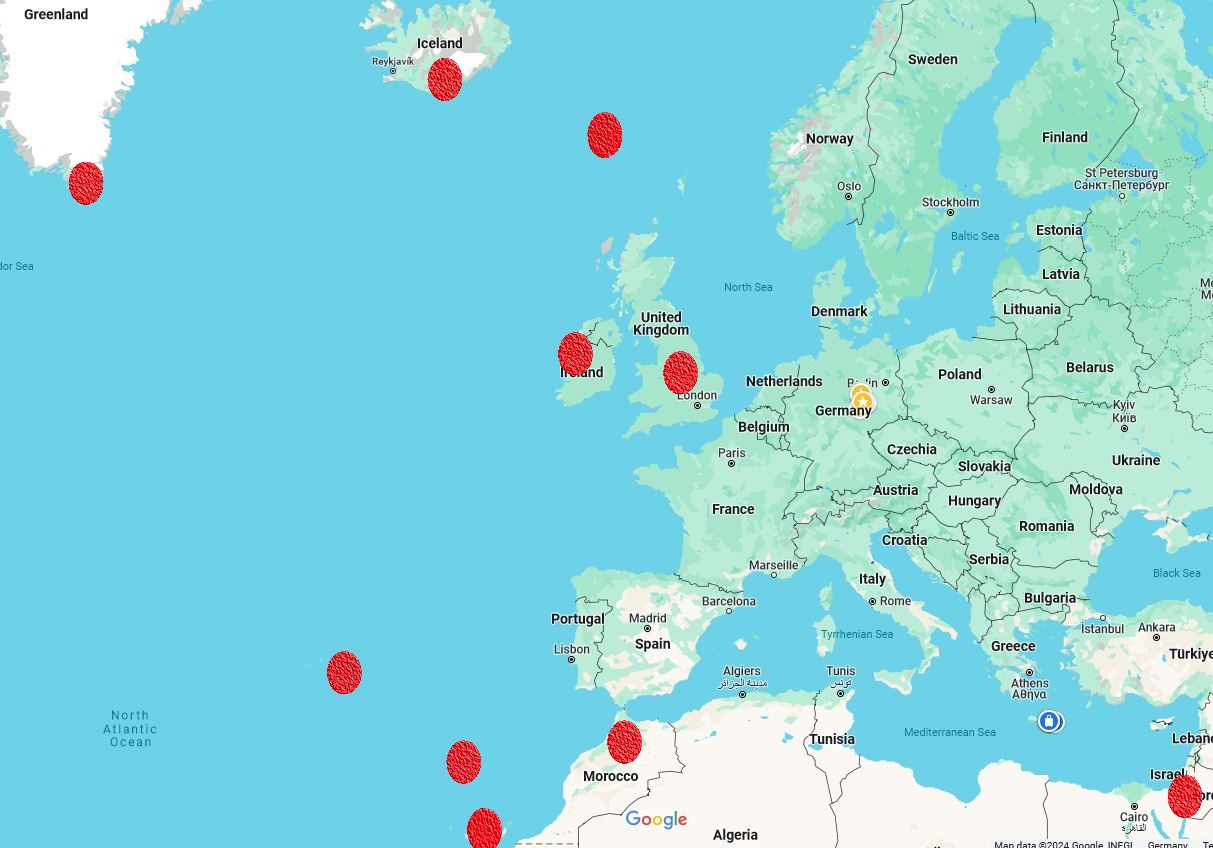
This leaves mostly the existing map of land bases as a huge (USAF-sized) issue:


Greenland would be difficult to garrison sufficiently in peacetime.

Morocco, Israel (and possibly Egypt) are sovereign non-allied countries and could rather not be garrisoned.

Iceland, Faroers, Ireland, Azores, Madeira and Canary Islands could be defended, but fortifying these with missile-based defences and artillery-strong garrisons (though largely just pre-positioned hardware for such) would require much local real estate, budgeting for more than € 100 bn initial costs, consent by the respective sovereign European country and most of all politicians who actually understand that we may need to deter & defend towards the West. They were raised into a world where this sounds like mirror universe concerns. Additionally, the Eastern European countries are obsessed with the threat posed by Russia for understandable reasons.

What does it take to defend an island base against a dozen supercarriers and the USN's amphibious fleet?  The easiest approach would be detection + area bombing with SLBMs.* This should be an option, for this option would force the attacker to disperse. Dispersed forces are easier to keep out (though not easier to defend against air strikes). Moreover, a "Marianas" base for bombing Europe would probably need to be annihilated by SLBM anyway. This means an evacuation of civilians from the smaller islands at the beginning of armed hostilities would be advisable (at the very least from the Azores). Such an evacuation might be decisive at deterring an invasion; who would execute a risky invasion knowing that it won't give a usable base?

Another important ability would be to enter the fight over Faroers, Madeira and maybe Moroccan Coast in the air. This is similar to the need to fight a conventional air war against carriers. We should have hundreds of sets for turning airliners into tankers and platforms for (anti-ship capable) cruise missiles. Moreover, we should have diverse (in case one technological approach proves a failure) anti-ship-capable cruise missiles and similarly-ranged anti-radar missiles in stocks. These munitions would also be relevant for deterrence & defence in the East (in land attack roles), so the expense may be justified rather easily.

A conventional approach against bases is to attack them via air strikes or to blockade them. A close  blockade might be a job for non-nuclear submarines, while a far blockade could be executed using armed merchantman commerce raiders. Air strikes on bases would be quite similar to air strikes on carriers; a standoff launch of missiles would be preferable. Converted airliners could serve as launch platforms for attack and decoy munitions while military aircraft provide the strike package's escorts (fighters, standoff jammers, passive electronic warfare).

Free Europe might have a good case for cooperating with unfree China to develop such strike package capabilities during the 2030's - all out of necessity.


Finally (for part III), a general statement:

It's foolish to buy any air forces or navy equipment from the U.S. that has a radio frequency antenna or anything that could technically serve as such. All such equipment might have a backdoor command embedded that permits the Americans to sabotage its employment up to exploding while carried by its platform. Such systems often stay in service for decades and take yeas to replace, so it's unacceptable to buy American NOW, not only once America turned full Fascist.

This includes that all F-35 purchases by European countries are foolish, and less obviously so, al Americans-dependent aircraft systems (such as the Korean F-35 equivalent) are off limits as well.


Part III got quite long, so the deterrence topic will be covered in part IV.


S O

defence_and_freedom@gmx.de

*: I'm sure that a first use of nuclear munitions against population centres is unacceptable, but a first use against naval forces of an aggressor is IMO neither unethical nor too risky. It depends on what alternatives are available, of course.

.

2024/02/06

"Evolving" transitory tech: FPV drones & electronic warfare

.

Back in the 1930's the Nazi government of Germany sent troops and vehicles to assist Franco's Nationalist-Fascist coup (later civil war) effort in Spain.

The only tanks available for employment (testing) in Spain were Pzkpfw I, bulletproof tankettes with two normal calibre machineguns. They did of course encounter bulletproofed vehicles of Soviet manufacture and even their steel core bullets proved to be useless against those. Germany got ahead of that problem by using 20 mm autocannons in the successor and later 37 mm cannons (and 75 mm stub guns) in the last pre-WW2 tank models.

The tech that was employed in Spain was hinting at the future, but it wasn't the future. Most of it was outdated two years later already.


I suppose the "This is the future of war!" claims based on what's happening in Ukraine will prove to be just as durable.


Let's look at a most striking example; the FPV (first person view) remote-controlled kamikaze quadcopter with a 1980's shaped charge that's a terrible threat to almost any tank in existence today. These proved to be more practical than Nammo's experiment with a multicopter that has a downwards-firing bazooka. For all I know (unconfirmed info) the rule of thumb is that you need ten of these for one hit, and in regard to anti-tank warfare they are very often employed against already immobilised or even abandoned tanks. Success story videos on Youtube have a "survivor bias".


These remote-controlled drones need a radio line of sight to transmit the steering commands and much more bandwidth to transmit a video feed from the drone to the operator. The onboard radio is tiny and weak and has no directional antenna. An airborne larger drone could jam this signal easily, but the ground forces under attack lacked a line of sight to the operator's radio and were thus hardly able to jam the video feed.

You can observe that the video feed of such kamikaze drone attacks often interrupts briefly before impact. All early such videos had this degradation and eventual loss of the video feed (example).


At that time the self-defending ground forces were able to employ a jammer to jam the steering command transmissions, for the attacking drone was in the defender's field of view. Two approaches were used; directional jamming with a directional antenna (examples) and semi-spherical/omnidirectional jamming (example). The latter was usually automated, while the former usually took the shape of a jamming 'rifle' pointed at the drone. The directional approach transmits more energy into the drone's antenna, which allows for a longer range (or weaker emitter). The omnidirectional approach did not require knowledge about the drone's whereabouts; a detection of the video feed signal would trigger a jamming of the steering commands datalink.

The jammed frequencies were often the typical frequencies used by commercial DJI drones; 2.4 GHz and 5.8 GHz. Some jammers were only built to jam the older 2.4 GHz range (jamming up to 3 GHz) and were useless against 5.8 GHz signals, leading some people to conclude that the self-protection jammers seen on tanks a second before impact of the kamikaze drone were useless. Predictably, there was and is a race of measures and countermeasures in Ukraine; different frequencies are now used (2.4 and 5.8 GHz are widely considered useless by now due to the jamming), often as modification of commercial drones by tinkerers.

The attackers attempted to solve the connection loss issue by using high vantage points or a radio repeater on a bigger drone. Nowadays many attack videos don't show the typical degradation and loss of the video feed any more.

The defending ground force have a line of sight to the repeater as well, so jamming the video feed (downlink) rather than mostly the steering signal (uplink) is feasible if an airborne repeater is used that has the attack target in line of sight. In fact, the defenders might triangulate the repeater (or detect it by radar) and jam it directly (with directional antenna and strong jammer) in an area defence effort rather than to rely on a short range omnidirectional self-protection jammers on vehicles, at trenches or in backpacks.

The self-protection jammers can be valuable, of course. A self-protection jammer can jam the drone if it's ahead of it in the measures-countermeasures race. The defenders' problem is that this doesn't necessarily help. A drone can be independent of its radio link entirely in the final attack phase; it can be "locked-on" the target at a safe distance (safe from omnidirectional self-protection jammers) and then execute its terminal approach to hit. this is 1970's technology, already seen in the AGM-65A "Maverick" missile. It's not much of a challenge for an average young electrical engineer or a programmer, as the pattern recognition algorithms are easily available. You just need a bit more computing power in the drone than for normal flying and you need to crack DJI's proprietary steering software if you want to use DJI drones.

Maybe the radio jamming efforts will escalate to the point that all drones above treetop altitude will be detected and submitted to strong directional RF jamming efforts. Maybe the entire battlefield will be jammed broadband by so many cheap & small emitters that you cannot triangulate and kill them by artillery.

That will still not protect from drones, as aforementioned pattern recognition tech long since advanced to the point that drones could find, identify, decide to attack and attack ground targets on their own, without any radio link. And maybe they even do so from multiple directions, with a couple of linked drones splitting up after 'locking on' themselves. Or they communicate by means that would not be jammed as long as they fly in a very close formation (acoustic, by light or by radio frequencies with very high atmospheric attenuation).

Maybe you think a typical hard kill active protection system for tanks would protect against drones? It might, but such systems could easily be saturated by an attack of more than six drones within few seconds and they usually only intercept the incoming munition at a few metres distance. Hard kill APS were designed with anti-tank guided missiles and RPGs in mind. An anti-ATGM solution from the 1980's combined a radar with machineguns to shoot down the missile. Almost all other systems are meant to be able to stop a RPG shot at very short distances, and thus their intercept of the munition is at very short distances.

That's a problem, for an airborne drone does not need to come close to hit, penetrate and potentially destroy a tank. The evidence for this is the smart artillery munition that fires with EFP warheads at tanks. You can easily see the distance involved.

A drone could calculate a distance estimation based on how quickly the target becomes bigger in the vide (knowing the own speed by inertial sensor) and fuse a EFP for lethal effect from a safe distance without any potentially jammable rangefinding procedure.

So what next? Dazzle the drone with laser? It might not even use an optical sensor. Maybe burn or perforate the drone with a laser or gun?


I wrote about autonomous attack drones years ago (of course no original thought of mine). I wrote about the remotely controlled weapon station for anti-drone defence (with possibly a little utility against ATGMs as well) years ago. I also wrote about the hard kill APS with RPG and ATGM in mind years ago. These two hard kill defences were very obvious choices to me, but are just barely in existence outside of Israel.

All that electronic warfare with jamming and radio wizardry to counter jamming are extremely important right now, but they are not the "future of land warfare". There will be jamming, but you will need hard kill defences. The electronic warfare defences of Ukraine 2022 and 2023 will look like a T-26's merely bulletproof armour in 1941; of little use, and definitely not the future.


S O

defence_and_freedom@gmx.de

.

2023/10/28

Fahrer im Turm

.

There was a German-American project for a joint main battle tank development in between the Leopard and Leopard 2 development. It was too technologically ambitious, too expensive and the two countries could not agree on a common approach or even type of main gun. The project failed by about 1970 already (the Soviets were much more successful with their technologically daring tank project, which became the T-64).


http://www.panzerbaer.de/types/bw_kpz_70-a.htm

The turret is so huge for a serious reason: The driver was in the turret. This solves some problems (especially how he gets out through the hatch real quick in case of fire and main gun just above the hatch) and added huge problems.

I suppose that modern technology with all-round cameras has largely overcome those added problems, albeit maybe not for  all kinds of battlefield vehicles.

A self-propelled gun (SPG) is a category of vehicles that does not require much line of sight combat capability, especially not on the move. So I suppose a tracked (nowadays continuous composite bandtracks) SPG could make use of a driver in the turret. SPGs have the gun in a certain travel position (usually straight forward) during almost all movement anyway.

The further crew could be two men for loading (one for shells, the other for propellant modules). Manual loading with just some power ramming is fairly cheap (unless you insist on active duty personnel all year round), very reliable, low maintenance, very adaptable and there's more personnel for maintaining and securing the vehicle than with a more or less extreme autoloader concept. The driver would be busy driving while on the move, but could be the commander while in firing position. One of the loaders could watch the flatscreens and make decisions for crew on the move. A fourth person would increase volume and weight for allow for a conventional (permanent) commander function and would also add much (but likely not important) combat capability on the move.

Drive-by-wire was extremely ambitious during the 1940's to 1960's, but today it's nothing special any more. A driver in the turret could steer the vehicle easily with drive-by-wire.

What's the benefit of having a driver in the turret? You get rid of some ergonomics issues (see the driver escape hatch problem of Boxer SPG) and the vehicle can be a lot (almost 1.5 m) shorter. The vehicle would be reduced to frame, suspension, wheels, bandtracks, a front engine compartment and a big turret. A shorter vehicle is a lighter vehicle, but it would also be less comfortable on rough ground (more pitching movement).


S O

defence_and_freedom@gmx.de

.

2023/10/14

Transitory drone tech implications

.

The current use of remotely-piloted vehicles (usually with video feed from drone to user) is likely but a step en route to more or less (likely most of the time) autonomous drones on a battlefield.

To simplify, I see it like this:

1st step: manned aviation*

2nd step: remotely-controlled aviation with high bandwidth feedback

3rd step: remotely-controlled aviation with low bandwidth feedback

4th step: partially autonomous unmanned aviation with occasional communication only (mission updates and reports)


The 1st step can be done without radios.The 2nd step requires a low bandwidth radio uplink for control and a high bandwidth radio downlink, typically for a videostream. The 3rd generation will process the video data such that a much smaller bandwidth downlink is good enough. The 4th generation will make do with less than a kilobyte of data transfer per day if it communicates by radio at all.


The bandwidth is the bottleneck. You cannot have a high density battle with thousands of drones operating in a 5x5 km area and transmitting a 720p colour video feed simultaneously. 

You may have that drone density with the 3rd step, and at the 4th step you could concentrate drones more than any practical necessity. In fact, having very many drones in an area may be beneficial then because drones could relay messages and thus reduce the required power of the onboard radio.


The limitation caused by drones largely using certain frequency bands further reduces how many drones can be concentrated. The classic RC channels have already been augmented by 5.8 GHz and drone onboard radios may be built for many different frequency bands (though antenna size and frequency band are linked), but that takes time, and we may just as well progress to step #3 instead. Many other frequencies are in use for other purposes or physically unsuitable anyway.


The drawn-out and long frontline nature of the Russo-Ukrainian War offers step #2 drones great opportunities to shine, though jamming equipment will be rolled out to counter RC aircraft. The question is whether we'll see a high density conflict that requires step #3 drones before either jamming becomes too effective or effective step #4 drones arrive in quantity and assume tactical roles other than pre-planned missions.


S O
defence_and_freedom@gmx.de

*: Especially notable examples were the late First World War ground attack aircraft and the Second World War flying forward observers.
.

2023/09/16

SEAD, Russian style

.

I don't know much about how the Soviets intended to attack Western air defence radars. I know they had a couple radar jamming helicopters that were highly effective against IHAWK and they had a MiG-25 version that would fly at very high altitude at very high speed and launch some big anti-radar missile before running away.

The French had a less spectacular approach. They used their own anti-radar missiles for use by ordinary Mirages and Jaguars and had Elint suite to support their employment. They had no dedicated anti-air defences aircraft.


The Americans developed their sophisticated and expensive SEAD/DEAD (suppression enemy air defences / destruction ...) over North Vietnam. It included dedicated wings with specialised antenna-laden two-seat aircraft and two different anti-radar missiles (one of which was terribly expensive and the other had a variety of seekers against different radars). Standoff Elint and jammer aircraft supported all this. The dedicated anti-radar aircraft would find and engage radars, but the actual destruction would often be left to accompanying fighter-bombers that went close in and bombed the air defences similar to how American fighters of WW2 strafed and bombed Japanese air defences to reduce the threat tot he following bombers. This American approach was developed further and they now have a versatile anti-radar missile, satellites help with finding radars and they mess with the radio communications of an integrated air defence. The American approach excelled over Iraq in 1991, but it failed to destroy most of the old Yugoslavian air defences in 1999.

The Israelis used quantity low level strikes to roll up the Egyptian air defences in 1973 and later introduced ground-launched anti-radar drones and ground-launched anti-radar missiles to their DEAD mix.

All this is public knowledge. So what do the Russians do over Ukraine?

  • They sometimes targeted air defence high value targets with a precisions trike by ballistic PGM  Iskander.
  • They provoke air defences with cruise missiles and drones. 
  • They sometimes use remotely piloted vehicles (Lancet drones) to attack air defence high value targets close to the front
  • Some of their fighter patrols and strike fighters carry a (rather big) anti-radar missile, ready to shoot at targets of opportunity and presumably hoping that this capability also protects the aircraft itself.
  • They fail to overcome Ukraine's Soviet-era air defence systems even though they know them to 100% detail and had 30+ years time to train against them.
  • No published information (AFAIK) about effective airborne jamming of Ukrainian air defence radars
  • No published information (AFAIK) about effective airborne jamming of Ukrainian air defence communications
  • No published information (AFAIK) about effective use of satellites (presumably because the Ukrainians change positions briefly after certain Russian reconnaissance satellites passed them)

Even the German air force might be more effective than that in DEAD (using its few Tornado ECR, a couple radar satellites, commercial photo/IR satellites, GUMLRS PGMs, Taurus and a small stock of old HARM missiles)!

I could draw up a fantasy force with an extremely resilient yet still affordable air defence. It would be necessary to deny the Americans effective use of bomb runs, even against their strike package tactics. Yet it's entirely unnecessary against the Russian armed forces, which are so crappy that they fall well short of meeting expectations based on a 1991 air campaign that lasted a few weeks. They had one and a half years. 

We need not look further than the 40 years old Buk-M1 system if we want to see what an effective counter to Russian combat aviation looks like. You'd at most need some gun-based system to keep them from being effective at terrain-following flight (less than 200 ft altitude).

Meanwhile, the Western military-industrial complexes focus on gold-plated cutting edge air defences. This makes sense to some degree (you need lock on after launch missiles to engage targets at very low altitudes and modern datalinks and processors sure make sense), but it's also very expensive. I'm guilty of this as well, but in my defence; at least I saw the need for some cheap missiles to defeat munitions (cruise missiles, smart glide bombs) in the mix.


related:

www.key.aero/article/investigating-russias-lack-seaddead-capabilities-over-ukraine

/2016/01/air-force-strike-packages-and-peer-wars.html

S O

defence_and_freedom@gmx.de

.