2011/11/13

Sniping: History and theory

.
Snipers (the real ones, not the occasional rifleman whose position is unknown) have become a fashion during the last about 15 years.
It began in my opinion during the SFOR mission where snipers were wanted for counter-sniping and for giving junior leaders on the ground some 'surgical' weapon that would be practical against a target in between civilians.

New sniper rifles were developed and bought, sniper training was reformed - all measures that responded to the perceived need and were easily squeezed into the budgets.
Civilians with interest in some military things turned into sniper fanbois and there was almost some sniper cult again. The accurate long-range sniping proved to be especially fascinating, and long-range records claimed in Afghanistan with anti-tank  heavy sniper "anti-material" rifles caught a lot of attention.

I'm still not sure that the role of a sniper in the grand scheme of land warfare is understood, thus this text (about my opinion on it):

- - - - -

First of all let's remember the roots and history of sniping:

Back in the 17th century it was largely about sitting in wait during a siege until an aimed shot of sufficient promise could be fired at either the besieger or the besieged. Even earlier than the 17th century this was regularly done with heavy crossbows, often as means of killing time for terribly bored aristocrats up to kings.

Back in the 18th and 19th century, sniping had its importance in taking out enemy officers. Many 18 century European armies had light infantry units with rifles (muskets were the common infantry weapon).
There was even an age of rifles from the 1850s to the 1880s when blackpowder rifles were practical and often out-ranging the artillery of their time. Artillery personnel became thus badly endangered by sniping. Magnifying scopes were introduced for sniping afaik during the 1860's.

U.S. Civil War sniper
Up till the turn from 19th to 20th century, long range accurate rifle fire was simply not decisive in battles. 

This changed with smokeless powder around 1890; smokeless powder made machineguns practical, gave rapid long-range fire more practical value (and made salvoes less necessary), and it enabled accurate long-range rifle fire. The key was the improved muzzle velocity (about +50%).

The first real test became the Boer Wars, fought on suitably open land. The British were thoroughly embarrassed by the accurate long-range fire of the Boers (to be fair, they were embarrassed by their poor marksmanship training more than once during the 19th century). Even as of today it's easy to find references to great Boer marksmanship - but a statistical look at the duration of firefights, rounds expended and casualties does not support them. The Boers did rather suck less in marksmanship than the British, and were at times in superior positions.

The result was an emphasis on long-range and quick rifle fire during the 1900's, and pointed "spitzer" bullets were introduced to make better use of the smokeless powder's capabilities.

The First World War did not experience much long-range rifle fire, but it's the birthday of modern sniping. Snipers were commonly shooting at few hundred metres distance (still preferring scopes because very often their targets were tiny slits or trench scopes). Suddenly, camouflage, concealment and deception became most important. The ability to hit at very long range was almost irrelevant.
There's more to sniping in WW1: Snipers were almost universally 'disliked' by regular infantry, on both sides. They were only welcome when they arrived to take on a harassing enemy sniper. Sniping at regular infantry was despised, for it regularly provoked revenge in form of artillery and sniping. The regular infantry suffered from sniping and revenge against snipers. Their stance may sound somewhat selfish, but I think it has a lot of merit. Harassing actions rarely serve a good purpose.

First World War sniper
Sniping fell into de facto disuse in several armies during the Interwar Years, the Germany army went to war in 1939 without a proper sniping scope. Some German thought on what's nowadays known as designated marksman or squad sharpshooter didn't yield much more than a poorly designed rifle scope for DMs that became the best scope available for actual snipers.
Eventually, sniping in WW2 turned out to be rather similar to sniping in the First World War (but less trench-specific). Shots that required high-powered scopes were rare and some snipers did much without any scope.

Post-WW2 sniping looked usually quite the same; very long range shots were rare, camouflage was very important. The Germans again allowed snipers to almost fall into disuse because of the dominant 'quick armor clash' WW3 scenarios. Again, it only issued some scopes for normal service rifles, this time at least a mediocre 4x scope.


Now about the theory (actually, my generalising conclusions): 

(1) Sniper fire should be held back as a deterrence when both sides have strong sniping capabilities.

(2) The only time when sniper fire is a really great asset is when the enemy cannot retaliate against their use effectively or during combat involving regular infantry fires.

(3) Moreover, nowadays the ability of snipers to see without being seen is much more valuable than their marksmanship.

First about the deterrence thing: Mere harassment is useless unless it serves a real purpose. It merely makes warfare more messy without a real purpose, and that's simply not desirable.

Second the lopsided case; an enemy who cannot retaliate much against sniping will quite inevitably learn that there's little reason to hold said snipers back. This is when they really rack up successes. Keep this in mind when you allow Afghanistan reports to influence your appraisal of the relevance of snipers.

Finally about fieldcraft: The first compact radios were introduced during WW2, and by the 60's really compact radios with decent range were commonplace in modern armies. This enabled snipers to become forward observers. The firepower of mortars and artillery is obviously totally superior to the firepower of a rifle or two. Calling for fire support entails some risk of having your radio transmission triangulated, but you don't need to give away your presence with a shot. I don't even think of muzzle flash and bang, but of the fact that a rifle shot usually comes from within a kilometre, while indirect fire may be based on spotting from much longer distances. Sniping thus provokes a greater (more dangerous) effort for spotting the sniper than do indirect fires.


Snipers with their extreme fieldcraft (camouflage, concealment, deception, movement techniques, choice and preparation of positions) are furthermore important for the improvement of regular infantry. This mirrors somewhat the importance of light infantry heritages for improving regular infantry during the First World War. The "see without being seen" thing should become commonplace in Western infantry (I don't mind it at all if non-Western infantry doesn't do it!).


The attention gained by long-range shots fired by snipers is in stark contrast to their relevance in great wars and in even bigger contrast to their real importance. Serious people should not pay much attention to long-range shots, but instead consider snipers as deterrents and forward observers, probably most important as fieldcraft benchmarks for our regular infantry.

S O

P.S.: A WW2 video on a German wartime sniper course, meant to familiarise regular troops with snipers and their skills. It might work on interested blog readers, too.

.

2011/11/11

On national defence

.
I've recently stumbled on the topic of relative military spending and force sizes in NATO again. The childish "free ride" talking point aside, there's in my opinion simply no good reason for increases in military spending in Europe. We could make our forces fitter with the current budgets - and even fitter with a smaller budget.
These forces would still suffice - just as they do today.

Look, NATO was meant as a collective defence bulwark against the Kremlin-guided forces. Germany promised and raised 12 divisions to guard the Central European frontier of the alliance (total strength there was 26 divisions).
For a very short period after re-unification we had about 14 divisions. Now it's much less (and has admittedly too much overhead). Does this mean we're bad at defence? Hardly.

There's no huge Kremlin-controlled army any more, after all. The 'threats' of today were not or would not have been taken seriously enough to be mentioned as 'threats' during the 80's.

The Arab forces deteriorated much and are still largely on the other side of the Mediterranean, without noticeable naval capability. They're not exactly hostile to Europe anyway.

Iran is on the far end of Eurasian NATO member Turkey and its parade/museum/stunt forces look weak in comparison to Turkey's power. Iran is also on quite OK diplomatic footing with Turkey.

The Caucasus countries can raise armies that are barely comparable to a European NATO heavy division in strength. Again, no hostility to us there.

The Ukraine has retained a tiny fraction of the former red hordes, but the equipment is largely rusting and rotting, decades old and on top of that they're -you guess it already- friendly to the EU.

Finally the forces left under Kremlin control, the Russian army. They're a plausible threat to the Baltic EU and NATO members; Estonia, Latvia and Lithuania.
Only Estonia seems to have noticeable diplomatic troubles with Russia from time to time. Now, do European militar forces suffice to defend the Baltic?
First of all, they would come late. The Baltic Sea happens to freeze at times and block some ports, airports can be turned into concrete versions of Swiss cheese and the land connection with the Baltic is basically one road. So even the glorious 1991 14-division army could not intervene there in time.
The Russian army is on the other hand so much neglected, rusting and rotting that by comparison the EU military budgets were lavish and EU military forces well-trained, well-equipped.

Is the U.S. approach of throwing near-endless amounts of money into the armed forces a better security guarantee for the Baltics? I doubt it, for Washington DC is thoroughly disinterested in the region for any other purpose than using it as a pool for auxiliary forces, a source for UN assembly votes and a region of potential proxies for the sabotage of EU consensus-requiring decisions.


The question is not whether (continental) Europeans could fight their way out of a symbolic wet paper bag. They question is whether they could if there was one at all. Right now, there's nothing.
The forces of NATO's EU member states could defeat all neighbouring non-allied countries simultaneously in a conventional war and two of them could basically nuke every country to 'some other period', including the U.S..

What we're lacking is not the capability to defend ourselves, it's the capability to launch punitive strikes and expeditions in U.S. fashion. We do so because our defence would happen at home, there was no ocean between us and the Cold War front line. We never needed aerial tankers for trans-ocean fighter deployments, we never needed a high seas navy to reach our enemies, much less did we ever need aircraft carriers for national defence. Our fighters can basically sortie from paved roads - how would big expensive aircraft carriers and their can of worms of expensive escort ships and logistical support help our defence?
This is, btw, one of the reasons for why we get much more combat power for the buck than the U.S. does. We simply don't need so much long-range logistical support and we don't do expensive forward deployment much.

- - - - -

The real problem in regard to military readiness isn't one of current budgets. Budgets are superficialities.

The real readiness challenge is to be ready for worse times. NOT with a fully built-up force with high costs of maintenance and reinvestment, but with, well, readiness.

We need readiness

(1) to recognize a military power build-up in the periphery (China's army is irrelevant to Europeans)

(2) to have the political will to build-up ourselves with a minimal political lag

(3) to have the economic and fiscal health to sustain such an arms race if necessary (or else it won't impress anyone)

(4) to have the economic capability and diplomatic relations for the timely procurement of good equipment for the forces

(5) to have decent equipment designs on hand, suitable for a conventional great war (not the same as MRAPs and assassination drones!)

(6) in our industry to actually produce the equipment; heavy industries, automotive, aerospace, chemical, electronics, shipbuilding, machine building industry

(7) in our officer and senior NCO corps; the readiness for a personnel expansion without terrible loss of competence.


Let's face it; the U.S. and UK approaches are great for bullying developing countries in distant places and it's great for certain domestic special interests, but it sucks in regard to some of these points.
The U.S. shipbuilding industry is a laughing stock, especially if you subtract the Great Lakes shipyards. U.S. and UK equipment is frequently gold-plated (big ticket items) or inferior due to internal politics (everyday items such as small arms). The fiscal and economic health is 'questionable'.


I wish for defence policy discussions that discuss these readiness challenges. 
Budget discussions are for special interest lobbyists, run-of-the-mill journalists and people who prefer to not look beneath the surface.


S O
.

2011/11/06

2011/11/04

Everything about Iran has to be bad, apparently

.
Western intelligence has known it for years"

The military blogosphere -if blogs picked the story up at all - was not pleased. So far the only reactions I found considered the "news" to be horrible (if true).


Now think again. What would it mean if Iran has had operational nukes for years?

It would mean that they didn't even bother to use them for the purpose of deterrence, much less actually use them or even give them to terrorists: All the horror scenarios about Iran's behaviour as nuclear power would have been obliterated by recent history.

Yet, many people are so much conditioned to think that everything about Iran is bad that they don't really seem to think any more.

S Ortmann
.

2011/11/01

Interesting German newspaper commentary on the Greek referendum

.
There's an article about how suddenly the democratic idea of the nation's (= the people's) sovereignty is being forgotten when a referendum (in this case the Greek one on the debt deal) might not yield the desired outcome.

Im Minutentakt las man gestern, wie Banker und Politiker drohten und drohen, die Börsen brachen ein. Die Botschaft war eindeutig: Die Griechen müssten dumm sein, wenn sie ja sagten. Und Papandreou ein Hasardeur, weil er sie fragte. Doch ehe die Panik-Spirale des Schreckens sich weiter und weiter dreht, ist es gut, einen Schritt zurückzutreten, um klar zu sehen, was sich hier vor unser aller Augen abspielt. Es ist das Schauspiel einer Degeneration jener Werte und Überzeugungen, die einst in der Idee Europas verkörpert schienen.

I've seen similar comments in other contexts as well; especially when there were referendums about joining the Euro or about joining the Lisbon treaty.

My impression is again and again that a ruling oligarchy of professional politicians and top corporate figures perceives democracy ever more as a deception of the masses away from the oligarch's power, not as the only legitimation of governance.

This works even in micro scale, as for example in the half-humorous affair about the "Bud Spencer Tunnel".

The only good referendum is a referendum that agrees with the powers that be.

S Ortmann

P.S.: This is not meant as a conspiracy theory text, but as an observation about a creeping slide away from living democracy towards democracy as a facade. One could come to much, much more extreme views on how this country really works.
.

2011/10/31

Confused by German palestine policy

.

We practically went to war in 1999 to support the Kosovars against the supposedly ethnically cleansing Serbs, guarded Kosovo, recognised Kosovo, subsidised the genesis of a Palestinian state through the EU for years - and now we're voting against Palestine's membership in UNESCO even though our government should have known in advance that this application would succeed?

This sounds devoid of principles to me, to say the least.

By the way; congrats to the Palestinians.

S Ortmann
.

2011/10/24

On the Central Quest of Military Art and Theory:

.
The pursuit of the decisive, "unfair" (net) advantage over the enemy.

Many recipes have been developed over time for the accumulation of such an advantage. Clausewitz developed the military Schwerpunkt, Erfurth wrote a book about surprise, v.Schlieffen became fixated on encirclement battles and especially Cannae, ancient writers such as Vegetius already wrote about training, strategems and rules of thumb (Master Tzu).
It's been also a classic approach to overpower an enemy with superior numbers. This took in modern times the shape of overpowering the enemy with superior military budgets during peacetime and superior industrial output during wartime.
The modern approach is typically a combination of almost all known ones, epitomised in doctrine manuals and organised training.

The central theme in almost all of these ways is to seek victory/success before (or even without) a fight. You strive for being the almost safe winner of a battle before you go to battle. All else would be negligent.

This is where the previous post kicks in; it's important to draw a strong line between small contacts with the enemy and the big battles.

The focus is usually on the big battle; popular military history is especially fixated on battles.

That is disconcerting, especially in regard to military theory development, for battles should be among the least interesting episodes of a skilful campaign. Battles should be pretty much decided prior to their initiation. The real challenge is ahead of a battle.

By the time a battle would be accepted, the enemy should be so much disadvantaged that he better withdraws and accepts a pursuit (a common occurrence in turning movements and 18th century army-manoeuvring campaigns). The withdrawal and pursuit -albeit no easy thing for either party- were in many historical wars the really big affairs. The losses of an army after its ranks were broken were usually much bigger than during battle itself. There were exceptions (such as Greek inter-Polis warfare, Pacific Island battles, 1st World War), of course.

The only thing that's better than to pursue an enemy without needing to break his force in battle first is to encircle him. Thus the aforementioned Cannae fixation of German military during the 2nd and 3rd Reiche.

The focus should be -today as ever - on the accumulation of a decisive net advantage. Later on, this advantage has to be realised.

This is a bit analogue to seeing the value of your stocks rising; you also need to sell them at some point in order to cash in. Stocks rising in itself is of no value.

The accumulation of a decisive net advantage may happen through diplomacy, force building, reconnaissance, ruses, skirmishing, positioning and many other known components of military art and theory.
The realisation (exploitation) of the advantage require battle, pursuit or -best of all- peace negotiations. A political move will be the ultimate realisation of the accumulated net advantage, of course.
Yes, I'm that much a Clausewitzian.


Some readers may be tempted to think that all this is trivial; it isn't. It's helpful to look at war this way.

For example, activity that in itself has a poor record (such as reconnaissance with high attrition) can be fine, even necessary. This is part of the reason why a truly attritionist mindset is very problematic. Such a mindset would usually label such activity as wrong.

So basically this post addresses the decades-old anglophone debate between 'maneuver'-oriented and 'attrition'-oriented schools of military theory. That distinction is simply not as helpful as the distinction between "accumulating a net advantage" and "realising the net advantage". This addresses only those people who aren't overburdened by 4-word titles instead of 1-word ones, of course.


Just in case of doubt; my two concepts are of course not phases with a discrete succession. They do overlap each other. They're constructs to help a more clear and more purpose-focused thinking about military art and theory.


S Ortmann

P.S.: I'd be proud if I could say that I developed this clarity of thought (which I think it is) before skirmish and scouting tactics caught my major interest. Sadly, it was the other, not-so-methodological, way around. First I formulated my skirmish theory (largely unpublished), then I formulated this text in support of it.
.

2011/10/23

What is a "battle" - what is not?

.
(This post is a preparation for the following one.)

The English word "battle" is nowadays more ambiguous than the German word "Schlacht". It's also in a much more inflationary use.
I found it useful to not call fights of all kinds and all scopes "battle". Such an ambiguous use of the word clouds the view for what's important (in the next post).

It's about as annoying to me as the typical description of a lone AK shooter as "sniper" just because he didn't shoot at stone-throwing range and his position is unclear.

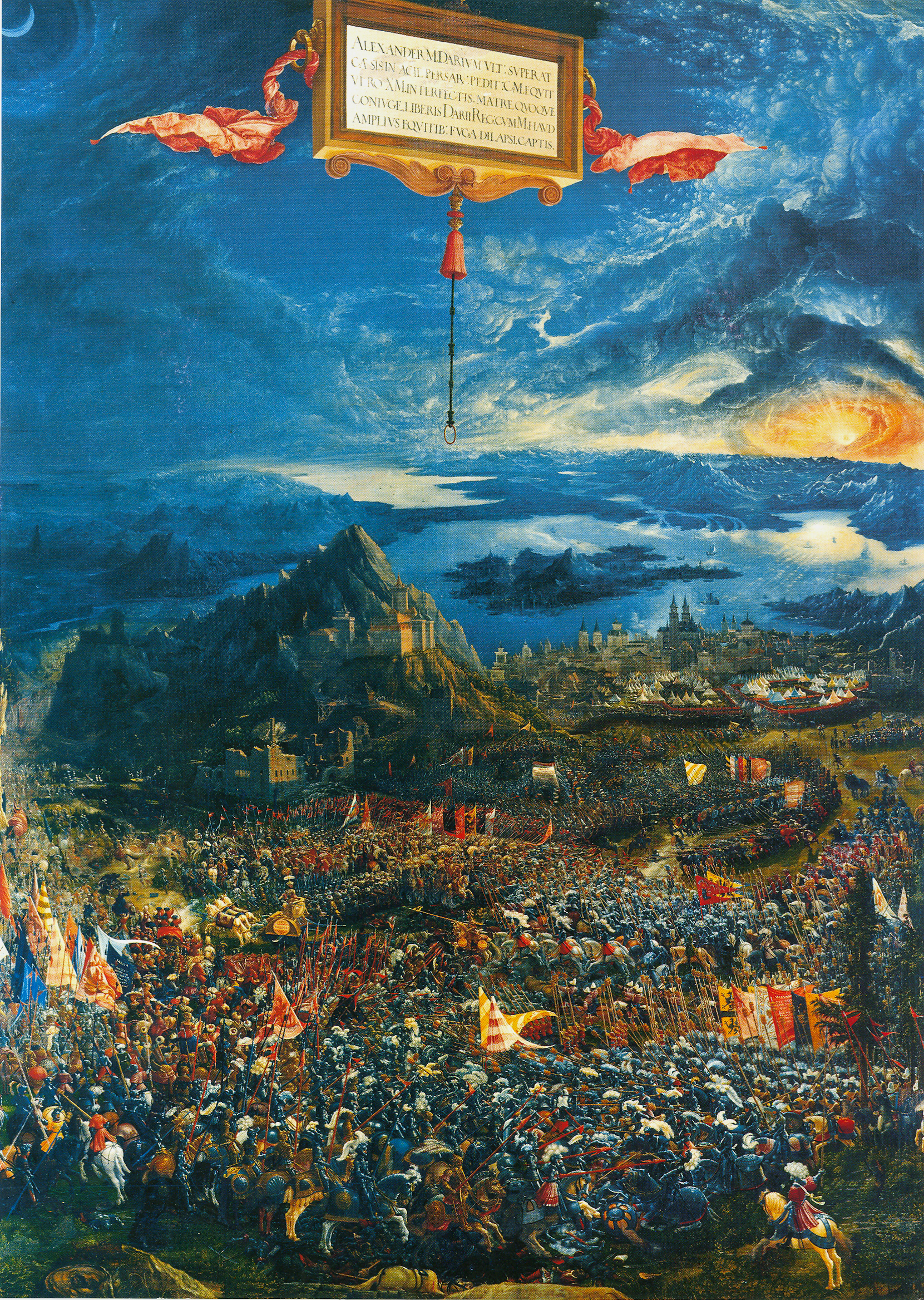
Die Alexanderschlacht; oil painting of Albrecht Altdorfer, 1529
 
For example, it would be a mis-use of the word "Schlacht" to call an assault on a platoon-sized outpost a "Schlacht". That word is reserved for much bigger fights; as a rule of thumb I wouldn't call anything smaller than a division on division engagement a "Schlacht". Meanwhile, it seems to be common practice to call almost ever fire-fight "battle" nowadays - as well as many entirely non-military actions that don't even necessarily include opposing parties.
I've been told that this inflationary use of the word "battle" only began by the time of the Vietnam War.

As a contrast, even many corps vs. corps contacts of WW2 weren't even mentioned in daily reports of the German supreme command, much less named as "battles" with their name. I got to admit that Germans coined a dedicated word for the really, really big world war battles in order to differentiate them from more normal battles; "GroĂźkampf" (great fight).

A platoon vs. battalion-sized engagement would be - especially in a great war context- nothing bigger than a reconnaissance (if the platoon is moving) or a practice assault for a green battalion.
The attention on small wars during the last years has done us a disservice and clouded our mind. It helps to have a clear linguistic differentiation between a real battle and a small contact between hostile parties that merely gets equal attention as a battle would (for lack of a real battle).


I cannot redefine a language that changed over time, but I wanted to point out that it's important to keep the difference between a small exchange of fire and a real battle in mind. Clarity of language is important for clarity of thought.

S Ortmann

P.S.: The German word "Schlacht" (battle) is a close relative of "schlachten" (slaughtering).
.

2011/10/22

Website recommendation: "Napoleon, His Army and Enemies"

.
I can heartily recommend this great website, for it's a huge and great and just splendid website about the major European armies of the Age of Napoleon.


The "Strategy and Tactic" section is outstanding!

S Ortmann
.

2011/10/19

An article about artillery

.
Typical articles about artillery in professional journals look like

Artillery [blah] 21st century [blah] transformation [blah] lethality [blah] network [blah] leap ahead [blah] revolutionary [blah] effects [blah] efficiency [blah] joint [blah] system of systems [blah] excellence !

I stopped reading such articles years ago.

Their illustrations are often neat, but the content of truth or even actual information is 'moderate'. Moreover, often it's important what's not being written (for example that the shiny new gun is already out-ranged by foreign substitutes or that the bureaucracy plans to buy only a small supply of the new ammunition). Ongoing programs are usually being hyped - up to the day when they're being cancelled. Afterwards there's perfect silence about them and whatever is the next move of the bureaucracy is going to be hyped as super-wise.

In short: Most professional journal articles about artillery (or most other military topics) are pretty much an insult to the reader's intelligence.

Luckily, this blog is not professional journal, so I can dare to write an article about artillery without being ashamed.


Earlier blog posts about artillery looked at hardware examples, sub-sets or specific conditions for effectiveness or other specifics:

2011-09: A "15 years too late" analysis on precision munitions and survivability
2011-08: The underrated genius gun
2011-01: A German artillery fire control computer in '45?
2010-08: "Who Says Dumb Artillery Rounds Can’t Kill Armor?"
2010-04: A little bit German artillery and anti-tank defence history
2009-11: The future of multiple rocket launchers
2009-09: On defensive firepower and much else...
2009-05: DM 121 purchase / modern artillery
2009-04: C-RAM
2008-11: Cluster munitions ban
2008-07: Mortars and howitzers

This time I'll try to write about the grand picture, of all artillery since the 20th century. It will also be somewhat applicable to other indirect fire arms (such as mortars).


The purpose of the artillery is to influence a land campaign advantageously by achieving effects through fires (and the threat thereof). These effects were exclusively destructive / lethal / repulsing a long time ago, but jobs such as illumination, smoke screening, disruption, radio jamming were added during the 20th century.

The effects are the centre of attention (or should be), for they are the justification for the effort.

Old photos about arty can be interesting, too...

It's thus interesting to create a list of what influences artillery effectiveness (in a somewhat abstract way). This is the area where public discussions of artillery are especially narrowed-down and dumbed-down. My attempt to create such a list follows:


Artillery hardware-dominated factors

(1) Ammunition quantity (including the availability of ammunition to the firing unit, not just in national depots!)

(2) Ammunition quality (type and quality of warhead/cargo, quantity of sub-munitions, including fuse type)

(3) Duration of munition flight (relevant against moving targets)

(4) Angle of descent (important for unitary fragmentation munitions and in hilly/mountainous terrain)

(5) Reliability of guidance / trajectory correction and fusing (inclusive ECCM)

(6) Vulnerability of ammunition to hard kill countermeasures (C-RAM)

(7) Fuse setting in use (timed, proximity, super quick, quick, delay, mine fuse?).

(8) Quality of ammunition storage (especially for certain white phosphorous rounds) and ammunition age / shelf life.

(9) Fires observability (radar cross section or smoke trail of munition in flight, flash, noise, smoke, trajectory height, manoeuvring munition?) 

(10) Resistance of artillery to non-fires influences (EMP, deep sub-zero temperatures, moisture, heat)

(11) Dispersion of impacts (usually an elliptical pattern, not a simple circle - thus a difference between longitudinal and lateral dispersion)


Other artillery factors

(12) Reliability of artillery personnel (morale, accidents and errors, willingness to fire when civilians are present)

(13) Close security (360°) concerns

(14) Survivability of artillery against dedicated anti-arty measures (camouflage, concealment, deception, hardening, redundancy, mobility, tactics)

(15) Readiness of artillery (On the march? Shoot and scoot? Double crews? In range? Fuelled? Supply times? In need of repairs? Suitable trajectory when mountains are present? Suitable direction (in light of different safety distance requirements for longitudinal and lateral dispersion)? Artillery in a self-defence fight? Authorised/actual strength?)

(16) Accuracy of impacts (or of projected impacts if rounds become effective prior to impact; correct calculation with correct input variables including ammunition characteristics, barrel wear, temperature, altitudes, coordinates, meteorological date and more)

Communication and command

(17) Delay (lag) between arrival of request/command and fires (calculation, checks, deconfliction, loading, aiming weapons, communication between calculating and firing small unit)
 
(18) Resource allocation (Centralised decision-making? Schwerpunkt?)

(19) Reliability of communication (line of sight, range, clarity, inter-lingua, ECCM)

(20) Delay (lag)  of communication (speed of transmission, queuing of messages, procedures)

(21) Timing of fires requests / commands (tactical timing, not = lag!)

Related to observation of the enemy

(22) Accuracy of observation (own and relative position)

(23) Reliability of observation (IFF, recognition of decoys, night and bad weather performance)

(24) Lag of observation (non-digital aerial reconnaissance, acoustic sensors)

Target (area)-related factors

(25) Susceptibility to soft-kill countermeasure reactions (timely warning, taking cover or evading, deploying smoke/chaff/dazzler/decoys against target-seeking munitions)

(26) Surprise factor

(27) Surface quality (Deep snow? High trees?)

and a big one:

(28) Nature of the target (dispersion, cover, hardening, morale, proximity to "blue" troops, size, movement, importance, vulnerability to secondary effects such as secondary fires or explosions, ability to make identification more difficult, exploitation of red cross or protected sites etc)

I suspect the primary utility of such mil porn pictures is to keep readers motivated.

Having thought about this for a while, I'd like to make three comments and leave all else to the reader and later blog posts:


(a) The challenges are much greater and much more diverse than the mere shopping of some fancy precision munitions or new guns. I hope none of my readers will be ever tricked by marketing hype about a supposed silver bullet (again)!


(b) The actual effect is much, much smaller than the potential effect because no force comes close to mastering the first 24 points. An incomplete understanding of these influences leads to a wrong estimation of artillery's actual effectiveness and the relative importance of specific influence factors.


(c) Wouldn't it be great if sometime in the near future we'd be able to read an article about artillery in a professional journal in which the officer-author writes about the artillery of his army and uses a list such as this one as a check list, commenting on every point briefly? I mean, instead of a buzzword mash-up?


S O

P.S.: Word count for buzzwords: 4 x "effects" and once "tactical" (in some contexts that would be a buzzword) in my 'article'. All uses seem justified to me, for they're being applied with the original meaning.

I do sometimes ask others to preview and comment/correct my texts. This time I'm thankful for preview comments by the SWC members "Xenophon" and "GMLRS".
.