2016/04/04

Link drop April 2016

.
These two links kind of belong together:
https://theintercept.com/2016/03/28/israelis-reject-murder-charge-army-medic-killed-wounded-suspect/
http://www.sott.net/article/315298-Cognitive-dissonance-Watch-what-happens-when-AIPAC-attendees-slam-Trumps-racist-comments-then-learn-they-were-said-by-Netanyahu

http://fmso.leavenworth.army.mil/Current/current.pdf
see pages 42 and 47

https://www.washingtonpost.com/news/the-switch/wp/2016/03/28/mass-surveillance-silences-minority-opinions-according-to-study/

https://twitter.com/mehdirhasan/status/713361161161408512
"I asked the Saudi ambassador to the UN why he supports democracy in Syria but not in Saudi Arabia"

http://www.economist.com/blogs/graphicdetail/2016/03/daily-chart-15
I was so very much not surprised. Many people enjoy getting angry about imaginary problems

http://firearmshistory.blogspot.de/2010/05/rifling-manufacturing-hammer-forged.html
My old blog post about gun drilling is still one of the most-read ones because it was linked in an apparently very busy South Korean forum

http://www.rand.org/pubs/research_reports/RR676.html
"Precision and Purpose Airpower in the Libyan Civil War"  Edited by Karl P. Mueller


http://www.chinadaily.com.cn/china/2016twosession/2016-03/13/content_23847904.htm
"Xi orders breakthrough in military theory"
It never came to my mind that it's as easy as ordering a pizza! Xi Jinping must be a genius.


S O
.

2016/04/01

It's the training, stupid!

.
(no April's fools joke included)

Back in the late 1930's the Royal Air Force's Fighter Command deemed it too risky to train its pilots in combat larger than 1 vs. 1, due to the risk of collision accidents. Its training accident rate was low, but the German Luftwaffe with its much less experienced senior pilots trained in battles of 4 vs. 4, or even squadron against squadron. It developed there and over Spain tactics for small units of fighters, as opposed to mere aerobatics for individual fighters. This made the Luftwaffe's fighter force a formidable threat to the Royal Air Force in 1940 even though its senior personnel had much less flying experience (there was no Luftwaffe before 1935, and no covert Luftwaffe before 1933).
Meanwhile, the Italians apparently focused more on individual aerobatics than any other air force (save for maybe the Japanese), and as a result badly neglected to push for higher practical and top speeds of its fighters.

The M1 Abrams main battle tank introduced in the early 1980's was technologically well ahead of its predecessor M60 Patton, but when new the crews still had to learn how to make use of its strengths. During the early exercises M1 Abrams-equipped units were actually less effective than M60 Patton-equipped ones. This is inconceivable to laymen, but actually a very common outcome and one of the reasons why hoping for "wonder weapons" is often foolish.

Back in WW2 it was considered best to train soldiers into infantrymen for six months, and pilots into fighter pilots with 400 flying hours. Due to urgent demand of forces in contact with the enemy many soldiers were sent to serve as infantrymen after six weeks of infantry training and many pilots were sent to serve as fighter pilots after about a hundred flying hours on a fighter. This contributed greatly to excessive casualty rates among the green infantrymen and rookie pilots. Less than ten per cent of fighter pilots scored more than half of the kills in the air, and it was even more extreme in the German and Japanese air forces where experienced pilots were never withdrawn (for good)  to serve as trainers till the end of the war. The lopsided kill results were so extreme because most rookie pilots lost their plane on their first four contacts with the enemy, and all those inexperienced hostile pilots who weren't able to avoid  getting shot down provided a large choice of easy targets to experienced pilots.

Infantry tended to accumulate the most losses in armies historically, with very few exceptions (steppe warfare with almost nothing but cavalry, occupation armies). Good training - not only long training - is pivotal to the infantryman's survivability. The German army of WW2 trained its soon-to-be infantrymen harshly, and even more so from 1942 onwards because of the harshness of the Eastern Front. A short-term result was a horrible accident rate. A newly set-up or refreshing infantry company would typically suffer one or two soldiers killed or permanently disabled during training until sent to the front (again). This looks horrible, but the life-saving effect on the front was much greater than a 1-2% mortality during training. The German army considered its infantry as qualitatively superior until about 1944, in great part due to superior (relative to opponents, not relative to what would have been possible!) training.


There are some lessons from this*, especially when you look at it from the background that there were short (approx. two years) but intense arms races prior to both World Wars:

Lesson #1
Do not expect a relevant improvement of combat capability from a very new weapon system at a critical time. Consider recently re-equipped units as in training and not combat-ready, and keep enough combat-ready forces available at any time.

Lesson #2
Be prepared to switch to more expensive (and especially more risky) training when you expect a major peer war in the near term with a high probability. Sweat and blood in training may save much, much more blood in battle.

Lesson #3
Devise your training and force build-up plan such that enough time (and budget!) is given for training of combat troops. The intensity of training during a pre-war arms race is likely not sustainable during peacetime in general, whereas the advisable long duration of training may not be sustainable during an arms race or war.

Lesson #4 (drawing from lessons #2 and #3)
Armed services should be fully competent at three modes of operation: Peacetime routine, accelerated expansion in expectation of a war in the near term and wartime mode.
The legal framework (red tape, what's permissible, acceptable risks et cetera) and training regime need to know these three modes - with three different sets of regulations/manuals**. The planners need to have plans for all three modes, with transitions between the modes happening at unpredictable times.

S O

*: I used anecdotes and didn't bother to look up the sources again, but you can find similar historical stories in many places and many times.
**: + a manual to point out the differences.
.

2016/03/29

Low intensity blogging

.
I wrote no more than eight blog posts this month, and the reasons are obvious to me:

My thinking about military theory pulls me back to the central point of delaying actions again and again, though I don't make much progress on this regard. Over the years I identified skilful delaying actions as THE central replacement for the extinct frontlines, but I'm simply not ready to write about it even though I had a couple ideas that I've never seen in literature (including field manuals). Everything else appears to be frustratingly uninteresting by comparison, or covered long ago. What new could I write about the hysteria about terrorism? I wrote it all already. Armed forces = bureaucracies? I covered this one redundantly. Much of what I could write about infantry has an eerie if not even embarrassing similarity to Jagdkampf, and it's been like that since 2009. Some other ideas are close to Raumverteidigung and similar 1970's and 1980's concepts that don't fit all that well into Eastern Europe. Maybe this for mountain and urban warfare? Mmmh.
I could comment on faraway countries' defence issues, but experience told me that much effort is required to avoid mistakes based on gaps in my knowledge.

The best I can do today is to remind my readers that this blog isn't a news blog. Posts from 2009 may fit to current events just as well as if they were written today. Tired of mainstream hysteria on terrorism? Use the search function on the left and look for "terrorism" or better "errorists", for example. I never dignified them with a dedicated label.

My view on the German military is that it's doing business as usual under a ambitious minister of defence who had no clue about defence prior to getting this job and since tried to get the bureaucracy under control with help from outsiders. Not so much to provide the common good of security at lowest possible price, but to further her own ambitions minister of defence is usually a dead end for politicians' careers, but she likely wants to become chancellor sometime). The military is getting the budget for extra personnel to handle "new" demands for conventional deterrence, instead of cutting out fat or re-purposing "overhead" personnel slots or simply getting more fit overall.

Milblogging can be quite depressing if you're not easily excited by sexy toys. BTW, this is what pops up when you google 'F-35 sexy':


S O
.

2016/03/20

Musings about timeliness of forces for continental defence in Europe

.
The EU and European NATO are vastly more powerful  than all non-allied neighbours combined, even if we would count Switzerland and NATO ally Turkey against the EU, for example. Russia doesn't come close to the sum of EU military power.
The present challenge for deterring violent conflict on the European continent is thus not about the quantity of forces or the sizes of budgets. That's what superficial voices want us to believe, and it's also a myth that's conspicuously self-serving for the armed bureaucracies and arms industries in Europe.

The real challenge is to let these forces be relevant (and meanwhile, we could actually reduce military spending and force numbers and still stay safe). "Relevant" means "timely" and "suitably prepared". A suitable preparation is a preparation for defence; insurgents won't attack us, if any power dares to attack us it's going to field a powerful regular military that's used the time it had to counter our doctrines, our technologies and that's prepared to exploit our weak spots. Forces focused on how best to occupy some distant country and force a puppet regime on it are a waste of money and time in regard to defence.
"Timely" is about how quickly the suitably prepared forces arrive.
The most plausible scenario for an attack on our alliances (NATO and EU) isn't a full-out assault to make us all speak Russian, Chinese or Arabic. It would rather be a quick coup de main followed by a fait accompli, a "I'll use nukes if you try to take back what I conquered!" message. A very promising counter would be to make the original coup de main improbable by showing the ability to counter it with enough military power IN TIME.
The old NATO "strategy" of counter-concentration is bollocks, for it assumes that an aggression can be predicted in time and politicians actually act on the intelligence without prohibitive decisionmaking lags.

We need forces either where we'd need them or able to get there real quick.
This is how I'd rate the different timeliness of land and air power:

(1) high readiness forces in-theatre (incl. allied forward-deployed forces)
(2) air-deployable forces with resupply secured (including with prepositioned material)
(3) low readiness forces in-theatre (including personnel reserves)
(4) high readiness road march-deployable forces (incl. tanks on tank trailers)
(5) rail march-deployable forces (only diesel locomotives are relevant)
(6) low readiness deployable forces (including deployment by sealift)

The cut for actual relevance is in my opinion among those forces of category (3) that are close and those that are very far on the continent.

The typical air-deployable forces would be air power (self-deploying air force aviation with core ground crews deployed by transport or passenger aircraft) and "airborne" forces. The "airborne" forces might do a jump, but not close to known opposing forces. Such a jump would rather serve to deploy them farther forward than the most forward safe airfield. Surface-to-air missiles are still less long-ranged against slow* transport aircraft at very low altitude than the 500 km limit in ground-launched ballistic and cruise missiles of the INF treaty. So airborne forces may arrive a few hours earlier on the scene if they jump than if they land at some safe airfield (that's probably overcrowded anyway).

There are problems with both air power and airborne forces. Air power will likely not achieve much initially, for Western air power doctrines have grown to depend on either a slow force-build-up (1990) or even a long conflict (Vietnam, Libya) and enough time to first go after the opposing defences (air defences, fighters, supporting HQs) and then influence ground war. Western air forces are poorly suited to make themselves felt on the ground within hours or days even in face of powerful defences. We could change this by investing more into ground--launched cruise and ballistic missiles, but we've allowed our air forces to idolize fighter pilots so much that the ranks of air force generals are dominated by pilots. Pilots don't want a force of trailers with missiles ready-to-use, they want manned combat aircraft! Thus we neglected GLCMs and GLBMs.

Airborne forces have horrible problems as well:
- poor if any artillery power
- poor anti-tank power (dependent on shaped charge principle, especially anti-tank guided missiles)
- poor battlefield mobility (hardly any armoured vehicles)

Airborne forces that qualify as quick reaction forces for collective defence need to

(a) have these three problems solved (maybe with an arms room concept in which their artillery battalion switches between towed artillery and air-deployable self-propelled guns as needed)
or
(b) they cannot be used as stand-alone formations (they'd be reduced to infantry reinforcements for mechanised brigades)
or
(c) they can only be used for niche missions such as defending a bridge, towns/cities or woodland

A plausible recipe for collective security at spending levels that include hardly any avoidable waste would be focused on collective deterrence, not on the interests of warmongers, not on the interests of the armed bureaucracies, not driven by path dependent customary force structures and habits.
Europe is vastly more powerful than needed and is spending vastly more on military power than wise, regardless of the uninformed gut feelings of people who claim otherwise. Yet Europe's military power is not oriented at doing its noble core job; providing collective security through effective (and preferably highly efficient) deterrence.
I am under the impression that the reorientation towards this is half-hearted and slow, but most worryingly, it's low on ambition:
So-called quick reaction forces are small, patchwork and not really quick. The quickest-deployed forces are predictably ineffective in the relevant collective defence scenarios.

Maybe the collective defence activities are 100% satisfactory and effective despite being largely symbolic, or rackets to serve the armed bureaucracies and the careers of their political masters. Well, if this was the case then that would be a most convincing reason to still become more efficient, and to cut spending levels accordingly. What can be done by much at poor efficiency and rather symbolic effectiveness can surely be done at much less expenses if the efficiency was better.

S O

*: Either fast or very low altitude, one cannot do both with transport aircraft.
.

2016/03/18

IR illumination and mortars

.
I noticed that some things are simply passing under the radar, for they aren't 'sexy' enough and don't find multipliers who disseminate the information. Even people with great attention to military affairs, including insiders, often don't know about developments 10-30 years old even if those were not kept secret. This is particularly common regarding electronic warfare and surveillance technologies, but it afflicts even seemingly simple things such as mortars.

Here's one snippet that may close one such gap. Infrared illumination by mortar bombs and howitzer shells. The first generation of low light sensors depended on illumination searchlights. Some of the earliest examples are presented >>here<<. 


Such illumination searchlights were still in use during the 1970's, particularly on tanks as gunner and driver aids at night. These devices work in the near infrared spectrum usually. Entirely passive devices that show the warmth of objects (and are useful even in daylight to find otherwise camouflaged vehicles and troops with ease) have become common in Western armies during the 1980's only, and for dismounted personnel during the 1990's. They're still rather expensive and rare as night sights for individuals as of today.
Instead, the typical rifle or helmet mounted night sight is a low light amplifying sensor that is sensitive enough to make do without an artificial illumination source usually. This misled many people to believe these would work well without any illumination, but they don't. They were called "starlight scopes" for a reason; at new moon or under dense clouds, far from civilian light sources and fires you won't see far with these. The availability of light sources coins the effective range.

The use of conventional illumination munitions is troublesome because these light amplifiers must not be pointed at an intense source of light (or be activated at daylight). The answer was to develop illumination munitions that are the typical flares on a parachute as known since the 18th century, but emitting light almost exclusively in the near infrared spectrum.

The slides below are excerpts from a presentation given in 2001 and show this technology:


The source document is here.

So in other words; there's some need for illumination munitions even in the age of night sights (in addition to batteries for the latter).

I included the third page for a simple reason: I did write a couple times about how infantry needs to be elusive, to not stay for long in some place once detected. My rule of thumb was to not stay in a detected position for longer than two minutes. 


The slide shows why; the potential for responsiveness is mortar (or artillery) fires within less than one minute. There are other lags in addition to this one, thus my rule of thumb of two minutes.
Please, form your own opinion on whether doctrines and equipment have evolved during the last 15 years in order to enable Western infantry to strike and vanish within two minutes routinely. Keep in mind how very much the attention was focused on occupation warfare where the opposing forces were devoid of even 1939-style mortar capabilities!
S O
.

2016/03/17

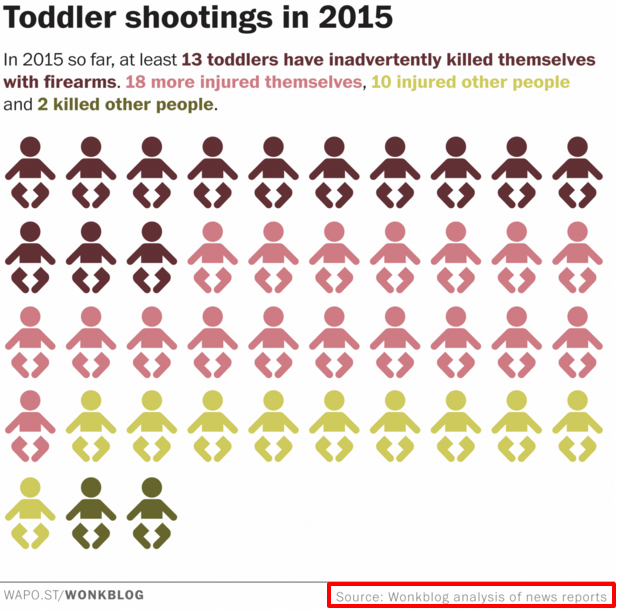
"Toddlers killed more Americans than terrorists in 2015!" - Fact checkers: "True."

.

.

P.S.: Everybody who thinks an insult is in order when I didn't unlock his or her comment (for whatever reason) within three days obviously doesn't behave like a well-mannered guest and thus doesn't qualify as a commenter here.

2016/03/14

John Oliver on Encryption

.

Military history and modern conflicts

.
There's an anecdote about General George S. Patton:
He had read so much on military history that little in then-modern warfare (of WW2) was really new to him.  He even told admirers that hardly anything he did was original, it had all been done before.

My observation is that indeed there's very little truly new in modern warfare.* Mistakes done in ongoing wars are usually easily perceptible to a student of military history, and the widespread disappointment with the results of warfare that afflicts the public after a few years or months of warfare is utterly predictable, too: It was already known to the ancient Romans:

"The outcome corresponds less to expectations in war than in any other case whatsoever."

I find it much more challenging to be constructive in regard to future trends. They don't surprise a student of military history ex post, but an accurate prediction is a very different challenge.

Knowledge of the status quo and of military history alone isn't enough to find answers to changing circumstances. Extrapolation from the status quo based on historical trends is not reliable, for occasionally things do change. 
The new things usually resemble old things, such as tanks resemble clibanarii (and their line of descendants that ended with cuirassiers) in some ways. It's difficult to predict the exact path, for the theoretical knowledge doesn't suffice to predict the results of new experiments.

It's thus difficult to predict, and one can only develop scenarios; options that might actually work well as a reaction to changing circumstances.
Sadly, the usual quality of discourse is a very different one: It's still difficult to collectively break with obsolete concepts until they've proved to be disastrous under modern circumstances. Trends developed during long periods of peace among great powers that are demonstrably in violation of military history lessons and almost certainly going to prove disastrous in a war among great powers linger on. Often times there's institutional self-interest by the armed services as well as economic self-interest by the arms industries providing life support to such obsolete approaches.

Attempts to develop concepts for future warfare (or strategy) often take a very, very bad turn because either the fascination with (supposedly) new technology becomes too powerful or (often related) a lack of military history or military theory knowledge keeps them from understanding the consequences of new technologies.
Another common pattern is that senior and retired officers have been indoctrinated with their armed service's doctrine so much (and often have become so extremely partisan in favour of their armed service's self-interest) that they cannot possibly form any original thought. They often pretend to do so and some get attention because they mastered the style, but their musings are utterly predictable to someone who knows the doctrine and patterns that ruled during their last decade in active service.

The reader likely understood that I've got little confidence in the competence of senior leadership in regard to changing environments or in regard to serving the nation first instead of serving the own armed bureaucracy first.
This lack of confidence in them made me question the wisdom of their decisions, and it motivated me to try to add possible scenarios to the discussion. I know, I'm not being read much (less than 1,000 times per day if you subtract the bots) and my guest writing on other blogs doesn't change this. It's still providing me some satisfaction to know that I did at least try, even though it took a non-negligible part of my lifetime.

I still have hope that sometime in the near future (or maybe even right now, unknown to me) more influential people bring together knowledge of military history, military technology and military theory to get things right without us paying a horrible price in the next big war.
Even better; maybe we can avoid that war altogether, and reduce the benefits from getting military affairs right to keeping the peace with no much greater economic burden than necessary.

S O

*: Even the hardware and seemingly brand-new gadgets of modern warfare are usually merely refined successors of what had been developed 30-100 years ago already.
.

2016/03/05

Mounted forces survivability in high-end conventional warfare

.
This will be a summary of some musings of mine back in 2008 and 2009. It's going to be very abstract.

Let's think about mounted forces survivability, such as a mechanised mixed battalion battlegroup of roughly hundred vehicles, most of them tracked and armoured.
Furthermore, let's only think of artillery and fixed wing air attack. This focus shuts out all the distractions from the other threats and allows for more clarity, akin to the ceteris paribus technique. It serves clarity of thought at the expense of not dealing with the whole complexity (which would fail anyway).

One possible option to reduce the losses taken by hostile artillery fires would be to just keep moving. Save for missiles which find and lock onto targets after launch all artillery munitions are very much degraded in their effectiveness if the target is moving, and unpredictably so.
The battlegroup will run into troubles caused by movement, though: Vehicles will get stuck or involved in accidents, fuel consumption will be excessive, and crews particularly in tracked vehicles will tire out very quickly - even before the material breaks down from wear. So movement can be a temporary solution only.

A second option is to try to counter attacks with active, hard kill defences. Artillery shells, rockets and missiles would be intercepted by incredibly expensive (and bulky) defensive systems, and air attack would be countered by the firepower of air defences. This happens to require de facto constant radio emissions, which will be unacceptable against a peer threat. The defences would be defeated through tactics (such as saturation) and hardware sooner or later. The expenses required to prepare such a hard kill defence for an entire battlegroup would be excessive anyway, and a too large share of the force would be occupied by this defensive mission, leaving the battlegroup weak in its other defensive missions and in its offensive mission.

A third option would be to try to counter attacks with active, yet soft kill defences. Sensors of aircraft and munitions would be jammed in some way, false radio emissions profiles would be generated and so on. Again, this ends up being very, very elaborated and sophisticated. Nowadays a division would be glad to have enough such soft kill defences against artillery reconnaissance and air power to hide a single battalion battlegroup. Many soft kill defences (such as radar jammers) would be emitting constantly and thus be destroyed soon. A permanent employment of smoke would furthermore be unacceptable from a logistics point of view.

A combination of some movement, some soft kill defences and some hard kill defences is almost exactly the recipe preferred by real (first and second) world mechanised ground forces, of course. The fourth ingredient is the fourth option: Hide. Hide in woodland, hide among or in buildings, hide behind hills, maybe even hide among civilian road traffic. Hiding has become more difficult, though. Nowadays very distant radars cannot only detect a tank, but also its track marks on the terrain. The tank usually is at the end of such track marks. Radars can also tell tracked from wheeled vehicles over impressive ranges.

So the normal and seemingly self-evident approach is to combine all four; concealment, movement, soft kill defences and hard kill defences to increase the survivability of mounted forces.


Now there's a huge problem: How to apply this in terrain such as many almost featureless Eastern European flatland areas? This isn't such a problem in the Baltics which have much woodland, but the Ukrainians sure have a huge problem - even through the Russians don't use their air power for air attacks.

Mounted forces might end up hiding and resting in sufficiently large concealment-rich areas only to occasionally sprint across the open terrain to the next suitable resting area. This may help understand the "Stop & go tactic" text which I wrote more than six years ago. The technological approaches to survivability - soft and hard kill defences- may be useful, but aren't sustainable. They may be applied to protect the sprints, and this may both be an organic and a theatre-level effort. A corps commander may for example order a battalion battlegroup to extricate itself from a mess and muster much support - including fighters, radar jamming aircraft, ground-based radar jammers, air attacks, artillery fires and so on - to protect this movement. Maybe the lethality of ground and air forces is at such an advantage over their survivability that entire corps consisting of a dozen battlegroups only dare to more one battlegroup at a time, supported by many others, corps-level assets and theatre-level assets. Parallel movements may be restricted to the most rewarding opportunities and the most desperate attempts.

Where to hide?
In much of the Ukraine and Belarus the only vehicle hiding spots
against ground observation are trenches created by soil erosion.


And this - even mounted forces hiding out of well-justified fear, being immobilised just as were armour-clad infantry sitting behind an Afghan wall waiting for help against some not yet spotted rifleman who shot at them - may be a central element in replacing the long-lost frontlines: When ground forces don't advance out of fear on a large area that's not much different from them not advancing past a rather discernible line on the map because of oppressive fear of defensive fires along that line. Only great efforts or a general disorder and confusion among the opposing forces would then lead to a mobile warfare phase.


The idea that battlegroups or brigades simply move through open terrain as if it was an Arabian desert, trusting that they're superior there at least to infantry, that idea seems incredibly misplaced in much of Europe. The necessity to increase the survivability of individual manoeuvre elements by a concerted effort may soon (or already) be so pressing that it could be compared to the need to dig in and form continuous front lines back in 1915.


S O
.