
Acoustic sensing with technical support had been introduced into warfare during the First World War. The British were early adopters of sound ranging to detect artillery batteries, used it much during the Second World War and they are still using acoustic ranging equipment for this purpose. This isn't expensive (except in personnel), but such a dedicated system is rather difficult to use in mobile warfare, similar to radio triangulation equipment.
Nowadays the much more accurate artillery radars can cope with the demand for artillery and mortar locating much better, albeit with the disadvantages of much higher purchase prices and treacherous radio emissions.
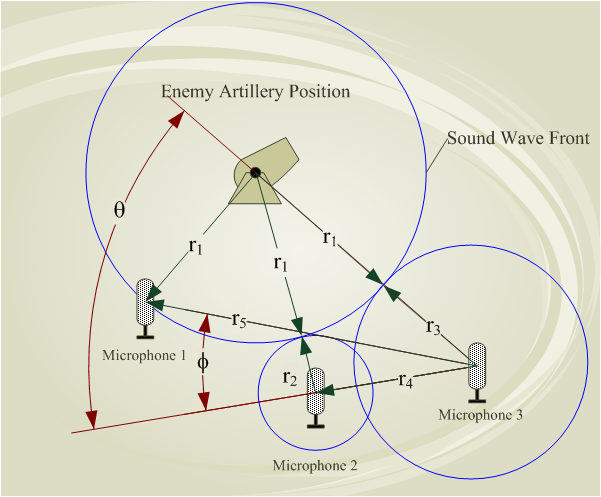 |
| Basic sound ranging operation |
It appears that after many decades with little improvement other than the use of electronic computing, the Microflown acoustic sensor (which is no microphone) may actually have brought substantial improvement to artillery sound ranging. A small sensor package with multiple Microflown sensors can apparently not only register the time of a sound event, but also the bearing - allowing for triangulation as with radio waves (instead of using the time difference of the sound arriving at spaced microphones as shown above). The applications for this kind of sensor are numerous.
A modern application for acoustic sensors has been the use for sniper (and more generally firearms) detection, I wrote about this a bit more in 2009. Most such systems appear to rely on the supersonic crack sound caused by a sniper bullet, rather than the muzzle blast's noise.
 |
| typical sniper detection microphone array |
A third - once quite important - use of acoustic sensing was the detection of aircraft through clouds with ground-based sound amplifiers. These grew to ridiculous proportions quickly.


I'm sure the relief brought by radars was great.
Why am I writing about all this acoustics stuff?
Well, there's one application that doesn't seem to be widely known; a non-line of sight detection of helicopters with ranges of about 8-10 km. The only published device for this that I found is the Israeli HELISPOT. It was available in Mk 2 version back in 1993 already, and apparently Mk 3 around 2003. So it's not brand new.
Range claims go up to 25 km in optimal conditions, and apparently the Israelis have or had a second system of this kind as well (source).
I think this is quite interesting, because when you think of networked warfare with no radio comm outage and you have microphones and acoustic sensors in many places, you probably don't even need any such dedicated devices. I'm certainly no sound or electrical engineer, but I suppose microphones mounted on vehicles for one purpose (such as sniper detection) could also be used for other purposes (such as early warning about helicopters), and this coupled with automated accurate navigation and radio datalinks may create a network of acoustic sensors that serves artillery detection, mortar detection, moving tank detection, helicopter detection and sniper/rifleman detection alike.
The network may break down if either navigation or communication breaks down, but with the right technology even a mere three vehicles with acoustic sensors in a 200 x 200 m area might suffice to accomplish such detections, and you can usually maintain radio comm over such distances and navigation (or at least bearings and distances between vehicles + heading of the vehicles) isn't much of a problem unless the vehicles are moving.
 Now combine this with another entirely passive warning device against aerial threats, such as the classic AD/AD or its de facto successor Rheinmetall FIRST* and you have a foundation for battlefield air defences that's impervious to classic, counter-Radar focused suppression of enemy air defences (SEAD). Now add a missile such as Bolide (RBS70NG) that's extremely hard to counter (laser beam rider) and cheap and the outcome is a battlefield short range air defence that keeps manned aerial threats at a respectful distance (~ 5 km) at most times.
Furthermore, all the warnings can be transmitted to the troops on the ground by radio. Modern tactical radios often have satellite navigation (GPS, Galileo) integrated, and could receive miniaturised inertial navigation systems to bridge the times of satellite navigation unavailability. The endangered troops could thus be warned about the nature of threat (jet, drone, helicopter, tank, even sniper) and the direction and would be able to minimise their exposure by exploiting concealment against that direction - or set up an ambush.**
This doesn't even require them to report their location into the radio network. The software-define radio would rather run an app that listens to all warning messages, knows the own position and alerts acoustically only if the threat is relevant to the radio's user. This wouldn't work at all times, but sure would be welcomed as helpful whenever it works.
The end result is a serious degradation of effectiveness of attack helicopters and SEAD in particular. Tank, combat aircraft and helicopters would have a harder time generating surprise. All sensed threats but those out of range would see their survivability degraded by such sensors and communications against which they can hardly do anything.
S O
defence_and_freedom@gmx.de
.
*: "Other IRST concepts were created for air defence purposes, such as ADAD in the United Kingdom, ANSAR-8 in the United States, VAMPIR in France, IRS-700 in Sweden, SPIRTAS in Israel and IRSCAN in the Netherlands". Source
**: The same approach to warning troops can be applied to incoming artillery and mortar ammunitions: Artillery locating radars may calculate the point of impact of ballistic projectiles a minute or more (other times mere seconds) before impact. This data may be used to send a area-related impact warning, so troops can take cover or get out of the targeted area, denying the surprise effect if not even the entire lethality to the attacker.


