"Dunning-Kruger effect" is the term for people basically being too stupid and incompetent to understand that they are too stupid and incompetent for an issue.
'He's a stupid man's idea of a smart man.' was said about a certain politician.
Combine these two things and you get the modern-day pundits (and more general: "comment-givers") who now diagnose the need for more military spending. They do so with an aura that spans a spectrum from "honest truth-teller" to "elder statesman".
They're idiots. That's the nice way to put it.
And the media people who amplify such messages are too stupid to smell the horseshite.
The Russian Armed Forces are failing to subdue a country that hadn't even come close to spending at least 10 billion $ in a year from independence three decades ago till the all-out invasion of 2022.
And the horseshite producers conclude that, obviously, we don't spend enough. European NATO outnumbers Russian military personnel about 2:1 without counting the U.S., and outspends it by about 4:1 (not quite as dramatic when correcting by purchasing power parity, but still outspending).
We do spend too much - not too little - on the military.
There's practically no other direct threat to NATO than Russia, and it proved to be a sick man of Europe, utterly rotten and incapable. Their air force is ineffective, their army is shite, Russia of today combines all flaws known from past 200 years of Russian history while the only strength is the size of their dumb munition stocks and factories.
The realisation that the only threat is impotent leads to the logical conclusion that previous threat estimates - and thus required military power assessments - need to be revised DOWN.
Some people may be concerned about the PRC, but that's no direct threat to any NATO territory*, and nobody seems to argue to pump arms, spares & munitions into Taiwan for real NOW. No, these horseshite spewers want more military in Europe, where it matters jack shit for Taiwan.
Horseshite is not "honest truth-telling" or "elder statesman wisdom". It's homicidal horseshite, it's quasi-genocidal.
Misallocating so much money has real-world opportunity costs. It's not fantasy money in a fantasy game.
The horseshite-spewers are ethically to be ranked well below bank robbers and rapists. Not only is horseshite more dangerous to the society; at least some bank robbers and rapists are aware of themselves being terrible, antisocial persons.
The European armed forces as a whole (and big ones such as the British or German ones) don't have an underfunding problem. They have an inefficiency problem. Billions and billions of Euros are being allocated to worthless crap that matters jack shit for deterrence and defence. Meanwhile, essentials such as large and properly cared-for munition and spare parts stocks are getting neglected.
It's the "hollow force" syndrome. The "hollow force" syndrome is not being caused by underfunding. It's caused by stubborn resistance to cutting fat and stubborn resistance to resizing according to budget. The generals and admirals prefer to keep units and platforms in service in hope of getting bigger budgets later again rather than to resize. It's a shared responsibility of minister of defence and generals/admirals.
They (MoD, admirals, generals) fail their nation by hollowing out the armed forces, NOT the legislators who appropriate budgets that don't fit to the legacy military size. The executive branch is supposed to follow the legislative branch on this, not the other way around. Your waiter does not get to dictate how much you have to spend on dining.
We have huge fiscal challenges to cope with. The demographic changes in much of Europe (fertility well below 2.0) make long-term investments in infrastructure and real estate (rather than building cheaper, less durable stuff) advisable. Decarbonisation costs much. Chronic large budget deficits are unsustainable, as the rate of technological progress (and thus GDP growth) keeps slowing down. Generational budget distribution fights are brewing under the radar.
There's never a good time to waste resources, and that's very evident today.
We need to improve the resources allocation in the armed forces (more spare parts, more munitions, more budget for exercises, less units that are irrelevant for deterrence and defence).
We do NOT need to spend vastly more on the military. In fact, we could cut our military spending by half without any loss of security or stability.
I thought a bit about what's the minimum variety of weapons and vehicles for land war in Europe, as a thought exercise to create clarity, kind of cutting away the fat. The list follows, but be prepared to disagree violently. Keep in mind, this is a minimum list, not an optimum list. The thought exercise is about what do we really need?
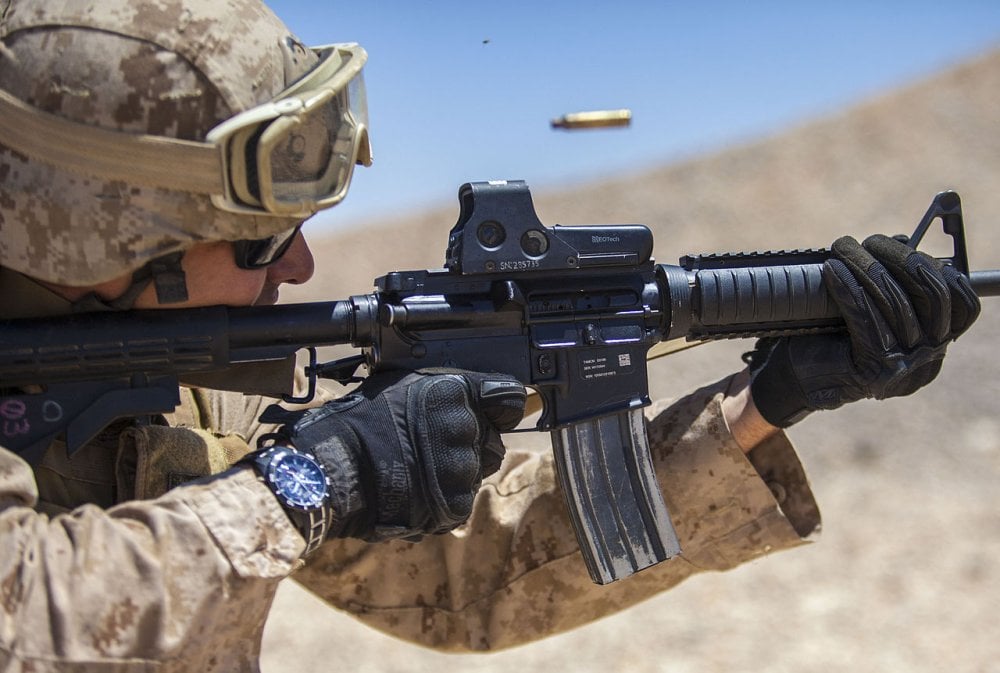
(2) assault rifle with red dot sight (5.56x45 mm M855A1 EPR round, 14.5" barrel)
Why illustration with an M4? Because the mass production made it cheap.
(3) "automatic rifle" (assault rifle with thicker barrel and adjustable bipod for light machinegun role)
(4) HEDP rifle grenade* can hit & penetrate BMP target reliably @ 100 m, graze PDSQ & delay fusing modes, off-centre nose spike, bullet trap
Most HEDP rifle grenades have a IMO too weak HEAT at 35 or 40 mm diameter.
Few bullet traps could stop an EPR round reliably, so no legacy type is fully satisfactory.
(5) short-range anti-MBT weapon* (RPG-28/RPG-30 combo as anti-APS solution)
(9) wheeled 155 mm SPG (either 52cal with limited traverse or four-legged 39 cal for all-round traverse, no autoloader, power ramming, modern positioning/northfinding & fire control)
1. Defensive (with fragmentation sleeve) hand grenades are a hazard to the user in many situations, as their fragmentation effect has a larger danger radius than an offensive hand grenade's mere blast effect. Convertible hand grenades weigh more, are not significantly more useful in practice and the screw on/screw off of the frag sleeve is an opportunity for fussing around in combat stress.
2. A red dot sight is the easiest for quickly gaining marksman proficiency and is fine out to 300 m. It also avoids tunnel vision, as both eyes can stay open. Downside; no magnification means that the sight does not help with target ID. Section leaders need binoculars (minimum 8x21).
3. I expect 90% would expect some longer-ranged infantry weapons including "sniper" rifles and belt-fed machineguns as well. This is a doctrinal choice of mine. Break (line of sight) contact if you get shot at from beyond 300 m, for you have exposed yourself too much, period. Commonality with the assault rifle helps to cut down training requirements.
4. Rifle grenade are out of fashion in many countries and one might miss the greater effective anti-BMP range of a LAW (~200 m instead of ~100 m). The HEDP rifle grenade should rather be thought of as something that pierces as window (cracking it with a hard spike) at 30 m distance and explodes with delay fuse and frag effect in the room. It could defeat a BMP in street combat or in woodland combat, though.
5. A dedicated anti-MBT munition, it's very heavy at about 15 kg, only to be issued (and taken out of vehicles) more than one per section when the need is anticipated. It's necessary because the FOGM would not cover some close terrain such as woodland. RPG-28 has 125 mm tandem HEAT and RPG-30 features a 2nd decoy projectile to trigger hard kill APS so it misses the main shot.
6. Main anti-AFV asset, primarily meant for indirect support fires and launch based on 'bird's view' leads. It could also defeat moving targets and targets that are shielded from 155 mm fire by buildings. I choose fibreoptic guidance because I distrust the radio link of loitering munitions; effective jamming against them may appear any day.
7. Gets rid of BMP-class vehicles at a distance, keeps helos away, may intercept some drones, threatens high subsonic speed combat aircraft during their approach and thus keeps them above ~15,000 ft.
8. Installed on APCs and 8x8. Distributed anti-drone and anti-loitering munition weapon, provides security against infiltrators and stragglers, hardly relevant for infantry fire support. MG3 was chosen for NATO standard calibre and its nowadays uniquely high rate of fire from a single barrel. The bolt could be lightened to increase the RoF even more. The calibre also offers little vibration, small weight and compactness. The bullet type should ignite non-insensitive warheads.
9. Standard NATO calibre. Other calibres and barrel lengths could do the trick as well, of course. Targets mostly based on 'bird's view' operator calls for fires, pre-planned assault support fires (neutralising fires with HE, flank screening with multispectral smoke), calls for HE salvo on a point by infantry platoons and rarely on satellite-identified targets hidden from 'bird's view' sensors. It might also deliver old-fashioned propaganda leaflet munitions.
10. Expensive anti-platform missiles such as SL-AMRAAM, VL MICA, CAMM and IRIS-T SL are not included because I assume good air power support. The same reasoning excluded GUMLRS-class PGMs from the list. What's needed instead is thus a low cost interceptor missile against drones, loitering munitions and occasionally passing cruise missiles, glide bombs and GUMLRS-class PGMs.
Radar support:
Especially #10 requires radar support. A 4x4-based radar could do the air surveillance for aircraft/munitions/drones including warning by radio of impacts about to happen. It would greatly help #7 to take on head-on and #6 to engage helicopters. #8 would also receive threat leads.
The Tamir missile launcher vehicle could use another radar and possibly some gimballed sensor package to guide the missile to its target. Both radars should be GaN AESA radars, single antenna rotating in a rotation-symmetric housing with bulletproof backing.
compact 4x4 car (~Land Rover or G-Wagon, cabin proofed vs. PKM ball or steel core bullets @ 100 m, front axle well forward of driver and bottom plate as features for protection from mines and UXO, soft roof)
8x8 or 10x10 vehicle of 15...20 tons payload, only three versions in a brigade; advanced load handling (container & pallet), protected tanker (15,000+ litres) and recovery, protected cab with RCWS
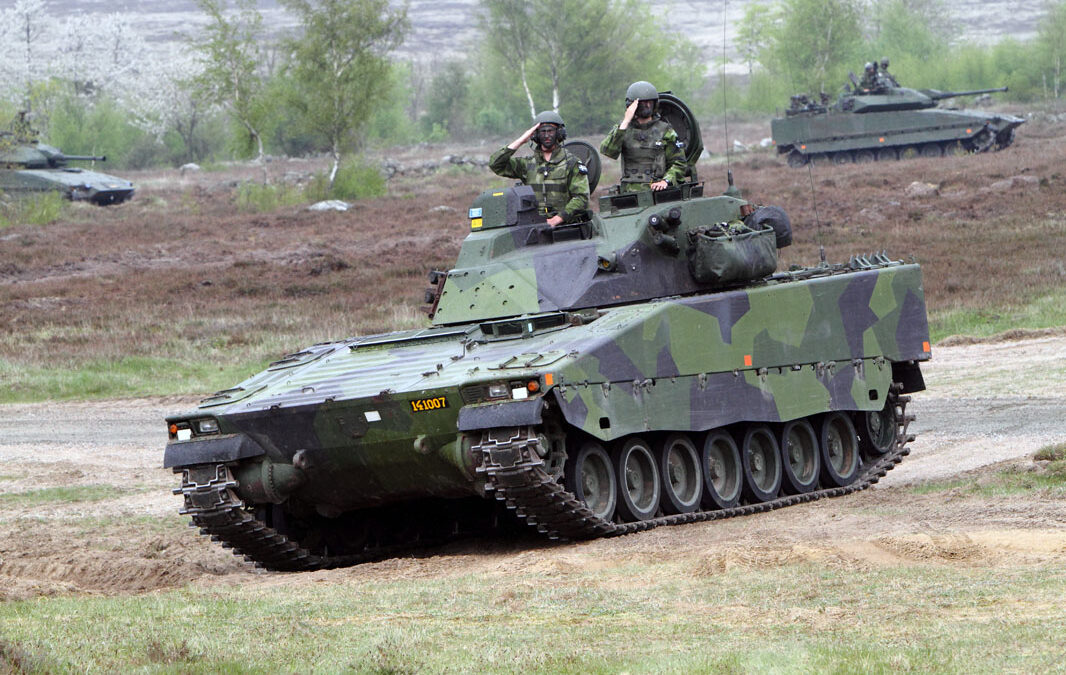
APC (continuous bandtracks, RCWS, armour against hypothetical 14.5 mm APDS, ROSY smoke including overhead smoke projection, forward powerpack, rear ramp, a couple of available add-on kits such as a dozer blade and recovery winch, ten dismounts on folding seats, crew of driver & gunner, a lightweight anti-HEAT 360°x90° hard kill APS (Iron Fist IFLD, but with two rotating rotation-symmetric radar antennas instead of four fixed ones). Might be used for scouting with at most two dismounts, but 95% of missions would be transportation or assault&run. Weight fuelled without payload; approx. 20 30 tons.
P.S.: This was a minimum list, not an optimum list. Just a thought exercise. Maybe I should have made it much easier on the eye with graphics & a layout that's not stuck in the 90's, but I'm rather busy in private life.
*: Technically that's a munition, not a weapon.
edit: I should have mentioned WHY a minimum set of equipment is attractive, despite not being an optimal one. Our procurement bureaucracies are FUBAR. The more diverse the equipment they need to procure, the lesser the chance that they get the job done. Ruthless standardisation and reduction of variety would not just ease training and logistics; it would also be a workaround for FUBAR procurement.
I meant to write a blog post outlining the essentials for a European army, focused on deterrence & defence in Europe. It first got unwieldy and then I realised that I was foolish; there are too many such necessities.
So instead, I'll try to write a not necessarily complete list of things that are almost certainly luxuries in European armies. Some of these luxuries are still nice to have, but luxuries and unlikely to justify the budgetary expenses nevertheless. I may later write a brief list of necessities that we don't have.
Rifle-proof body armour
Videographic evidence does not show much hard body armour in use in Ukraine, and it appears to be confirmed yet again that high explosive shells, not bullets, are the real killers by a large margin.
Attack helicopters have become a farce over Ukraine due to battlefield air defences that they cannot cope with. They're about as useful as a pickup with a mounted rocket launcher for too small (57...80 mm) rockets, for lobbing rockets into the general direction of villages or fields is their (and Su-25's) standard operating procedure there on both sides of the conflict.
The Western attack helicopter approach emphasises staying close to the ground, expose the platform very little and briefly, find targets with expensive sensors from there (treetop height) and engage them with quick and expensive missiles. This can be done MUCH more easily, with more persistence and for much less budget by a combination of land vehicles with mast-mounted sensors and missile launchers. Both 4x4 vehicles and trailers can be used for this, there's no need for expensive helicopters.
Attack helicopters are extremely dangerous to poorly-equipped insurgents (and survivable against them especially at night), but they have approximately no use for conventional deterrence & defence in Europe.
Heavy lift helicopters
There are 15 ton lorries, 'nuff said. Heavylift helicopters are obscenely expensive to buy and operate. Their occasional quick transport function does simply not justify their obscene costs.
Utility helicopters
Military utility helicopters play a small role over Ukraine. Their greatest usefulness appears to be evacuation of wounded personnel in extremely low altitude flight (thus mostly limited to good visibility conditions). Modern Western utility helicopters range from about USD 12 million to obscenely overpriced. I understand if existing moderate operating expenses utility helicopters are kept in service, but it makes no sense to buy those, even the 'cheapest' ones. European NATO has hundreds of civilian helicopters that can be commandeered and used for casualty evacuation at very low levels in good visibility conditions.
We don't need to spend gazillions on army rotary aviation; we need a reservist scheme for civilian helo pilots and aircraft mechanics.
Area air defences against manned combat aircraft
I argued in favour of such myself AND the Ukrainians depend very much on their S-300 and Buk systems, but I still rate these as unnecessary luxuries TO NATO land forces today.
NATO has so many fighters and so much capability to strike at airbases that it could gain and maintain air supremacy without such anti-platform area air defences. This picture changes a little if we ignore the Americans and assume that the Russians launch a war with a real strategic surprise (one they rebuilt their missile inventory), knocking out hundreds of European combat aircraft on the ground.
Anti-missile defences are a different story. Such defensive missiles (or gunfires) should be cheaper than the targeted munitions (per kill). Both the Israeli Iron Dome approach as well as autocannon-based (30 or 35 mm) approaches appear to be well-positioned to get many deserved orders for protecting rear area point targets against cruise missiles of any kind. Anti-missile defence is more tricky far 'forward', as radiating much with radars is too treacherous there. It provokes artillery fires or missile attacks.
Missiles that were designed to take on high-flying supersonic combat aircraft which feature countermeasures are too expensive for a fight against mere munitions, almost none of which feature countermeasures.
NATO could easily stomach the damage that was done by hundreds of Russian cruise missiles, especially when assuming that some of them would be intercepted by fighters. So even the necessity of anti-missile defences is debatable as long as Russia doesn't have something similar to GUMLRS (such as the Iranian BM-120) in large quantities.
Infantry fighting vehicles proved to be not survivable enough in face of anti-tank guided missiles. That may be rectified with hard kill active protection systems (adding even more expenses and maintenance needs), but the issue remains that the infantry needs protected offroad transport capacity a lot more than autocannon fires when tanks are already providing support. The IFV-mounted anti-tank guided missiles are a secondary explosion hazard if carried inside and generally not needed, as the dismounted teams can operate such missiles just as well.
Then again, I am on record as an opponent of the IFV concept.
The Ukrainians have at the very least occasionally used main battle tanks to provide indirect fires on point targets, with aim corrections based on observation by 'bird's view' drones. The Russians do it as well.
All horizontal targets can be hit by 155 mm howitzer indirect fires and vertical targets (such as building walls) can be hit by tank indirect fires (or by artillery that's close enough).
What fire support roles are left for tanks to fulfil? Suppressive fires with machineguns (could be had with other platforms than tanks, even unmanned ground vehicles) and direct fire support (on targets visible to the tank) that needs to be very quick (including against moving targets).
You don't need the hunter-killer "all in one" approach of the tank for direct fire support to infantry when you can set up the fire support for a not very hasty attack. Even infantry in surprise meeting engagements could be well-supported without tanks, as long as drones and loitering munitions don't get countered. This is more an important insight for those "mobile gun system"-ish direct fire support procurement programs than for legacy main battle tanks. It may still make sense to keep reservist main battle tank units with legacy systems for fire support.
Autoloaders can increase the rate of fire of howitzers (they cannot increase the rate of fire of mortars, as manual mortar loading is very quick). This comes at the price of technical complexity that provokes high purchase prices, technical failures, high maintenance needs, high operating costs and low readiness.
The Russo-Ukrainian War has shown that having enough artillery munitions, firing well over 100 rounds per day and gun for weeks if not months and small shot dispersion are more important than what NATO artillery and their suppliers publicly obsessed about; high burst rates of fire, with high MRSI* counts.
The really slow-firing M777 and some other towed howitzers and Caesar did well (as would have any 155 mm towed howitzer of the 70's and 80's).
The ability of a 155 mm artillery piece to fire hundreds of shots in a day for weeks without needing depot-level maintenance is much more important than the burst rate of fire in the first minute or two of firing. Autoloaders are nice to have when they work, but appear to be unnecessary and inadvisable luxury for artillery guns.
Ebpv 90, an almost unarmed dedicated artillery observer vehicle
Dedicated forward observer vehicles without a high mast have no good perspective on the battlefield. They see too little compared to mast-mounted sensors and 'bird's view' drones. Tiny masts such as the one on the German 4x4 Fennek vehicle aren't satisfactory by comparison, either. The very minimum should be a tethered drone (example).
Mortars smaller than 120 mm calibre
Smaller mortars deliver less firepower for about the same personnel requirements and they require about the same logistics support for the same effect. Moreover, smaller calibres almost invariably offer less maximum range, but not much less minimum range. The safety distance (of impacts) to own troops is quite similar as well. Finally, 120 mm offers enough 'bang' to justify a good (proximity airburst) fuse.
Tracked self-propelled guns
Tracked self-propelled guns have much higher procurement and maintenance costs than wheeled SPGs, but they didn't seem to justify this extra effort requirement during the Russo-Ukrainian War. Their losses were on par with towed artillery pieces of the same calibre. The mud periods were the only times when tracked SPGs offered a real advantage over wheeled SPGs that really mattered. Yet driving in mud conditions is very straining for tracked SPGs as well and greatly increases fuel consumption, maintenance needs and wear. So wheeled SPGs being restricted to paved roads for a couple weeks per year seems tolerable given how much less they cost than tracked SPGs.
The tracked SPG's typical advantage of firing with 360° traverse of a turret didn't seem to matter much with modern position-finding and north-finding equipment. The SPGs were usually hiding in woodland or behind (or inside) buildings and move into a firing position when they receive a firing mission by radio (or SatCom). This renders the 360° turret traverse of M109-patterned SPGs unimportant at least in the front-line combat of the current war.
Multiple rocket launchers with unguided rockets
These classic MRLs were used much until they ran out of munitions, but their huge dispersion at distance, their long minimum firing distance and their (dispersion-driven) huge minimum safe distance of their fires to own troops have shown them to be the inferior artillery concept.
The transition to wheeled multi missile launchers for guided munitions (and possibly short-range heavy warhead rockets along the lines of TOS-1) including air defence missiles and loitering munitions seems to be very advisable.
Heavy unguided anti-tank munitions
The likes of Panzerfaust 3 and RPG-29 were employed in quantity, but didn't appear to score many tank kills. This may be due to video documentation bias, of course. On the other hand, longer-ranged weapons usually exceeded the tank kill count of Panzerfaust and Panzerschreck in 1944/45 whenever both were available. It appears to be normal.
It is debatable whether the repelling (deterring) function of short-ranged AT weapons was super-important and super-effective, but it appears that a sufficient distribution of guided anti-tank missiles (or at least predicted line of sight missiles such as the 800 m range NLAW) and the use of loitering munitions and attack drones can substitute for burdening the infantry with 10...15 kg heavy dedicated anti-MBT munitions that still have only 200...600 m range.
The more lightweight anti-"tank" munitions on the other hand were useful and good enough for keeping BMPs at a distance, enabling the expensive anti-MBT missiles to be focused on actual MBTs when both MBTs and BMPs (IFVs) were present. Even a 67 mm calibre M72 LAW has plenty penetration to deal with a BMP. We could probably go even smaller than that.
Radar-guided anti-tank missiles
It appears that the Russians were indeed too inept to cope with the mid-90's thermal vision approach to anti-tank missile guidance, which keeps astonishing me. That approach has many advantages, so it's an unnecessary luxury to introduce radar-guided anti-tank missiles.
Battlefield surveillance / artillery radars
Such radars pick up movements of personnel and (at greater distances) vehicles. This provides some intelligence on where the enemy is and how active he is, but it can also be used to choose coordinates for artillery fires. The approach is not very long-ranged unless you have a high vantage point (hills or a high building) for the radar.
These vehicles are very fuel-intensive relative to their usable payload, especially when compared to 8x8 logistic vehicles with protected cabs. Their protection is useful at times, but MRAPs are designed for on-road operation and too often fail on unpaved roads in mud season and offroad. Being de factor road-bound on a battlefield is a risk in its own right.
It makes sense to give wheeled vehicles fragmentation protection, but the protected cabs of 9...15 ton logistics vehicles are much more sensible than the offspring of occupation wars, the MRAPs. This was totally anticipated by just about everyone, of course.
Dedicated counter-artillery radars
There are some in use, but the losses of towed artillery are similar to the losses of protected self-propelled artillery. Counter-artillery radars do not appear to do the job as advertised, or else the towed artillery would have been slaughtered (as it is slower to leave its firing position). In fact, even the short-ranged 105 mm guns proved to be very survivable.
'Bird's view' drones and often times high vantage point (hill, roof, mast) sensors can pick up artillery firing signatures (flash, smoke) fairly easily at long ranges, around the clock. They are justified for other reasons already, so if they can do the job of spotting artillery (even and especially when it does shoot & scoot), then the case for a dedicated tool becomes very weak.
Dedicated counter-artillery radar may make little sense any more, but some counter-artillery radar modes in multi-purpose radars do make sense, as they would force the enemy artillery into the shoot & scoot behaviour that reduces artillery fire intensity. The "scoot" (movement) part of that tactic also exposes them more to bird's view (drone) observation. Such a 'counter-artillery radar mode' by-product of a battlefield air defence radar may also assist 'bird's view' operators with leads on where to look for targets with high zoom.
It may also make sense to keep rocket/artillery/mortar alerting functions in some multi-purpose radars. This function does not permit to determine the origin of the munitions accurately, but it permits prediction of where it's going to impact. This can be used to alert troops in the danger area seconds before impacts, reducing surprise and giving them a chance to seek cover if not move away.
I limited this statement to dedicated counter-artillery radars because counter-mortar is a different story. Counter-mortar radars are much smaller, lighter, cheaper, less demanding regarding vehicles and power supply and the OSINT data on mortars does not allow the conclusion that they proved to be very survivable even in face of countering radars. Furthermore, mortar firing signatures (flash, smoke) can be hidden from 'bird's view' sight much more easily than artillery firing signatures.
Radio communications jamming
It appears that triangulation and listening to human-to-human radio traffic is much more valuable than jamming, which also degrades how well your own forces can use the radio frequencies for communication. Other radio frequency jammers than comm jammers have proved to be very useful, though that may be transitory. The useful jammers include jammers that counter the radio datalink of loitering munitions and 'bird's view' drones (if the latter can be jammed, which seems unlikely in the near future).
Headquarter tent & container cities, "fuel farms"
You can't have these within range of guided surface-to-surface missiles. The Russians are soon going to use Iranian GUMLRS (colloquially "HIMARS") missile equivalents. To defend against such missiles becomes too unreliable once the missiles use terminal phase evasive manoeuvres.
Same story with hospitals (and indeed all red cross markings): The Russian military does not respect the red cross, so it's too dangerous to use field hospital container & tent cities, and it's even debatable whether we should forego camouflage in favour of using the red cross on white background at all.
Field camps
Field camps are obvious bollocks from wars of occupation against poorly-equipped insurgents. Troops close to a wartime frontline should be housed in civilian buildings, in a dispersed fashion.
Divisional headquarters
It's a war of brigades, and those appear to be rather small (typical of countries with Warsaw Pact traditions). Divisional command made sense when the divisional artillery was able to cover the division's entire frontage with fires and served as the division commander's agile centre of gravity weapon. Nowadays the field telephone and radio nets as well as the command authorities allow for quick support fires beyond a division, the division commander's centralised control over artillery makes little sense at a time when the guy looking at the drone video feed is in a much better position to decide whether and what artillery strike is appropriate.
Long-serving (longer than 2 years) enlisted personnel
The mobilised Ukrainian troops do very well with limited resources. Even ad hoc formed infantry battalions manned by reservists served well even in the very first days and weeks. It is inappropriate to keep enlisted personnel in the services for long just to give superiors more experience in leading. We should instead recruit more volunteers for brief basic military service and improve the military education of the leaders.
Compulsory basic military service
Ukraine defends well against Russia with little resources despite having a mobilised personnel strength of apparently less than one million or slightly more than one million. European NATO alone has about two million men under arms (about half of them in Turkey). We don't need compulsory basic military service for deterrence & defence, albeit I understand that the Baltics would want to make the most of their small populations for their own security and prefer to have troops at home rather than at distant allies.**
*: Multiple round simultaneous impact. Several shots with different propellant strengths and different elevation angles all impact at the target within a few seconds. The longer the range and the higher the burst rate of fire, the higher the maximum MRSI count can be. How many shells fit into a MRSI attack depends on the distance as well.
**: I'm opposed to "tripwire" forces and thus to the four multinational composite (thus poor cohesion, much friction) brigades in the Baltics and Poland. I'd prefer to have a NATO land warfare training centre in Poland where the U.S. prepositions one brigade set of hardware and always 3 to 4 national NATO brigades are present for exercises, with spares and a NATO standardised munitions depot complex nearby.
P.S.: You're mistaken if you think that my frequent mention of bird's view drones indicates that i think that they are revolutionary. The principle was used in the early 19th century with balloons, WWI with tethered balloons and aircraft, WW2/Korea/Vietnam with forward observer aircraft and later also with scout helicopters. The real step forward is not the use of multicopters with electric motors; it's that the optronics have become great in the past 20 years. The high resolution, strong zoom and digital data compression enabling video transmission by radio are the real steps forward.
There are certain ideological dead ends that are plaguing the Western World, albeit with very varying degrees among its countries.
For example, some people seriously believe that a bunch of cells equals a human being and an abortion is thus homicide (or "murder").
So once you've convinced yourself of this, you see a gazillion of "murders" happening in your country every year. Certainly, there's nothing more important than ending that, and voilà, you've become a single-issue voter. A useful idiot who is going to support the party that more or less seriously represents your position on this single issue, but its heart is really with giving rich people tax breaks and allowing corporations to poison the environment and everyone (and rip everyone off).
Still, at this point nothing trumps this single issue to you and you're locked into that ideological dead end.
And then there are people who have convinced themselves that the opposing party is riddled by paedophiles, sells children's organs, well, maybe they're satanists. Oh yes, and their most prominent politicians are super villains. So villainous indeed that no amount of investigations over many years can uncover a single criminal act of theirs.
At this point it doesn't matter how many paedophilia scandals your own party has, or that investigations of the politicians whom you hate are fruitless. You refuse to be ruled over by paedophiles and their league of child-eating super-villains! It doesn't matter to you what the other (your preferred) party does regarding the quality of life and security of yourself, your family, your children, your neighbours. it just doesn't matter. You refuse to be ruled over by paedophiles! Paedophiles cannot possibly legitimately win an election, ever! It doesn't matter whether they were declared winners of an election even by office-holders of your own party. Any story about how they allegedly cheated in the election has to be true, obviously. Moreover, accusations of such election fraud are not just accusations, they're evidence! They have to be true, no more evidence needed. Doesn't matter how many courts dismiss lawsuits about the election, those judges are probably lizards or paedos.
And of course, fact checkers are propagandists when they say something you don't like (but you send your peer group their fact checks if you like the result!).
Some people are even serious about the "lizard people control the world" thing, or similar ideas.
All reasonable arguments against your position become weightless once you've convinced yourself of such things. There's no reason to listen to paedos, lizards, baby-murderers. You're smart, you're standing against the puppetmasters! Including against those puppetmasters who beg you to not vote against your own family's economic interests for once!
You've got your news source, and those news sources informed you that all other news sources are run by lizards, or something. Don't trust them!
- - - - -
Bullshit accumulates, and so far biology is the only really effective way of cleaning it up. It can accumulate to the point of poisoning a major party. "First past the post" election systems favour two-party systems (though the British definitely broke that old wisdom a bit up), and having one of only two relevant parties poisoned is a national tragedy. It's even worse if your constitution has the defect that different institutions can block each other very often and paralyse the country (it doesn't matter whether the country as a whole has put lipstick on the pig and pretends that such blockades are a feature, not a bug).
- - - - -
Now maybe you're a right winger and think that I've once again bashed right wingers. That should give you pause to THINK how the heck you think that such outlandish behaviour could be descriptive of your tribe.
Besides, I bash left wingers as well. There's just a huge difference between the real world consequences of left wing idiocy and right wing idiocy now that left wing parties don't push for planning economies any more and don't party with Stalin any more. (That's kinda the fashion in the right wing these days.)
One example; I was enticed to think that a lot of the trans stuff is bollocks and legislation should point at a certain way. Then I learned that much of that stuff was already settled law in Germany since 1981, with important addition by constitutional court decision in 2011. It was enlightening to me. Absolutely none of these rules have ever affected me, my family, friends nor did I ever notice anyone being affected. All of this controversy was entirely irrelevant to practical life as far as I can tell. Meanwhile, as an economist, I can tell that certain other policies make the difference between working poor and middle class for people whom I know. In fact, the pendulum is stuck at "working poor" for them. The whole trans bollocks is but a distraction from what matters for real. Thus I mock people who get exasperated about who gets to use which restroom.
I heard the siren's call clear and loud and I sailed on.
I wish more people could avoid getting stuck in ideological dead ends and would be able to focus on what matters for real. That would be a nice new year's resolution.
. The Prussian army of 1741 won Frederick the Great's first battle because it was better drilled. It was capable of shooting about three shots per minute, while the opposing Austrian-Hungarian troops shot about two times per minute. The psychological pressure of getting shot at so much more often while the Prussian lines were advancing was too much for the Austrian-Hungarian infantry and it broke and ran.
Prussia had to become good at much else (cavalry charges, use of artillery, first all-mounted "horse" artillery brigades, improvements of skirmishing, battle manoeuvres) to prevail in that was and the next, but the infantry remained obsessed with shooting faster than the enemy.
1773 Prussia introduced a new ramrod for loading infantry muskets that had identical ends and thus the drill was shortened by eliminating the movement of turning the ramrod around.
1781 Prussia introduced a conical hole between the barrel and the pan where the flintlock's sparks ignite the blackpowder. This shortened the loading drill further, as the movement for adding blackpowder to that pan was eliminated and the movement to close the pan was eliminated. The blackpowder from the barrel now fell by itself into the pan through the conical hole.
The rate of fire was improved to about six rounds per minute. The infantryman carried 60 cartridges at that time, but the shooting order inevitably broke down in battle and even the best flint of the flintlock had to be replaced after about 50 shots, so there was enough munition for much more than 10 minutes of shooting.
That's how the Prussian army went to war with Revolutionary France and later Napoleonic France, but the infantry failed to impress in those battles. This was certainly in significant part to the increased numbers of artillery pieces in battles, but those had already risen before 1763. Inferior morale of the infantry was another issue. But maybe something else was wrong, too?
Let's look at the conical hole, which as far as I can tell is universally lauded as an improvement in literature.
This hole allowed blackpowder to fall into the pan from the barrel. The infantryman only needed to open the paper cartridge, pour teh blckpower into the musket muzzle and then ram the ball bullet down the barrel. So the blackpowder that was ignited by sparks was identical to the blackpowder that drove the lead ball forward in the barrel.
I see a problem here, and it is about the nature of blackpowder: Blackpowder is made of a carbon source (charcoal), an oxygen source (saltpetre) and sulfur. What's the purpose of sulfur? It's much more flammable than the others, so it can be ignited with adequate reliability by sparks (if dry). Adding more sulfur does actually not make the blackpowder more powerful.
So you want a high sulfur content in the pan (to be ignited by the sparks) and low sulfur content blackpowder in the barrel. You can have that if you store and load a more sulfur-rich blackpowder for the ignition pan.
To have more sulfur in the barrel than necessary is wasteful and provokes supply issues in wartime. Flint was imported from France, England and Spain (Spain was usually at war with either Spain or France and allied with the other in 1740....1815), charcoal (preferably by hemp stem cores) could be produced anywhere, saltpetre could be won from any pigsty. Meanwhile, sulfur was imported from Italy.
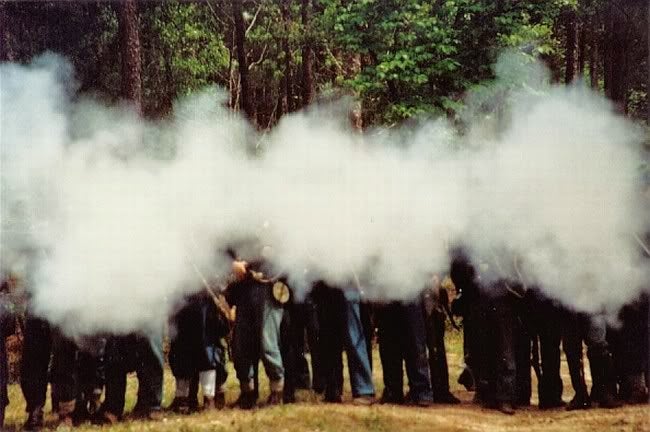
So the Prussian method was economically wasteful, but that's not the whole issue: Sulfur is the part of blackpowder that makes blackpowder famous for producing much smoke.The smoke became an issue, as troops and leaders could not see their enemies well any more, as the smoke of muskets and cannons accumulated on the battlefield.
The Prussian infantry of the 1780's did not only shoot three times faster than the Austro-Hungarian infantry of 1740, it did also produce more smoke with every shot. This was done by an army that kept the three-rank line (as opposed to the British who used a two-rank line), another +50% smoke.
The Prussians had muskets that looked neat, but their buttstock was not angled well and made the use of sights very awkward. That didn't matter much, as the muskets didn't really have sights. Well, adding sights would not have helped past the first salvo anyway.
I suspect that the Prussian focus on infantry rate of fire was too singleminded and suboptimal. Skirmishing, morale (motivation) and coping with logistics austerity was much more important than nominal rate of fire in 1792...1815. Later, the ingeniously simple invention of the Minié ball allowed quick muzzle loading of riflesand for the first time the accuracy of fire of general infantry became most important.
... would be an army that gets the basics right at every level, even if it has no luxuries, no bells & whistles, not a single piece of equipment newer than 20 years old design.
Like a perfect storm
Such an army would overrun more sluggish lethality-obsessed armies, it could outlast much larger Potemkin village armies, it would benefit from every season, it would be only mildly impeded by air power and it would generally have very lopsided (in its favour) "exchange ratios" in battle.
It would also be only mildly attractive to defence contractors, as they would not get many outsourcing contracts, and could not make much profit off gold plating development contracts. They would get a steady stream of revenue from good-sized munitions & spares orders, though.
Systemic deviations from the optimum
I understand that the leadership of most developed world armies wants to get the basics right, they probably even think they do.
I strongly suppose they don't, based on the observation of symptoms. I strongly suppose there are systemic issues in group and organisation behaviour that lead to suboptimal outcomes. To get the basics right on all or nearly all levels requires to betray tactical and organisational traditions. It requires constant effort. It requires that you free up time from everyday activities to learn about what others do differently, why, and with what results. It requires to forego self-interest and peer - group self-interest in favour of the pursuit of getting at least the basics right.
Identify and fix
The concept may be abhorrent to many military fanbois, but the way to go is to bring in external economists (which the German military actually educates in its own university!), psychologists (same), historians and sociologists (including anthropologists!) to work out the patterns that drive the army bureaucracy away from optimum paths towards self-serving paths. Some additional research is needed to identify (and likewise call out) civilian influences that cause such harm as well.
We can aim to counter the bad patterns and influences once we understand them, and everyone who gets into high leadership positions needs to be briefed on these findings thoroughly. In fact, I would have them educated to the point that they need to show they understood everything in tests, and have to work more on test questions where they failed to score. I'd rather have an interim leader and the designated leader stuck in a training course for months than to let anyone new into a high level position who does not understand the issues well.
The insiders can't fix themselves
It is utterly self-evident that the German professional officer corps is a failure. It's not their fault, really. Some wrong people got selected into it and the rest is also working within a rotten system, unable to decisively reform it from inside. They sure have a very high opinion of themselves, but their results are damning and their excuses (especially blaming politicians) are weak sauce considering how much goes wrong that a handful of politicians cannot possibly have been responsible for.
Example: The antiquated small arms training that got reformed only a couple years ago after generations of stagnation. No army officer can reasonably argue that ministers of defence forced the army to bring firearms training that's limited to 1920's style shooting ranges into the 21st century. Another example; the utterly unrealistic layout of exercise areas, which can easily be identified on satellite imagery because they stand out from the real world so much. Even the best built up training area could not be mistaken for any real world settlement. The army preferred to ask for gold-plated vehicles rather than to insist on realistic training (areas).
It's furthermore completely impossible that the German military wasted millions on Global Hawk drones that could never be used, but somehow it would be the civilian politicians' fault that we don't have a gazillion of dirt-cheap consumer-grade multicopters like the ones employed with success in Ukraine. They get money for a lot of crap, certainly they could have gotten funds for such drones if only they had prioritised it. It would even have been less than the famous 25 million threshold*, so political interference opportunities would have been minimised.**
Civilian overseers have to force a course change
The insiders cannot fix themselves, thus we need outsiders to do it. outsiders with the power to force and remove insiders, to break all resistance. The civilian leadership by politicians such as the minister of defence has this job.
This job hasn't been done for decades, though. Not a single German minister of defence did a decent job in the post-Cold War era. Rühe had to lead in a very demanding period (integration of East German military including retaining some officers, post Cold War downsizing) and certainly some things were done well back then, but he also launched a terrible, terrible refocus towards stupid "out of area" missions that brought practically zero benefit to the nation over the next three decades.
We need a competent minister of defence with a team of competent, trusted reformer managers and a competent civilian chief of staff. This minister and his team shall not become one with the armed bureaucracy, shall not adopt its self-interest as their self-interest. They shall be rewarded for exposing scandals and shaming failures, for firing and disbanding. The press usually instinctively does the opposite; it blames ministers of defence for what goes wrong in the armed forces. That's an incentive to cover up and keep things silent, rather than an incentive to clean the house of crap. The minister of defence should publish scandals themselves and the press should shame the predecessors for scandals instead (unless the minister has been in officer for more than the last three years already).
In the end, we need very few legislative changes. Most importantly, the entire approach towards the office of the minister of defence needs to change. No more no-clue non-specialised politicians shall be sent there to bury their career, to give them some office after they failed with some more grand ambitions or for mere party coalition offices distribution maths. We need reformers with a passion for breaking resistance and clearing out crap. Brutal personalities who don't bend arms to get what they want, but cut throats right away - so the peers understand the new direction of flow right away. We shall ignite a passion for clearing out bollocks among the officers and ignite the hope that the rotten institution becomes a deservedly proud one again.
Those generals? They're worthless pawns. They cannot repair the armed forces. The professional officers are the insider club whose autopilot is stuck on the wrong course. The minister of defence needs to be the power that drives reform. He/she/it (I REALLY don't care) has to change the course, and everyone who resists shall be eliminated from the armed bureaucracy, regardless of rank and the treatment should be as mean and disrespectful as possible within the limits of article 1 to discourage resistance by others.***
No need to shine
There's no need for anything spectacular, shiny, "sexy", super-impressive in an army or air force. We need no GUMLRS-ER missiles, for example. We need no dedicated national military radar satellite. We need no high end main battle tank. We need no F-35.
We need to get the basics right. We need stuff that works, in good quantity, with enough consumables, we need to be able to get it where we need it and when we need it, our troops need to know how to use it well, they need to be fit, alert, ready, deployable, motivated, confident, take care of each other, follow orders without delay according to the superior's intent. Command has to be modest, self-restrained, agile, clear, quick and imaginative. We don't need a hugely impressive military machine, but its gears need to be well-lubricated and sand-free.
And anyone who dares to stand in the way of achieving this shall be eliminated from the armed forces, period.
*: Orders bigger than € 25 million require additional parliamentary involvement.
**: That being said, I'm convinced that lobbying and "my region before the country" politicians in the armed forces committee are responsible for much money wasted on defective helicopters, defective transport aircraft, combat aircraft for which there are almost no spares or munitions and certain useless warships. These are no excuses for all the other things that went wrong, though.
*: German constitution, article 1 is a very general article that protects human dignity.
. Putin's regime is still playing the American far right like a fiddle.
They have buttons on their table, and they know exactly what happens when they press the button "American right wing shall hate other Americans and their president some more".
So POTUS wanted the two Americans who are being held with dubious criminal convictions in Russia, and his diplomats negotiated. The Russian regime did the obvious thing; it maximised how much damage it can do, for the U.S. has nobody in custody whom they really want freed.
They gave POTUS a young, black, female and Cannabis-using and lesbian citizen back and categorically rejected the notion of releasing the other guy, a former Marine.
Naturally, the far right sprang into action and began hating, as if POTUS had betrayed the good guy to get some woke (the word they use on everything they hate these days, but cannot defined properly) person back instead.
There was hate on the freed captive, hate on the president, ... utterly predictable.
But why was there such hate? Wouldn't a patriotic party be glad that a fellow citizen was freed? Wouldn't it be glad that the president had a success?
What does it take to hate and be outraged instead? Maybe it takes hating about half of the own country, and putting party partisanship before country?
The remarkable thing about this exchange is that it happened despite the reactions being so completely predictable. POTUS obviously decided that freeing a fellow citizen would be worth the backlash to freeing a fellow citizen. He's put country before party politics. This was clearly no issue suitable to mobilise followers for the next elections (which are now very distant), so this degree of selflessness is plausible.
By the way, that "marine"? Discharged for bad conduct. A thief. The reflexive militarism that was exposed by the reactions was interesting. "marine" = "good guy" was implied, because militarism. He's neither. The marines don't think he's one of them, they didn't want him to be one of them. A thief.
He's still a citizen who should be repatriated, but that was not on the table. And the reason for that is probably the far right wing. Their predictable response to him not getting freed is what made it so unattractive to the Kremlin to let him go.
BTW, the lying moron had two years time to get Whelan for Bout only if that was ever a possible deal. He didn't. Well, coherent thoughts are not a requirement to become a hyperpartisan hater who hates half of the own people.
The Russian regime needs to play slightly different tunes to control the German far right (or the German far left), but it knows how to do that as well. These days show who's truly the vaterlandslose Gesellen.
It's important and valuable to expose who gets played how easily and clearly. Keep in mind who's a puppet of the Kremlin, dancing by the Kremlin's tune, when you get to vote again!
BTW, if you think Bud is going to be a big arms dealer again, maybe importing weapons fro Putin: Bollocks. His business model was to bribe high-ranking officers to sell him what's in Russia's arms warehouses and he had a fleet of old cargo aircraft to deliver those weapons. If anything, Putin is angry at him because this guy is a big part of the reason why the Russian army lacks equipment for mobilization and a small part of the reason why it's so corrupt and lying so much.
There's a saying - Artillery conquers, infantry occupies. The American Maneuver Warfare military reformers of the 80's and 90's used this to describe the French First World War approach, which the American army adopted as it became the French army's apprentice as late-comer to WWI.
The effect of this on American thinking about artillery and air/ground attack is indeed profound. Lethality here, lethality there. It's all about lethality.
The Russians seem to follow it as well.
Those who follow this philosophy have good arguments; there were battles if not entire wars in which indirect fires accounted for about 80% of casualties. The current Russo-Ukrainian War appears to follow this pattern as well.
Artillery could be thought of as an enabler to battlefield manoeuvres of land forces.
Let's say there's a patch of 100x200 m woodland from which an infantry force of 30...150 personnel (not exactly known) can fire on vehicles in 2 km radius with missiles and call artillery fires onto infantry in the same radius.
The "Artillery conquers, infantry occupies" school of thought would destroy this force by bombarding the entire patch of woodland, thoroughly. They might want to have a bird's view on it, so troops who evaded to open fields could be shot at as well. The defenders may have dug in properly, so a very high density of 155 mm shells of multiple very big bombs such as Mk 84 (914 kg GP bomb) or special thermobaric/fuel air explosive munitions would be needed. The amount of fires would be calculated to destroy the force. Then infantry in IFVs or APCs would drive to the patch of tree stems, dismount, count the bodies and take a few prisoners.
The Maneuverist school of thought would do this very differently. It would execute a very brief but intense bombardment by artillery and/or mortar HE munitions and would rush in with the infantry mere seconds after these "neutralising" fires were lifted. They would assume that the brief but intense bombardment has "neutralised" the defenders. That's a state of shock that goes away within minutes. At most a handful of defenders would open fire on the advancing troops, and they would easily be overwhelmed by direct fires. Almost all defenders would be taken prisoners.
So let's sum up.
Advantages of Maneuvrist approach:
less munitions expended
less firepower needed
less planning required
quicker
less killing
smaller calibre artillery and mortars suffice, may even be better
enables rapid advance through deep defences without extreme amount of fire support
Advantages of the "Artillery conquers, infantry occupies" approach:
Your officers don't need to be smart about land warfare.
I mentioned the 80% casualties by indirect fires statistic. This is true and valid, but you can achieve a much better statistic if you have a large competence advantage. Operation Barbarossa caused about 4.5 million personnel losses to the Soviet Union in 1941. Half of these were prisoners of war. The Axis forces could not have defeated that much personnel and could not have advanced that quickly if they had relied on "Artillery conquers, infantry occupies". They did use up the ingredients of this success (competent infantrymen were worn out, logistics vehicles were worn out, strong horses were lost, motorcycles were worn out) in the later years, but the events of 1940 and 1941 show that if you have a big competence advantage and the means to exploit it, you can do much better than the firepower fetishists.
The philosophical difference is between surprise & shock or lethality of fires. It's obvious how laymen and undereducated army officers gravitate towards the latter. It requires much less understanding of what happens and what works in battles. Most superficial knowledge suffices to understand the 'lethality über alles!' approach.
The lethality approach is nevertheless the approach to go with if you lack competence in your officer corps or if you cannot or don't want to advance. If all you can really do is shoot, you shoot - regardless of whether something else would be better if you just could do that as well.
Firepower's lethality fascinates laymen just as much as the Americans (I'm not sure about today's Frenchmen). The focus on lethality should be a fallback position for when you can't do better.
BTW,
the loss of DPICM bomblet munition to the cluster munitions ban doesn't
seem to be all that bad when you expect enemies to use overhead cover
or if you just want neutralising fires (which works fine with "unitary"
HE munitions). Yet the theoretical lethality advantage of DPICM made it
the dominant munition in the U.S. Army of the late Cold War (something
like 70% of 155 mm rounds were DPICM if my memory of a secondary source
serves well).