2023/04/08

Military ranks in an army

.

The rank system appears to be a mess in all armies. 
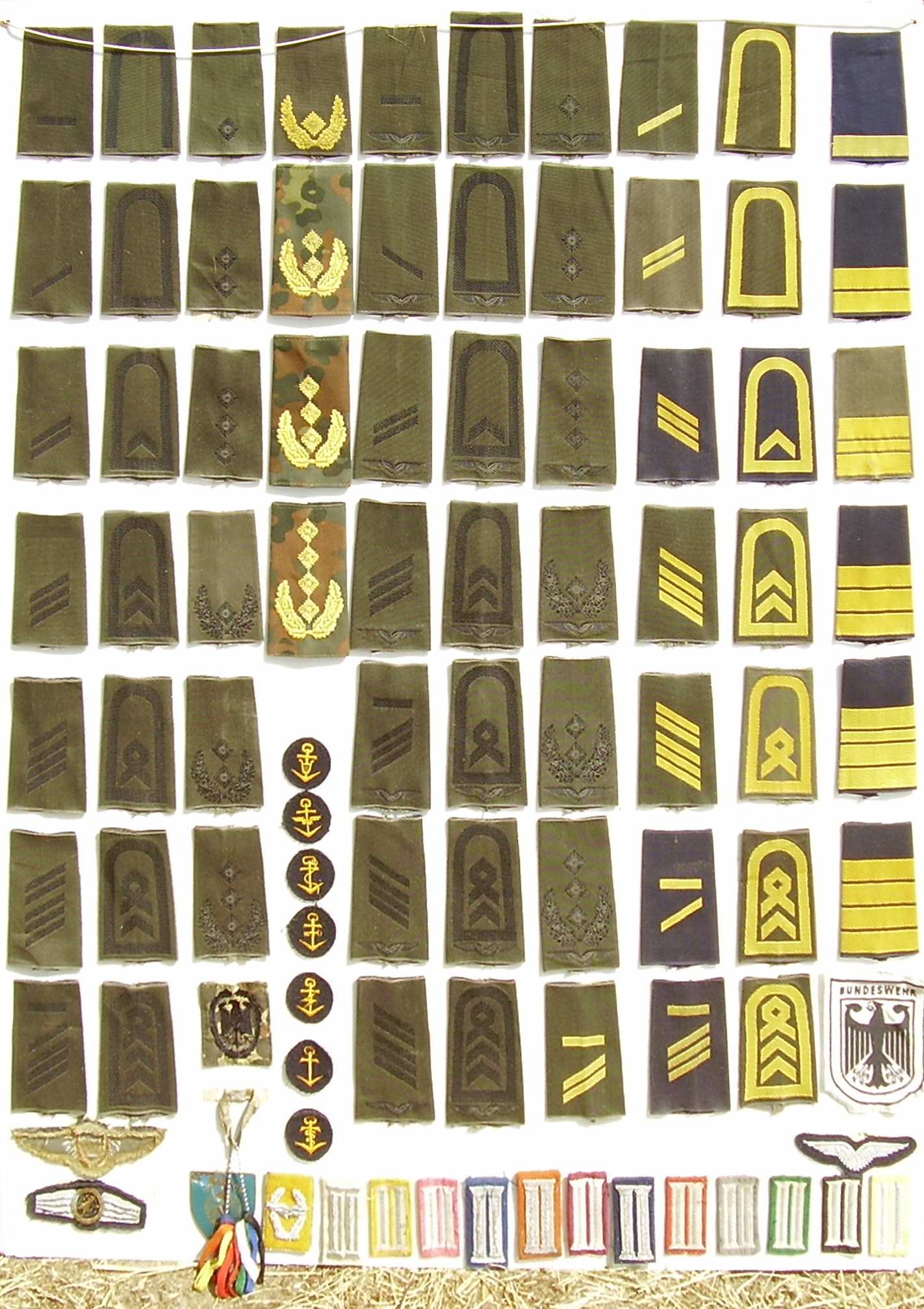
The Bundeswehr has 11 officer ranks, 10 non-commissioned officer ranks, 8 enlisted personnel ranks  + 9 medical officer ranks (which have a total of 17 designations because some ranks have variations for human medicine, apothecary and veterinary). I think we really could make do with much less total, maybe ten ranks.

Huge corporations thrive (despite their inefficiencies) with hundreds of thousands of employees without a rank system and usually also without a uniform (especially without a uniform that encompasses manual labourers AND staffs with one uniform).

Armies have decent arguments for having ranks, though. The most solid argument is for a division between

  1. enlisted personnel
  2. non-commissioned officers (leaders who live with the enlisted personnel)
  3. officers (higher level leaders who separate themselves from the enlisted personnel for some psychological reasons

We can further divide between junior and senior non-commissioned officers. The latter of which would not live with the troops in the barracks (peacetime), but justify themselves by being very experienced and thus indispensable for good training of enlisted personnel and junior NCOs. They may also be very helpful authority figures.*

  1. enlisted personnel
  2. junior NCOs
  3. senior NCOs
  4. officers

We can further divide the officers between small unit and unit leaders (up to captain rank) on the one hand and formation commanders (major and up) on the other. The latter require more experience and need to have proved themselves in unit leadership. Battalion (battlegroup) command is the lowest combined arms leadership position, and combined arms expertise requires learning much about at least two arms, which junior NCOs don't need to have done.

  1. enlisted personnel
  2. junior NCOs
  3. senior NCOs
  4. junior officers
  5. senior officers

Now we could take into account that the majority of officers are actually NOT in leadership positions. They're in staff positions. It seems like a strong argument to separate officer ranks by this criterion, but somehow even armies with clearly separate career paths for leadership officers and staff officers usually don't do it for all I know. The maximum example that I'm aware of is the "i.G." suffix used by German armies (i.G. = "im Generalstabsdienst", 'in general staff service').

  1. enlisted personnel
  2. junior NCOs
  3. senior NCOs
  4. junior officers
  5. staff officers
  6. senior officers

The authority to give orders independent of the chain of command would be like

enlisted personnel < junior NCOs and senior NCOs < junior officers < senior officers 

and

enlisted personnel < junior NCOs and senior NCOs < staff officers

in addition to the position-specific chain of command. (The complicated conditions of command authority don't matter here.)

A participation in NATO headquarters requires that armies send officers with certain NATO-compatible ranks. It's debatable whether NATO HQs are any good and whether North Atlantic Treaty members should withdraw their forces from NATO subordination as France did long ago. Anyway, I strongly suppose that temporary ranks could be assigned to satisfy NATO's idea of ranks if need be.

So I'm at six distinct groups of army combatant personnel. I suppose that we COULD make do with this. A certain unit could have four slots for junior officers, four slots for senior NCOs, dozens of slots for junior NCOs and more than a hundred slots for enlisted personnel. Who gets to work which position exactly after falling into one of these categories would be decided by qualification, JUST AS WE ARE ALREADY SUPPOSED TO DO NOW.

So why do we have such a rank system mess instead?

The simple answers are in my opinion

  • 10%: A lack of self-discipline makes everything messy over time.
  • 90%: Promotions have been misused to give men better pay when a pay rise for the original rank or performance-specific pay bonuses or qualification-specific pay bonuses were more appropriate, but not the policy.

I wouldn't mind adding one rank for unqualified enlisted personnel (recruits until basic or branch training is completed) or another one for medical doctors. 

Here's a list that doesn't seem too radical (that is, I think it could really be done) to me any more:

  1. recruit
  2. soldier
  3. corporal (junior NCO)
  4. sergeant (as senior NCO)
  5. lieutenant (small unit leadership, battalion staffs)
  6. captain (unit leadership, brigade staffs)
  7. major (battalion command, divisional/corps staffs)
  8. colonel (brigade command, national and theatre HQ staffs)
  9. general (divisional and higher commands, army branch leadership)
  10. (doctor)


Would any battles be won through such a rank reform? Would any wars be averted? Would much money be saved? No.

The primary point of reforming the rank system would be to send a strong (symbolic) signal that the undisciplined cancerous mutations and general bollocks of the past are getting wiped away. It would only be worth the effort if that signal is true.

A secondary (and very small) point would be that the importance of qualification for a certain high level job would be highlighted. A current bright 1-star general would not be held back by his rank from getting a post that's meant for a 3-star general.


related:

/2012/05/rank-inflation-in-bundeswehr.html


S O

defence_and_freedom@gmx.de


*: I know that accommodations are more random in reality. Almost anyone in the Bundeswehr can live off-base, so I'm referring a bit to the old school barracks and life in the field here.

.

2023/04/04

Finland joins NATO

.

Finland joins NATO. It's unfashionable to think so, but alliances used to be a concept in foreign policy to further the own nation's best interests. The notion that a country somehow has to serve an alliance rather than the other way around is a perverse distortion.

What's in it for Germany? Well, the accession of Finland adds almost no additional risk of a hot war (considering its longtime neutral and moderate foreign policy) and Finland adds a lot of land power (especially hundred of thousands of reservists in an army that always took actual defence seriously) to the alliance.

This added military power doesn't improve the odds that Russia would lose a war with NATO and given the demonstration of Russian military shortcomings in Ukraine*, it is beyond reasonable doubt that Finland does not improve the (already 100%) deterrence of Russian aggressions against NATO itself.

The logical conclusion is thus that Finland's accession to the North Atlantic Treaty adds military power on top of already sufficient (for deterence & defence) military power within NATO. 

This means that a continuation of the current military spending levels is necessarily and beyond reasonable doubt wasteful (even assuming there was no inefficiency in it at all). 

The accession of Finland thus means that we (the old NATO members) should revise military spending planning DOWN from the planned levels (at least down from the levels planned before Finland joining might possibly have been 'priced in').

The real benefit to Germany (and most other old NATO members) is thus that we can save military spending, as the alliance has gained military power by adding Finland rather than by adding military spending.

Military spending is not virtuous, it's not productive, it's not an efficient way of promoting science or technology. Military spending is government consumption like spending on armoured sedans for ministers. Its justification is not emotions, it's the achievement of a sufficient deterence (and as backup defence) to protect our freedom, prosperity and lives. It's comparable to buying a good lock for the door of a family home; there's no point in spending ever more money on it if it already does its job well. Likewise, you cannot further the prosperity of the family by spending more on the door lock; it's an entirely unsuitable tool for that purpose.


The insight that the accession of Finland should trigger military spending reductions is as alien to the general debate on military spending as is the insight that Russia proving to be a conventional military Potemkin' village  an empire without clothes, means that we need to spend less on detering it or defending against it than was previously reasonable to believe.

The dominant notion is that somehow we need to spend more on armed forces, and hardly anyone asks about what kind of reasoning supposedly supports that notion. The vested special interests of career officers, arms industry and legislators from arms industry-rich districts combine to support the illogical notion that causes more economic harm to a country than the vast majority of criminals combined.


The most disappointing part is not that we cannot defeat these special interest groups in pursuit of the nation's general interests. The truly disappointing part is that there's hardly anyone even only challenging to that fight.


S O

defence_and_freedom@gmx.de

*: Russia revealed that its armed forces combine all weaknesses and faults ever known from Russian armed forces of the post-Suvorov era at this time (other than the mutiny & revolution of 1917).

.

2023/04/01

China's naval geography problem and the USN

.

Germany was at a near-hopeless geographic disadvantage in regard to maritime warfare in the First Wold War, and it wasn't much better during the Second World War because peacetime rearmament could not anticipate control over the ports of Western France.

“British Islands: Approximate Positions of Minefields. 19th August 1918.” Hydrographic Department of the Admiralty, under superintendence of Rear-Admiral J.F. Parry, C.B. Hydrographer, August 6th, 1917. William Rea Furlong map collection, Geography and Map Division, Library of Congress.

The British were able to sail into the Atlantic Ocean directly, while Germany had to sail around the British Isles first. This was vastly more relevant than the question whether the nation is made of islands or continental.

- - - - -

The situation is similarly bad for the PR China, even disregarding the talk of "island chains".

The Western potential opponents of the PR China enjoy the huge advantage that they can find and engage Chinese surface warships and find, inspect and board Chinese cargo ships from bases all over the Pacific, Indian and North Atlantic Ocean as well as the Mediterranean. 

China has almost no overseas bases to speak of during wartime. They have commercial shares of ports and some overseas naval basing arrangements, but IMO only Pakistan's ports would be useful to the PLAN in wartime. Pakistan is a close ally of the PRC due to its existential fears about India and it's a nuclear power. A Chinese warship in a port in neutral Myanmar would be bombed to scrap, but it would likely be blockaded only if in a port in Pakistan.

Land-based air power has ridiculous radii of action with midair refuelling and there's also the American carrier fleet, so PLAN surface vessels could be found, identified and engaged everywhere.

The existence of expensive dedicated air defence destroyers should not deceive anyone into thinking that these ships are anything close to a match for air power. They're based on USN 1943-1945 & USN Cold War approach of having some shipborne anti-air firepower to deal with what penetrated the fighter cover that a battlefleet needs. A hypothetical quality air defence destroyer with 100 quality air defence missiles would almost certainly be overwhelmed by a saturation attack by 100 quality anti-ship missiles, which cost only as much as its air defence missiles. The entire extra cost of the ship (a billion dollars or so) is the financial disadvantage of defence. 

Land-based air power can wipe out surface warships fairly easily if it was prepared for the job (especially with suitable munitions in sufficient quantities, but also with midair refuelling capacity and expeditionary airbases capacity).

This means the PRC has no better perspective at securing its overseas trade or part of it (such as a minimum influx of crude oil) than Germany had in the World Wars. 

The PRC could use the underdog's tool of submarines (the naval asset that can still be employed where hostile airpower is an undiminished threat), but that would merely hurt its enemies a bit, not solve any actual problem of China. Any commerce raiders such as auxiliary cruisers and any offensive minelayers (surface vessels) could only cause an indecisive strawfire comparable to the actions of German cruisers in 1914.


In other words; it's in my opinion ignorant to believe that the USN requires a surface fleet or carrier fleet parity. The PLAN surface fleet can be countered much more reliably, cheaper and with more versatility by land-based air power.

The rapid repair of damages by air attack in WW2 and in modern Ukraine indicates that a carrier- and cruise missile-based land attack strategy is similarly nonsense for the USN.

The USN needs instead most what it despises institutionally and ignored almost entirely post-Cold War: The ability to actually protect maritime trade (especially against submarines, including missile attacks by the same). There's the pretence that it does this, but it doesn't except for very narrow scenarios such as in the Persian Gulf or (marginal effort) against Somali pirates. Mine countermeasures are a notoriously neglected are in the USN as well.

Today's USN is an attack navy, capable of bombing distant countries and invading undefended beaches. It's ship-centric and naval aviation-centric. This is self-reinforcing, as it draws its admirals especially from these backgrounds.

The USN doesn't need a single amphibious warfare ship and not a single additional aircraft carrier. It doesn't need more ship hulls and could very well make do with less ship hulls. What it needs the most is a feasible approach to protect maritime trade against submarines. There are two options for this

  1. aggressive defence: Destroy PLAN submarines in or close to their bases. This requires naval action in proximity to where the PRC's military is the strongest; at and near its bases.
  2. (coastal sea lane protection and oceanic) convoying: Defence against submarine-launched missiles, putting PLAN submarines at great risk when they dare to come within torpedo range.

The latter was mostly about anti-submarine escorts (nowadays we'd say ASW frigates) and escort carriers (nowadays we'd say ASW helicopter carrier) during 1943-1945 and during the Cold War. This approach is not feasible, as shipbuilding in NATO is ridiculously tiny compared to Chinese shipbuilding. Japanese shipbuilding capacity could help out but let's face it; the DoD is not going to pay USD 50+ bn per year on Japanese shipyards for a naval arms race. The same is true regarding South Korea's shipbuilding industry, and it would endanger South Korea too much if it was the cornerstone of a U.:S naval arms race.

Maybe the USN could buy relatively cheap steel hulls (with American gas turbines) in Japan and outfit them with the pricey electronics and missiles in the U.S., but doing this in the required quantities may go well beyond U.S. shipbuilding capacity in the next 10 peacetime years as well. The Allies built hundreds of oceanic escorts during WW2, to secure American trade with Europe, Japan, Australia and through the Panama Canal alone would require hundreds of frigates and dozens of escort carriers as well. Moreover, they better be fast enough to keep the pace of civilian cargo ships, which cruise at 23 kts and more over oceanic distances. This means the frigates would end up being 10,000 tons ships due to the required diesel fuel bunkers.

I say the solution is much more simple, radical and utterly against everything that's holy to USN admirals: The USN should stop building surface warships and instead stockpile containers. It needs the ability to turn hundreds of cargo ships into auxiliary warships (especially for the operation of AEW and ASW VTOL aircraft and for launching AAW and ASW missiles). There should be more than a thousand container sets that provide basic self-protection (threat warning, CIWS, decoys, multispectral smoke) to cargo ships. There should be legislation drafted for buying cargo ships for the USN and U.S. merchant marine in wartime. There should be a contingency plan for the first half year of conflict until the maritime trade protection scheme can be realised. National stockpiles of critical materials are necessary, especially with the commercial just-in-time practices in mind (the economy had about six months worth of raw materials stocks when WW2 started!).

Land-based coastal lane protection schemes can help securing trade along CONUS' coastlines.


more related blog posts:

/2017/02/cooperative-engagement-capability-and.html

/2009/08/cost-of-carrier-aviation.html

/2017/02/a-hypothetical-naval-treaty.html

/2018/04/a-deconstruction-of-micc-propaganda.html

my huge series (worth 80 book pages) on oceanic convoy protection:

/2018/01/modern-warships-i-introduction.html


S O

defence_and_freedom@gmx.de

.

2023/03/31

The U.S.Air Force story of hypersonic missile failure

.

Saddam Hussein's survived the 1991 Gulf War, and so did his regime. The Americans weren't satisfied with accomplishing the UN-authorised mission of liberating Kuwait. They wanted the whole Saddam regime gone despite it being hostile to the favourite bogeyman Iran and despite them being just fine with Saddam gassing his own people and shooting Scuds into Iranian cities just a few years earlier.

The USAF thought that it could do its part easily in the future if only it had some super fast precision missile that it could use to kill another country's politician based on intelligence. The whole process from intelligence gathering to giving the order to shoot would last hours, so at least the missile would have to be super quick to assassinate before the perosn is somewhere else.

This led to the 1997 FastHawk program. Nothing came of it, but the USAF stayed fixated on the idea, and the incredible 100% every time failure with 'decapitating' strikes attempts at Hussein's life in 2003 did not change this.

The 'hypersonic' missile saga went on and on, much money was spent, additional rationales (hypersonic missiles manoeuvre more and are supposedly harder to intercept than normal cruise missiles or (quasi)ballistic missiles) and very recently the USAF had to cancel its ARRW program.

Don't worry, they're continuing another program (HACM), so they're going to spend more money.

Meanwhile, the army is buying a quasi-ballistic missile (LRPF) and both air force and navy keep using subsonic cruise missiles, all of which are supposedly effective enough to justify thier spending. I wonder what hypersonic missiles are needed for if the other missiles work as advertised? The 'decapitation' strategy never really worked due to poor intelligence and slow process, after all. A quicker missile won't fix that.

related:

/2014/08/will-marine-corps-apc-racket-ever-end.html

/2021/11/hypersonic-missiles-of-long-range.html

S O

defence_and_freedom@gmx.de

.

2023/03/27

AC and IQ

.

There used to be a time when businesses were in awe of the organisational and management skills of certain leading armies. Armies had hundreds of thousands of personnel and were thus avantgarde in terms of personnel affairs at a time when megacorporations were very uncommon. These times ar eover, except in the U.S. where general militarism still gives the word "military" a good sound and reputation, deserved or not. This silliness goes even so far as Sun Tzu adaptions for business strategy.

Some of the army innovations for personnel affairs were about tabulations and primitive computing. One innovation originating from Germany was the assessment centre.

The 18th century method of recruiting new officers in much of Europe was about checking if the man is a nobleman (necessary at least for cavalry and infantry) and then having a meal with him to check whether he was 'cultured'. 'Cultured' people believed that they were destined to lead until the 1960's in some countries (*cough* UK *cough*).

This aristocrats-only approach changed into a more general elites-only approach during the 19th century, but without a satisfactory process. Having the school degree required for university access became a basic requirement in some countries, for exmaple. The German army invented such a process for evaluating candidates, and today's shapes of the process are called "assessment centre" (AC). It's mostly an attempt to simulate the job and observe how a candidate fares.

The results are mixed, to say the least. I'm not easily impressed by people, so I won't use that as a criterion, but by my observation about half of the officers shouldn't be officers of any rank. Half of those (overall quarter) shouldn't even be non-commissioned officers.

The AC should have weeded those out.

Studies about assessment centres in the business world are controversial. Some studies conclude that the AC fails to predict job success, others conclude it's a fine (albeit expensive) tool.

So it appears that armies weren't all that competent after all even back in the times when people thought of armed bureaucracies as innovative.

There's a non-controversial alternative, though: You could simply conduct a proper intelligence test, demand an OK primary education graduation, check for a clean criminal offence convictions slate and  conduct a health check. These things are done anyway. They may be sufficient.

I suppose we could do with these simple tests, a trial period and a hefty emphasis on the IQ test result.

  • IQ 120+ officer
  • IQ 110+ NCO
  • IQ 100+ enlisted personnel in demanding jobs
  • IQ 90+ enlisted personnel for a few most simple jobs

(I should mention that I want to see a much smaller share of NCOs and especially officers in overall personnel numbers than we've got in the Bundeswehr.)

We should furthermore keep the workaholic officers and NCOs away from leadership jobs and limit them to staff jobs.

High intelligence is a requirement for many things. I've very often observed that people are simply incapable of reasoning about something complicated. Part of that was bad faith, part was stubbornness and part was an obvious shortfall of intelligence.

You cannot solve demanding problems if your team cannot understand the problem or cannot understand a proposal for its solution, much less devising such a proposal. Too stupid people can even hold back (and easily outnumber!) the smart ones in a team.

This reminds me of a general ossification trend in Western countries, or in particular procurement processes. We have many small injustices and private financial issues, and welfare states try to address all these in detail rather than with a wide brush. This leads to much complicated regulation, complicated forms (income tax!), much process with substantial administrative effort and in the end there's still injustices and private financial issues. Likewise, we try to avoid corruption and nepotism in procurement by writing ever more rules and implementing checks - all this to the point of having a procurement system that's much slower and likely also more wasteful than free hand procuring by the minister in a functioning democratic country would be.

Whatever the candidate selection process is in large corporations or in armies; it doesn't appear to do a good job. Maybe we should slim it down to essentials.

That would put a premium on judging performance on the job, which is incompatible with the near-automatic promotions up to LtCol rank in certain armies, of course.


S O

defence_and_freedom@gmx.de

.

2023/03/25

Headquarter organisation

.

This blog post will make some observations and proposals about military staff work. There's (AFAIK) but a pitiful choice of published books on the subject. So far only two of them have impressed me favourably:

The very new book "Something Rotten: Land Command in the 21st Century" by Jim Storr (2022) (mostly about staffs on brigade to theatre level) and the by now ancient Austrian (thus German language) book Truppendienst Band 28: "Stabsdienst im kleinen Verband" (1979), which is centred on battalion HQs. Both are focused on combat command.

Decisionmaking doesn't get better by involving many people, and preparation for decisionmaking doesn't get better by exceeding a few people. Experiences in from software development to military staffs show that the time spent on communication grows to excessive amounts when you go beyond 40 members in an organisational cell, but really agile command requires much smaller elements.

So my simple idea is that a headquarter from brigade to theatre level should consist of three components:

(1) Administrative component led by a manager with enough authority to make decisions in absence of the commanding officer. This administrative component would be in a 'rear' location, left behind in a safe and calm place even when the combat formations are manoeuvring rapidly. Historical divisional staffs simply allowed the 'management' tasks to pile up during periods of much activity and focused on combat operations instead. The piled-up management tasks were then done in calmer times. This seems suboptimal to me. We should have a truly proficient head manager in this component who gets to work with officers and seniors NCOs who aren't exactly overachievers.

(2) Operations staff component, led by the Chief of Staff. This would include S2 (intelligence), S3 (operations), S4 (logistics), S6 (signals) officers and S9 (Civ-Mil cooperation, preferably an attached allied officer). All these positions would have a 2nd officer who's newer to the job. A naval-like watch system of each four watches per day (each 6 hrs) would be enforced to its practical limits in wartime.* This leads to four transition briefings time windows per day, with the Chief of Staff or 2nd Chief of Staff attending the S2, S3, S4 and S6 transition briefings in sequence, all in less than one hour. Further staff personnel would be senior NCOs and maybe attached allied officers.

This sounds like much, but in the end the preparation for the commanding officer's decision would rest on only five officers. The Commanding officer (CO) would give a brief order, which the staff officers understand by their training (20...40 command post exercises as a team per year) and the orders would be limited in quantity per day and in their size per standing order. All violations would lead to disciplinary measures for military disobedience (for every officer involved).

I did not propose a S5 (plans) officer. Planning is a small part of the job of the S2, S3, S4, S6 and S9, and any plan overarching the specialisations should be very concise and not require a dedicated officer.

(3) The CO crew. This would be a military policeman/driver, a signaller-qualified officer and an officer qualified for instantly taking over command of any subordinate unit. They would fit into a protected 4x4 car or a light liaison helicopter. The high mobility of the CO with his tiny CO crew would permit frequent leading from 'the front'. The CO would sometimes be briefed about new developments or about proposals prepared by the Operations Staff Component through basically one screen-sized graphic and up to one page worth of text, all digestible within five minutes.

The CO crew should be assembled very carefully, and at least one of them must not be selected by the CO himself, for this crew should have a counterweight officer who complements the CO to alleviate his weaknesses.

I did not propose a 2nd in command for the CO. The Chief of Staff would fill that role when communications contact with the CO is lost or the CO is incapacitated. The superior HQ would assign (and possibly send) a new CO if necessary.

This was about 'combined arms' combat command headquarters. A support headquarter could look different, and particularly replace the S? officer specialisations with specialisations that fit to the logistics headquarter's tasks. A supply HQ could have one officer for organising inflow (including Civ-Mil), one for outflow (including security concerns), one for the depots (esp. choosing sites and decision to move depots) and one for determining the needed quantities of supplies, for example.


This offers a path towards much more agile (smaller and better-trained) staffs for operations while at the same time offering improved administrative performance and a path for dumping mediocrity out of the command staffs without the mass deletion of officer slots that the armed bureaucracy resists with maximum determination.

S O

defence_and_freedom@gmx.de


*: I understand that the four watches system may attract criticism and may be found impractical. I suspect it would work worse in the first four days, but afterwards prove superior because it permits enforcing sleep discipline and thus helps to avoid exhaustion. There's usually a collapse of officer performance after four days of intense action due to loss of recovery (sleep), a frequent wartime problem that rarely  shows up in peacetime.

.

2023/03/18

Un-German behaviour

.
The Americans have that derogatory word "un-American" to describe that something done by certain Americans is (supposedly) very untypical and unworthy. The literal equivalent "undeutsch" is not nearly comparable, so I stay in English and call the behaviour that I'm going to call out "un-German".

There's political behaviour in the topic of German defence policy that's so strongly un-German that it deserves to be called out.

You may now think of the far right's and far left's eerie Putin and Russia fandom, but that's not what I'm going after this time. It's true that our far right appears to be even more "vaterlandslos" (un patriotic, literally 'without fahterland', a derogatory term usually used against socialists in Germany) than the far left, despite their opposite self-image, but that may be covered another time in its full ugliness.

The REALLY un-German behaviour violates something very central to the German way of life.

- - - - -

There's a comical view / caricature of Germans as people who are zealous about "wörk! wörk! wörk!", and this could not be farther from the truth. We are passionately lazy, well almost all of us. Very few of us are pitiful workaholics indeed. The ordinary German is very lazy. This laziness drove us to value efficiency very, very highly. We despise wasting time, we despise wasting work, we despise wasting materials. We despise that someone wastes our time by being late to meet us. Simply put, we despise the waste of resources. The wasteful and embarrassing large-scale infrastructure projects of "Stuttgart 21" and "BER" were incredibly shameful and un-German, and accordingly received much hate and ridicule.

Now have a look at people with (often even non-professional) interest in defence policy: The dominant opinion is that we need to spend more on the Bundeswehr. Supposedly, we underfunded it and need more, more, more. These people appear to seek an emotional satisfaction from feeling that the national armed forces are powerful, regardless of whether there's excess power and thus excess spending (waste of resources).

The current military spending of about € 50 billion per year is supposedly not enough, even though Ukraine seems undefeatable to Russia (the only significant threat to NATO in Europe) after never spending even only € 10 billion on an annual military budget and receiving material assistance much smaller than € 50 billion.

An ordinary German should inevitably come to the conclusion that we should spend LESS, not more, after having a close look at the issue. Hardly anyone does look closely, and those who do seem to be thoroughly un-German and irrational because of a pro-military emotional bias.

The vested interests of armed bureaucracy (especially the professional officer corps, which I simply like to blame for many ailments) and arms industry are pushing for more spending, and that's absolutely no-brainer ordinary and to be expected. More military spending isn't a waste of resources to them; they are obvious net beneficiaries of increased military spending.

The un-Germanness of others who comment on defence policy and of our politicians on the other hand is extremely repugnant. They deserve no better than the shamed managers of Stuttgart 21 and BER.

S O

defence_and_freedom@gmx.de

.

2023/03/11

Mea culpa a.k.a. Great news!

.

Some of my writing (or much) around 2010 was based on the assumption that frontlines would be indefensible in a European conventional war (at least involving NATO), or that such a large war would end before enough troops arrive in the theatre of war to enable a defensible frontline.

Here's a particularly late example.

I wrote about the functions of frontlines and how to replace those instead of having fragile mechanised battlegroups only. Mechanised forces need to rest much of the time, and they risk being overrun in bivouac if they rest without the protection of a defensible front-line. And by "defensible" I mean that it takes a concentration of forces and a proper breakthrough effort to penetrate it. This means that it would be too risky to infiltrate with armoured recce as raiders and similar, for they might fail to exfiltrate even if they somehow successfully infiltrate.

Well, the Ukraine War shows that the Ukraine - a country hat never before spent even only € 10 billion on defence in a single year - can hold a ~1000 km frontline against the Russian land and air forces' conventional might with foreign material assistance that does not seem to exceed its peacetime credit worthiness.

What went wrong?

The Russian land and air forces' conventional might is crap. Their only strengths were huge stocks of dumb munitions and at least nominally good quantities in relation to Ukraine's forces, especially in the air.

Right now it appears that I rather described what would happen in conventional war between Russia and China with their extremely long border (and in Mongolia) rather than describing what would happen in Europe. I admit, I did assume shorter acceptable defensive frontages per brigade or division than was widely accepted in NATO army doctrines anyway.

So I was wrong, and that's great news!

The feasibility of frontlines means that NATO could apply its hugely superior air power from the safety behind a rather reliable frontline. It also means that the Baltics - and especially Lithuania - would not almost inevitably be overrun, as not just I assumed.

The newfound confidence in the defensibility of frontlines also means that the force structures of NATO armies are very wrong, and again that's great news! We have an emphasis on mechanised forces in our armies, and some armies went for a medium weight route in an attempt to avoid the costs of 'heavy' brigades of the mechanised infantry or tank brigade style (both with many main battle tanks and tracked infantry fighting vehicles). We can instead spend much less on our armies by operating with 'motorised infantry' style brigades (or divisions). These would emphasise infantry numbers (and reserves) and artillery (with emphasis on long practical range), while armoured vehicles would be reduced to maybe one tank battalion per division (for counterattacks mostly) and relatively cheap armoured transports to insert/supply/evacuate infantry. We could even make much use of reservists, with half of such formations being reservists formations and the active ones being scheduled to get full infantry replacements after about 100 combat days.

So great findings overall!

The conclusion from the Russo-Ukrainian War is not just that the Russian land and air forces are as bad as barely imaginable before the war: It's also that they have been further degraded by attrition, their munition stocks are heavily reduced and their level of competence is so low that they permit vastly lower cost land warfare paradigms to be used.

The icing on the cake is that their weaknesses were old ones; they are displaying a perfect storm of all the weaknesses shown by Russian&Soviet armies and air forces in the past 200 years. There's thus very little reason to believe that they could "military reform" most of their debilitating weaknesses away in a decade or two. Those weaknesses are deeply ingrained ones.


The overall conclusion should be that we should reorganise for MUCH lower defence budgets and reorient our societies' resources to address other challenges, such as the decarbonisation.

It is a sad truth that primitive thinking rules over us. The widespread perception is that the threat is bigger rather than smaller, and that the expenditures of the past were inadequate to face it. That's total bollocks. Ukraine defends against Russia with less than Germany's defence budget. They didn't exceed a fourth of our defence budget in any year before 2022. We (NATO / EU) overspend on defence and should be focused on improving the efficiency of military spending rather than indulging in the absolute primitiveness of discussing or even passing increased military budgets.


S O

defence_and_freedom@gmx.de

.

2023/03/08

Attack waves (tactics)

.

The Russian (and before that Soviet) misuse of attack wave tactics in land warfare should not mislead my readers into thinking that attack waves are a bad idea in general.

The Russians do attack waves wrong.

Wrong way of using attack waves:

Superior orders an attack, that atatck fails, subordinate officer is urged to keep pressing and orders another wave that fails as well (as it has even less element of surprise), another wave, another wave ... German reports from the Eastern Front in 1941-1942 mentioned such very stupid behaviour. The success rate of the follow-up waves is near zero, but the subordinate officer can report that he did his duty by ordering repeated attacks.

Correct way of using attack waves:

The first wave assaults and occupies the first line of defence (preferably with element of surprise and a good combined arms effort), but is then somewhat exhausted, disorganised and probably weakened by suffering wounded and killed personnel. They might press on, but would soon exceed the culminating point of their attack and risk disaster when a counterattack strikes. So instead of pressing on, the first wave prepares to receive a counterattack.

The second wave was already part of the original breakthrough plan; it's meant to push through where the first wave succeeded and to use its good order and freshness to assault and overwhelm the second line of defensive positions.

Same with the third wave, if necessary. It might also be a wave meant for instant exploitation of a breakthrough through a two-line defensive system.

A fourth wave should be unnecessary, as the first wave's troops should be able to follow up on the third wave if needed (or become a reserve).


S O

defence_and_freedom@gmx.de

.

2023/03/04

That 'peace' manifesto

.

"“Dog whistle politics” is the practice of sending out coded political messages or subtle signals, which are designed to be understood only by a narrow target audience."

(Political dictionary)

"Plausible deniability is the ability to deny any involvement in illegal or unethical activities, because there is no clear evidence to prove involvement."

(Political dictionary) 

A couple German celebrities and failed politicians (former left/far left party leaders) have recently promoted a manifesto for peace in Ukraine. I do vehemently disagree with the proposal that compromises should be made with the aggressor Russia (presumably by Ukraine), but that's a matter of opinion. Some people value peace more than freedom, and I do sympathise with the "Lieber rot als tot" (Rather red than dead) attitude of the 80's peace movement, for example.

Another key demand of the manifesto is to stop the "escalation" of arms deliveries. It's rather confusing how supposed peace activists could oppose the remaining arms deliveries escalation stage of delivering combat aircraft that would be used to stop cruise missiles from hitting civilian buildings and installations, including playgrounds.

- - - - -

The manifesto was not received by the news media in a literal sense. In my impression they did largely report that it was against arms deliveries, if they reported contents at all.

That's why I brought up the two quotes first: The manifesto is in my opinion somewhat dirty rhetoric.

The authors wrote a manifesto that says very little, but implies very much. It's not meant to be read as it's written (dog whistle), and the difference between the wording and the message is supposed to provide plausible deniability against charges that it's favouring the aggressor Russia.

It's fair to say that the manifesto and the political demonstration of reportedly 13,000 people were meant to create political pressure against arms deliveries in general, not just against "escalations" of arms deliveries.

That sounds radical and pro-aggression today, but it was actually ordinary German law and practice until we delivered weapons to the Kurds for the fight against daesh a couple years ago. 


BTW, I don't think that the authors of the manifesto were bribed by Russia to do it. I think they're deluding themselves into thinking that what they want is feasible and smart.

S O

defence_and_freedom@gmx.de

.