2022/07/09

Threat country ranking for Germany (top 5) (2022)


Germany is very safe these days. My normal check list

  1. Will we get blockaded?
  2. Will we get bombed?
  3. Will we get invaded?

is almost completely unrealistic. Germany is almost certainly not even part of the most feverish Russian Empire restoration dreams of anyone with power in Russia.

To still participate in alliances is similar to why countries such as Portugal or Luxembourg participate:

  • solidify a sense of European-North American commonality
  • contribute to Western cooperation
  • collective security as a means to maintain buffers and to keep friendly Eastern neighbours from being forced into an exploitation scheme similar to COMECON
  • laziness and path dependency

I suspect an additional intent to misuse/abuse alliances for military adventure gaming, but that's not the topic this time.

So the military threats to Germany directly are marginal. Still, there are scenarios how certain countries can inflict great harm on Germany, and I will attempt to rank them.

First, let's remember the concept of expectation value, which is probability of an event multiplied with its importance (probability of something bad happening times how bad it would be). I bring this up because I anticipate that people will disagree with my ranking on grounds of low probabilities, while I attempt to pay attention to expectation value of harm, so the severity of the harmful event is of equal importance as the probability.

So, this is the ranking, and no, without further explanation you will not understand me correctly on this:

  1. Russian Federation
  2. United States of America
  3. People's Republic of China
  4. India
  5. Israel 

Now to the explanations:

#1, Russian Federation (with its appendix Belarus)

This threat is fairly simple.

  • Russia can attack NATO/EU allies and thus force Germany into a direct war,
  • it can cause economic damage (it actually already does so with de facto cyber war and economic war, albeit of course we do also kind of wage economic warfare on them via the EU trade restrictions),
  • it might affect Germany indirectly with radioactive fallout (I suppose a direct attack is too unrealistic to warrant attention),
  • it's known to exploit far right wing and other idiots (including the far left) inside Germany to undermine our democracy and promote internal distrust, paralysis and unrest.
  • It's the official threat, geographically close, there's a history of (always unnecessary) conflict with Russia and even politicians in power talk occasionally about how one has to be careful to avoid a shooting war with them.

#2, United States of America

This does beg the question why the U.S. would possibly harm us intentionally. The simple answer is it already turned 80% Fascist recently, just barely withdrew from that and I think there's a 30% probability that it will complete the move towards a Fascist dictatorship / 'controlled democracy' within the next ten years (maybe five). Moreover, the United States have already shown (and not just by Fascist politicians) a willingness to wage economic war against Germany by its attempt to blackmail us into a specific policy change (giving up North Stream 2). Regardless of how sensible that move would have been; it was up to us and the extreme efforts and economic warfare waged were extremely disrespectful of German sovereignty, which the Americans were used to ignore because it did not really exist until 1990. The U.S. also has a history of bullying and economic warfare, so this is totally in their tool set.*

There are multiple ways how they could inflict harm on Germany. The two most extreme ones are

  • They can basically switch off the German economy and government by backdoors in Microsoft software alone. Nothing more is needed really. In case you wonder how I can be sure about the existence of backdoors: Every autoupdater function in software is a backdoor technically, period. They have many options for less extreme forms of economic warfare.
  • A fully Fascist U.S. might side with Russia as its wannabe dictator already did in the past. In the most extreme scenario continental Europe might face a barrage of thousands of cruise missiles and air attacks from carrier battle groups (this is rather a scenario for the 2030's, as it would require much propaganda preparation for such a move).
  • Additionally, their idiotic economic policies habitually create business cycles of boom-bust that do by the very large size of their economy and through trade and financial system connections cause economic disruptions and even recessions in Germany as well.** This is not a security policy threat, of course.

#3, People's Republic of China

An intense conflict with the PRC could be launched both as a side effect of a Pacific War between the PRC and U.S. and as an effort to enforce Chinese intents of influence sphere expansion and economic expansion.

  • They could cease export of rare earths and other key goods as a means of economic warfare,
  • they could affect Germany indirectly by radioactive fallout,
  • they could drag Germany into a Pacific War by bombing North American soil,
  • they could wage economic warfare through 'cyber warfare', using backdoors and known/intentional non-patchable vulnerabilities of Chinese-made internet-connected electronics. The issue of the security of Huawei internet infrastructure electronics was raised in the past years.

#4, India

I do not suppose that India is a direct threat, albeit things can change. India's current cuddling with Putin's Russia sure is not encouraging to us.

The Hindu-nationalist government is on a confrontation and escalation course with domestic Muslims and Pakistan. This may lead to a thermonuclear war on their subcontinent. The probability is very low, but existing and the damage even to Germany could be extreme. This hypothetical conflict is the primary scenario for theoretical studies of nuclear winter nowadays.

I consider mostly the possibility of radioactive fallout (much more radiation than in the other mentioned scenarios) and nuclear winter-induced famine risk to be a possible harm to Germany, but even a limited thermonuclear war on the Indian subcontinent would certainly have severe consequences for Germany.

An India that closely aligns with Russia could add to the threat that Russia poses (see #1).

#5, Israel

So basically there's an apartheid government that waged a war of aggression and conquest and is despite numerous efforts of the United Nations still keeping territories illegally occupied and is colonising them. This government is armed to the teeth including a sizeable air force and has nuclear-tipped ballistic missiles that can easily reach Europe. Many of their people have a kind of aversion against Germany and ethnic Germans in particular and can easily be motivated to scapegoat us. It's astonishing that this is not widely considered to be a threat country, it seems an inescapable conclusion to me, albeit maybe one for chats behind closed doors.*

S O

defence_and_freedom@gmx.de

*: I think it's incorrect to scratch a country from a threat list only because relations are fine and peaceful NOW.

**: Post-WW2 Germany does not create severe recessions on its own, but it's importing them through trade. 

.

2022/07/04

Reappraisal of U.S.Army brigades

.
Back in 2016 I wrote negatively about U.S.Army brigades, pointing out certain cornerstone equipment deficiencies. 
                     
This requires a makeover in light of what we learned from the Russo-Ukrainian War so far.
 
Hardware: Tube Artillery
 
It turned out that maybe extreme range with dumb rounds is maybe not so important as the improved accuracy and dispersion of post-Cold War tube artillery. Some M777s were destroyed by counter-artillery fires in Ukraine, but so were many (tracked) self-propelled guns as well. I still dislike the M777 thoroughly, but towed 155 mm L/39 now looks more like an acceptable budget solution for tube artillery (although M777 is not cheap because of weight reduction efforts) than like something near-useless.

Hardware: Short range AT

I stick with what I wrote albeit the lessons in the next category greatly reduce the issue in this one.

Hardware: Long-range AT

So it turned out that the Soviets were able to counter Western ATGM generations within 10...1.5 years (see ERA, Shtora, Drozd countering the SACLOS ATGM generation), but the Russians cannot do the same in 25 years or more (Javelin is from mid-90's, its concept was public knowledge in the 80's). This was a huge surprise to me, I was sure they had an ace in the sleeve. Javelin still works because the Russians apparently suck at countering publicly known Western military technology.
The U.S.Army's anti-tank firepower is thus fine for now, even without main battle tanks present.

Structure: Heavy BCT
 
The text is still fine there.
 
Structure: Medium BCT
 
It turns out that the medium BCT is fairly well-suited to the kind of fighting in the Donbass, until its artillery is consumed. Infantry holds a line by manning and defending pickets/observation posts, artillery picks on targets with accurate fires. The Medium BCT may be a bit short on aerial observation platforms for artillery spotting. The bigger issue is the near-absence of air defences, which I mentioned briefly in the beginning of the 2016 blog post.

Structure: Light BCT

The text is still fine there.


So what should they do based on what we (I) know now?

155 mm L/52 on 8x8 or 6x6 would certainly be better than M777, a successor to Javelin should be introduced because the Russians are now extra motivated to protect their tanks against top attack,  and battlefield air defences need to be improved. The updated Avenger with AIM-9X* and NASAMS 3 with AMRAAM-ER would be fine, but additionally they (and we) need an answer to smaller drones. I suppose the answer is a mass-produced RCWS with suitable sensors (acoustic, thermal imager) to fight off small drones and refurbished old Stingers against cheap drones too high or far away for the RCWS' weapon (Americans would likely use 12.7x99mm in that RCWS).

And then find a concept for how to make mechanised mobile warfare work. Events in Ukraine have cast some doubt over whether the Cold War recipe for mechanised warfare can prevail against the defences it's going to face. The U.S.Army's armoured spearheads would not fare well against its own infantry's AT firepower, for example.

S O
 
 
*: I understand that 100 kW lasers might do the trick as well, and be cheaper per kill. It's just suspicious that after all the interest in laser weapons there are still practically no destructive lasers being fielded.
 
P.S.: Keep in mind I only picked a few aspects then and thus now. The U.S. Army's issues are more diverse, including a disastrous personnel system, inexperienced junior officers, training issues down to basic soldiering skills and cumbersome/slow command.
.

2022/07/03

DIANA

.
This makes total sense for NATO bureaucrats, who of course like to see an expansion of their bureaucracy (allocating and overseeing resources - they do not do R&D themselves), especially with something interesting as a topic such as technological gadgetry.

It's also a total and complete confession by NATO that it's not a smart organisation or alliance and incapable of reacting to events in a timely fashion.

Ukraine is defending itself with mostly 1970's and 1980's equipment against an aggression with mostly 1970's and 1980's equipment. Very little of the relevant equipment there is considerably newer, and almost all of it was conceptually already known during the 1980's. Some of the newer relevant items are
  • NLAW (introduced 2000's), conceptually going back to early 90's overflight attack ATGMs
  • Javelin (introduced 1990's), developed since early 80's
  • small recce drones (conceptually 1980's, see KZO Brevel)
  • Bayraktar TB2 (introduced 2010's, conceptually 1970's)
  • StarLink (introduced recently, conceptually 2000's, civilian product)
  • some thermal night vision devices (tech introduced in 1980's, improved in resolution)
Ukraine could clearly defend itself with purely 1980's equipment (even purely Soviet equipment) if it had it in the right quantities.
 
Defence can nowadays be just fine if you master the art of introducing 20 years-old equipment in suitable quantities. The potential aggressors are using almost exclusively equipment older than 20 years and conceptually older than 30 years. A robust defence implies a robust deterrence.

We're seeing a large-scale live demonstration of how unnecessary "leap ahead" / "revolutionary" technology advances are for defence. It's visible to anyone paying attention and thinking for himself/herself that NATO has paid too much attention to fancy new tech and not enough attention to quantity of infantry and indirect fires munitions. 

So obviously, this is just the right moment for NATO to set up a bureaucratic program to promote military technology advances.
 

S O
.

2022/07/01

Air warfare: Payload and what it means

.
The aviation community's opinion of tactical combat aircraft during the 1980's was split between awaiting the publication of rumoured stealth aircraft and fascination with extreme agility airframes that drove the F-16's high agility concept to extremes. 

By the 1990's and early 2000's another view took hold, mostly in the shadow of stealth aircraft that captivated the attention of only superficially interested laymen: Avionics had become extremely expensive and extremely capable since the 1980's. Seeing in darkness, very versatile radars, electronic warfare tools in all tactical combat aircraft, spectacularly successful (in '99) towed decoys, active radar seeker missiles, missile approach warners and much more had transformed old 1970's light alloy aerodynamically stable airframes beyond all public expectations for performance from the 1980's. Avionics, not stealth, were the real star in air warfare. Furthermore, agility performance expectations were shifted from the manned airframe to the self-guiding missile. The F-35's of today are not extremely better than F-16s from the late 80's in terms of rolling, turning, yawing, climbing, acceleration (if better at all) - but they make use of air combat missiles of drastically improved agility, sensor performance, manoeuvering logic and range. The stealth aircraft in general are not known for carrying much "payload", most of the promises of the F-35 were and are about avionics and peripheral offboard electronics.

You may look into books on aircraft and find payload or bombload figures. Tactical bombers of the USAF typically carried up to 4,000 lbs of bombs, for example. Payloads of individual aircraft were much higher than that during the 60's to 80's, especially with such types as Tornado IDS, Su-24, F-4, A-6, A-7. The A-4 was considered to be a great air/ground aircraft becuase its small airframe was able to carry an astonishing bombload over a good range.

The importance of big bombloads dwindled during the post-1991 period, nowadays tactical aircraft often take off to combat air/ground missions with more mass in external fuel tanks than in air/ground munitions. Still, payload seemed to be an important performance characteristic.

This view appears to be largely obsolete to me.

The real strength of manned aircraft of today isn't their payload, it's their avionics, specifically the mission-directed avionics. A Bayraktar TB-2 isn't so great because of its few puny guided glide bombs (albeit those destroyed much when air defences permitted it). It's the gimballed Argos II HDT sensor that's so important. It's a flying artillery spotter even when ordinary battlefield air defences keep it at a distance.

Whatever targets an aircraft detects, identifies and reports can be hit by artillery out to impressive ranges (over 70+ km with guided munitions), so having an artillery spotter that can see and ID a car out to 20 km is oppressive to the enemy.

Likewise, today's air/air missiles are essentially the same thing as a second stage of an area air defence (surface to air) missile might look like. You can see this clearly with the French MICA missile and the related two-stage Aster missile that uses about the same active radar guidance as MICA RF.

So basically as long as you're close to friendly ground forces you could shoot at a hostile air target with a two-stage surface-to-air missile instead of an air-to-air missile. About the same thing arrives at the target and stands about the same chance to hit it.

This means a defensive or air superiority fighter would not need much payload in terms of air-to-air missiles. Instead, its bird's view is what really matters. It could most of the time be used as an AEW asset, a flying radar platform that attempts to stay out of fights, but informs firing forces about contact vectors and identifications.

The payload of a tactical aircraft of today that really, really matters is its sensor payload. This is true both in air/air and air/ground.
To influence the ground war largely requires to have a bird's view on the ground, which requires a flying platform fairly close to hostile ground forces. This can be expected to cause high attrition, so a drone may be the best choice. A radar's bird's view onto the ground is less relevant in my opinion because it can be jammed much easier (lasers can also be used on drones using E/O and thermal sensors, but a powerful radar in SAR or GMTI mode is simply giving away its position much more).

To gain air superiority does not require to be far forward, as the primary sensor for this is still the radar. Air targets at normal altitudes can be detected and identified by land-based sensors quite well, but air targets at very low altitudes still require airborne radars for early warning. So the niche for the fast 8+ ton (maybe optionally manned) tactical aircraft of the future may be the use of a powerful look down radar, possibly in rather long wavelengths (L-band?) to devalue stealth. Such an aircraft might have a powerful radar with side-looking capability. This way it could fly parallel to an air war 'front line' while looking.

So the payload are the sensors, the shooters of munitions can be on the surface (which would greatly save costs despite more rocket propellant being required).
This applies to state of the art high end large scale warfare in my opinion. The optimum looks different for a Latin American country, for an African country, for a Southeast Asian country and for a carrier navy.

And below all this the air and ground war may soon be dominated by smaller than human drones on the battlefield, evading detection most of the time and able to act autonomously to avoid bandwidth and radio link reliability issues.

related:

S O
 
.

2022/06/25

Rest times for armour

.

One expectation / opinion of mine that was kind of confirmed by the Russo-Ukrainian War is that mechanised forces need secure resting (hiding) bivouacs.

They have extraordinary supply demands to catch up with (supply is unlikely to work all the time), extraordinary maintenance and also repair needs and extraordinary human rest needs (tracked vehicles are noisy, vibrate much and most have no air conditioning, furthermore armoured action can be very intense). The combat power of armoured troops would be spent quickly and likely to little use if they were used with high intensity for more than four days in a row.

My reasoning was basically that the German army of WW2 was about 85...90% infantry/artillery formations and only about 10% formations with many armoured vehicles, and the latter were able to rest, recuperate, repair behind a front-line formed by infantry and artillery.

Concealment (usually by woodland) and some battlefield air defences (mostly 20 and 37 mm guns) were enough to make these resting bivouacs very safe places for them.

An alternative approach was used by the resources-rich Americans; they gave more tanks to an infantry division than a German tank division had and had thousands of friendly tactical aircraft in support, and in consequence those armour units were also quite safe.

So my concern for the past ~12 years was that there would not be safe-enough bivouacs for armoured units due to the marginal quantities of infantry available. This is not just about combat power of infantry; the lack of delaying forces would mean that an armoured raid could advance 20+ km in an hour, so a bivouac could even be overrun, or come into even mortar range unexpectedly. A French armoured division was indeed overrun in its nighttime bivouac in 1940.

I looked at some things, and settled on a combination of militia infantry battalions (kind of the Ukrainian Territorial Defence forces, but better trained before the war) and small mechanised battlegroups as skirmishers well in front of most (then resting) armoured forces as the way to go.

So what is being done in Ukraine: The Russians saw their infantry shortage and did not keep armoured formations in good hiding positions in the relatively safe rear areas. They kept them rather close forward to reinforce the front. The BMP IFVs were not separated from their dismounts (infantry), so they must have been particularly exposed. Their main battle tanks were apparently operating in platoon strength much of the time, so they were dispersed very much as well.

We also saw MBTs used (and destroyed by ATGMs) in overwatch positions in Yemen and Syria, with Arab kleptocrat state armies and Turkish army making use of their good sensors instead of properly equipping the much easier-hidden infantry for observation.

Western land forces would probably have acted the same way as the Russians due to their weak infantry component.

The result of such behaviour is that armoured vehicles are much-exposed, easily found, identified and targeted with artillery. This is particularly troublesome against an opposing force with bird's view. This behaviour also leads to a dispersal of armoured vehicles, which makes it harder to mass forces for aggressive localised actions. This in turn leads to an inability to advance much, even though the infantry weakness should 'only' make it hard to hold ground.

It is a bit weird to see so little infantry in Western armies, as infantry is not really more expensive than many other branches. Many young men want to be infantrymen, especially some kind of special infantryman ("ranger", "commando", "marine", "para" are 'sexy'), due to male hardcoding and cultural reasons. 

So given the apparent difficulty to recruit (and re-enlist) enough full-time infantry, the way to might indeed be to set up militias (basically independent infantry battalions) that do give a decent training (six months basic, more for NCOs) and possess decent equipment. The frontier countries would naturally be expected to have impressive militias, while the more rearward countries of NATO and EU would not need to have full recruiting for the militias; their surplus of militia equipment could be valuable aid to countries under threat or attack.

And then - only then - after solving the infantry shortage we might be able to make armour work anything like it's supposed to work in our doctrines.

By the way; the issues I've mentioned here do of course not show up in a few days of exercise in mere battalion strength on an unrealistic "open fields + woodland" exercise area. They were easily anticipated and easily deduced from military history, though.

S O

defence_and_freedom@gmx.de

.

2022/06/24

"War is a racket"

.
"War is a racket" by Major General Smedley D. Butler is an anti-war classic by a highly decorated U.S. Marine Cops officer. There's still a USMC base in Japan named for this officer.

One quote of this remarkable officer sums his experience up, but isn't from his "War is a racket" text itself:

MG Smedley D. Butler, USMC, 1920's
I spent 33 years and four months in active military service and during that period I spent most of my time as a high class muscle man for Big Business, for Wall Street and the bankers. In short, I was a racketeer, a gangster for capitalism. I helped make Mexico and especially Tampico safe for American oil interests in 1914. I helped make Haiti and Cuba a decent place for the National City Bank boys to collect revenues in. I helped in the raping of half a dozen Central American republics for the benefit of Wall Street. I helped purify Nicaragua for the International Banking House of Brown Brothers in 1902-1912. I brought light to the Dominican Republic for the American sugar interests in 1916. I helped make Honduras right for the American fruit companies in 1903. In China in 1927 I helped see to it that Standard Oil went on its way unmolested. Looking back on it, I might have given Al Capone a few hints.
The horrors of war, the unjustified profits of the war industry, the suffering at home, mutilated soldiers and especially his experience in many needless and corrupt small wars convinced MG Butler that war is a racket and evil. I read his book several times, and it's obviously applicable to our time as well as to the early and late 20th century.

He judged by his personal experience of his lifetime - the "Great War" and many small interventions against sovereign nations in Latin America.

He wrote "War is a racket" in 1935, in hindsight probably one of the worst times ever if you want to have lasting impact and fame for an anti-war work. The axis powers didn't allow peace for long any more (he warned only about Italy in his book) and showed that there are two kinds of war; those you can avoid and those you cannot avoid without submission.

This distinction is very important if we try to apply lessons learned from history for a better future.
Patriotism is a good thing if used to mobilize for unavoidable wars, and it's evil if it gets exploited to reinforce support for needless wars.
Furthermore, the arguments of pacifists should not be dismissed completely, but considered for each and every war in detail - they apply to some wars and not so much to others.

Not only the understanding of patriotism should be influenced by past experiences - the whole approach to war needs to be checked. Are our societies really prepared to repel attempts to lure us into needless small or major wars in the future? Or will we fall prey to such attempts as the British did in 2003, when their head of government was able to participate in a war that the majority of the British didn't even want and that turned into a disaster?


P.S.: I know I repeat myself. It's worth repeating for a 3rd time after the original 2007 blog post.
.

2022/06/23

HQ issues

.


Feel free to click on this satellite image and look at the bigger version. Do you recognise something odd, something out of place?
I can spot military training grounds in Germany easily on such satellite imagery because it's always the most atypical terrain, with the fewest features. In this case the left green woodland + couple roads + yellow meadows is such a training ground, about 1.5 by 1.5 km large. The fields have identical colours unlike agricultural fields with their crop rotation.  There's always woodland and practically never anything resembling a village or at least some remote farm houses.
 
Generations of German army troops (and allied troops stationed in Germany) have been conditioned to think of this kind of terrain being the terrain in which the army has to function. Talk about operations in urban terrain are just that - talk.
 
One of the consequences is that the idea of a headquarter (brigade, division, corps level) in modern NATO is a very weird idea. Military history shows that hotels and large upper class mansions were the most typical headquarter locations in actual war. The German army had to be a bit less predictable on the Eastern Front for a shortage of such buildings and because some of the only such buildings were mined with huge basement explosives and days-long mechanical fuses by the Soviets. Still, according to military history a headquarter in shape of a couple tents has been most uncommon between the early Imperial Roman army and 1980's NATO. Container-tent hybrid HQ (and field hospital) complexes are a fairly new invention.

Now if the Russo-Ukrainian War has shown anything, it is that (as with the German army of 1944/45) hiding is of utmost importance. A dectected munitions dump at 30 km 'depth' is a gone munitions dump. An identified HQ is a shelled HQ (and a couple news reports about yet another general dead). A container-tent complex is guaranteed to be such a mess. I just picked this brochure up:

My scanner produced a moiré pattern as if it was 25 years old. It's more like 10 years old.

I don't blame the company for devising such a thing. They develop to satisfy demand. The demand is stupid, the idea of and thus requirements for HQ/CP equipment are bollocks IMO.

The ideal HQ/CP equipment brigade and/to corps is in my opinion a bunch of cases and folding furniture that can be moved by stairs-capable sack barrows into a building. The process would be as follows
  • a MP patrol (MP acting as HQ security anyway) finds a suitable shop or school building or storehouse 500 square meters or bigger
  • radio emitters are set up 1...2 km away and connected by fibre optic to the site
  • diesel power generators are set up inside buildings with flexible tubes for air intake and exhaust
  • HQ (small) unit arrives, unloads stuff, pushes away previously existing stuff that would be in the way
  • LED lights installed and connected to power
  • furniture unfolded
  • electronics connected to power cables
  • most data communication by bluetooth, reduced by some cables
  • local radio receivers installed (passive, thus no need for spacing)
  • the driver crews relocate all motor vehicles by least 2 km and hide
  • HQ is ready for the job
No containers, no tents. You could not possibly have such an idea of a headquarter if you stick to an exercise experience of "woodland and meadows, no buildings", of course.
 
For a completely different take see this:
 
S O

2022/06/18

About unconfirmed expectations

.
The Russo-Ukrainian War did not confirm some expectations regarding modern land warfare, well beyond Russians being a bit worse than believed possible. That's nothing extraordinary, wars differ very much from each other. The Spanish Civil War and the French campaign of 1940 were separated by only about 13 months, but were still extremely different, for example.

Some of my expectations for land warfare that so far were not really confirmed:
 
front lines:
I expected that no front lines could be established for lac of infantry. The Russians clearly didn't establish proper front lines, but the Ukrainians did so at least partially. They did it by mobilising much infantry. Still, even they appear to have proper front lines in some areas only.

at least temporary massing of forces:
The Russians do no more mass duel (line of sight combat) forces for breakthrough actions, after their failures in the north. I still suppose a proper fire plan and massing of say 50 MBTs and 50 IFVs should yield more of a breakthrough than all the shooting of the past four weeks, especially since the Ukrainian artillery is dispersed and unlikely to defeat such a force concentration.
 
electronic warfare:
Russian electronic warfare appears to be disappointing, after all. Maybe this is not so much Russians being Russians, as a plain physics issue. It may also be that their EW is too focused on the traditional radio frequency hardware, and not enough oriented against consumer digital radio tech that uses different radio bands.

tracked vehicles:
Videographic evidence keeps showing tracked vehicles moving on roads and dirt roads, not offroad. Dreams of fully tracked battlefield logistics were always 'questionable', but much effort was put into having at least fully tracked combined arms forces - and it appears that the gain in offroad capability rarely gets exploited even by the T-64/-72/-80 series and even MT-LBs, which should have at least equal or superior (MT-LB!) soft soil mobility compared to Western designs. So maybe we don't need nearly as many tracked vehicles after all and the 8x8 craze post-1999 was not all that crazy after all (save for the unit costs)?
 
infantry night combat:
Night vision-equipped infantry should in theory be capable of launching devastating nighttime raids on hostile infantry that has little or no night vision. Maybe this is simply not so suitable for private filming, but so far I have not seen anything supporting the notion that this is going on.

extremely weird performance of battlefield air defences (and fighters) against drones:
On one hand drones get shot down by ManPADS even though they should be quite invisible to ManPADS users (in worst case by Yehudi lights). On the other hand MALE drones defeat radar-equipped air defences that should be able to down them. I understand some reasons behind the latter, but I don't understand why the Russians cannot fix their problems that make MALE survivable sometimes, somewhere.

logistics:
The central question is by now the supply of artillery munitions. The rate of munition consumption appears to differ wildly by locations and days. The Ukrainians in particular appear to use artillery much if not mostly for responsive pinpoint fires, which is good for munitions economy.

morale:
An old rule of thumb is that an army formation can be expected to yield after 20...30% casualties. Some Russian BTGs appear to soldier on with terrible morale after more casualties than that. Then again, they're probably not being subjected to an assault that would give the last push towards flight.

Rosgvardia:
These paramilitary troops were used by Russia as if they were regular army infantry battalions. I did previously only consider them to be troops for mopping up and establishing control over the civilian population behind the regular army.

VDV:
The lightly mechanised Russian airborne arm appears to be a total failure. Their troops were more fit, more motivated, better trained, better equipped with night vision than other regular army combat troops, and it appears to have made no difference whatsoever. They even got bogged down at Hostomel airport instead of an aggressive defence with their bulletproofed vehicles and night vision. So basically Russians being Russians.

raids:
Practically no large-scale raiding appears to go on. Why? There are front-lines in some areas, but other areas appear to be little more than observed.

Russian artillery having more dispersion than expected:
The Russian artillery appears to have more dispersion than expected. Do you remember accounts from the 1942 Battle of Midway? 16 dive bombers killed three carriers in one attack. Compare that to the inaccuracy of the dive bombing against the bigger and slower Yamato and you get a picture of American dive bomber pilots having adopted much less risky attack patterns in 1943/44. Less risk led to les accuracy. The Russian artillery appears to suffer from the same. They do not appear to aim at the wrong point (their accuracy at least with corrected fires appears to be OK). They do appear to have a very high dispersion, which can mostly be explained with them firing at long ranges (and maybe worn-out barrels, but that's less likely). The Russian artillery dispersion patterns look about as bad as in WW2. Meanwhile, the accuracy-seeking Ukrainians appear to shoot at shorter distances to have impacts more close to the aimpoint.

Artillery munitions quality:
Both Russia and Ukraine refused to sign the cluster munitions ban, and I was firmly among those who believed that this gives Russia a huge advantage over Western artillery in terms of raw firepower. After all, cluster munitions are more deadly than normal high explosive.
Well, almost all the photographic and video evidence I saw so far indicates that not only are cluster munitions extremely rare in this war; the regular high explosive munitions are widely if not exclusively used with point detonating fuses.Radio frequency proximity fuses was introduced on the artillery battlefield in late 1944 and is understood to create much more fragmentation effect, especially at certain angles of descent. Well, Russians and Ukrainians don't appear to use such fuses. It's almost all HE with PD fuses, barely more effect per shell than on the 1941-1945 Eastern Front!


Again; keep in mind that the face of war can change quickly, even be different between two parallel conflicts. Yet the face of war in the recent Azerbaijan-Armenia war and in this war appear to be very similar. Almost none of the theoretical, doctrine and sales pitch talk of the post-Cold War period is recognizably present. The exception appears to be the use of drones, which is largely reminiscent of First World War use of airpower.
The face of war in Eastern Europe appears to be almost completely detached from Western preparations for defence, and at the same time major Western armed forces had their pants dropped and their hollowness exposed. The Russians have at least crude artillery munitions in quantity, while the German senior officers merely pretended to lead an actual army that could go to war!

.

2022/06/11

Luxury radars

.

I have an academic background in business (and engineering). This means I was indoctrinated at the university, indoctrinated with an aversion against wasteful use of resources.

Parkinson's law is the adage that work fills the time available in a project - regardless of how much time is available. Something similar is going on with budgets. It's only human that people become wasteful if equipped with a lavish budget.

Something like this is going on with radar equipment.

To equip armies and navies with (combat-related) radars is being considered self-evident, albeit it's not always this clear-cut if you look at the technology. The Russian army would likely fare better if its battlefield air defence was resting on the "cheap" Sosna-R which does not use a radar than on the now serially self-embarrassing radar-equipped Tor systems. The radar emissions can be detected even by satellites, and intelligence on where and when such radars are active informs the drone operational command, leading to destruction of Tor systems when they are not radiating.

Likewise, air defence warships have huge and powerful air search radars. The explanation for the same has long become questionable, considering that even the best ship-mounted radar would still be quite useless against the Super Etendard/Exocet combination attack that sunk HMS Sheffield in 1982 (aircraft very low level approach below the ship's radar horizon for almost all the time, seaskimming missile). AAW warships depend on airborne radars (AEW) and active radar seeker missiles (for non line of sight shots) anyway, so why the distinction of specialised AAW warships at all? Their radar betrays them and doesn't help against many normal threats any more than a normal-sized multipurpose search/fire control radar would.

Yet some radars make sense, or at least seem to make sense, on a battlefield. Especially the multipurpose radars are enticing, artillery has good use for muzzle velocity radars and I personally expect tethered rotary drone radars for use by motor vehicles on the move, at least in the ground surveillance task out to 20 km (detection range against motor vehicles).

We should be wary of relying very much on battlefield radars or of spending terribly much on battlefield radars because countermeasures including artillery fires on detected radars are likely against a 1st or 2nd rate opposing force.

Luxury radars are another problem; needlessly expensive "99% solutions". The most obvious such approach is the multi-antenna AESA radar. 


https://defense-update.com/20191017_ltamds.html

https://vpk.name/en/578046_diehl-defense-successfully-demonstrated-the-iris-t-slm-air-defense-system.html

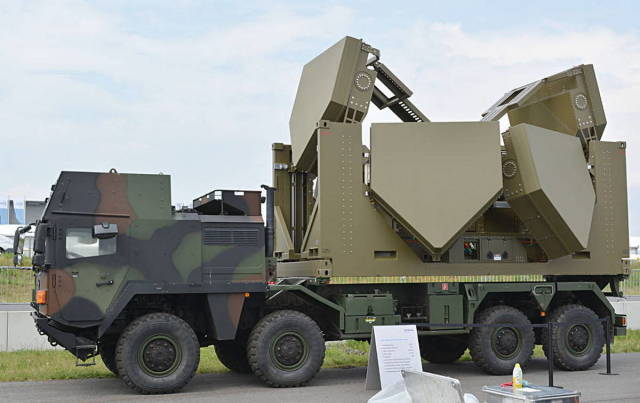
Classic radar antennas need to be mechanically turned into different directions to search all-round, which is slow. AESA and PESA antennas can switch the direction almost instantly, albeit an AESA antenna is limited to 90...120° in this. So the wasteful "99% solution" approach is to mount four such AESA antennas to cover the whole 360°, even on tanks. That's an issue, because old school mechanical antennas are cheap metal powered by a single transceiver unit linked by cables, while the AESA antennas are very expensive electronics (up to hundreds of individual transceiver/receiver modules) themselves.

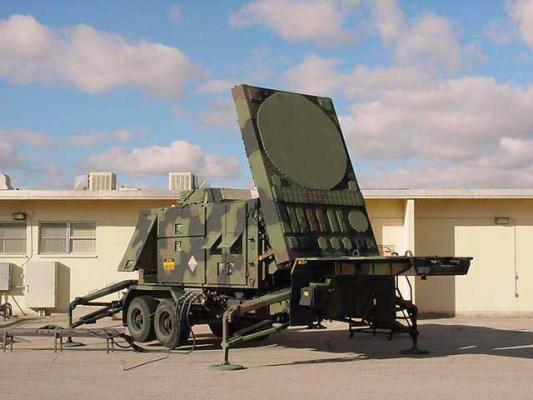
The Patriot air defence system was always crap because its big electronically steered radar was unable to rotate for 360° coverage. Its field of view was only 90...120° (sources disagree, but performance would be degraded beyond 90° anyway).

Patriot's AN/MPQ-53 radar, the work of idiots or saboteurs

It was an air defence system for a forward-facing line of SAM batteries, which is tactically an idiotic (too easily defeated) approach. You needed four Patriot batteries to protect one place not quite as well as a single SAMP/T battery can defend it using a rotating AESA radar antenna.

So the obvious approach to resources-irresponsible armed forces was to push for a Patriot upgrade/successor with four AESA antennas instead of one or two rotating ones. And then the system grew so irresponsibly expensive that of course Germany ended up buying zero copies (only in part because of this, admittedly).

99% solutions are stupid. It's much better to go along with "good enough", and survivability is extremely important. A vehicle with four fixed radars (360°) is less useful than two vehicles with two rotating radars. The latter can be used alternatingly, with one vehicle breaking contact or lying in wait while the other one radiates. The radiating one can shut down when an anti-radar missile or drone appears to approach it (thus making the attack more difficult), and the second one activates. A freak accident or lucky shot may disable a radar vehicle, and the all-in-one-basket solution would be a complete failure, while the two radar vehicles solution would still be fully capable for most of the time.


We should strive for robust, good-enough equipment, not for 90...99% solutions in the armed forces!

 
.

2022/06/04

Absorption camouflage

.

Land warfare has been technicised the way air warfare had decades earlier, notwithstanding that Russia apparently wages war with a motley of equipment rooted mostly in the 1960's to 1980's.

The technicised warfare leads to some unintuitive optimal choices. This blog post will propose a *possibly* optimum approach that *might* be superior to a more intuitive, obvious approach.

The topic is armoured fighting vehicle (AFV) camouflage.

The traditional camouflage of AFVs (let's just think: tanks) is the application of camouflage paint, and the German three-colour paint scheme fits much of Central and Eastern Europe. A big issue with such camouflage is that apparently nobody does anything against the dark spots caused by shadows, even though simple LED lights could help with that. 

Maybe everyone thinks that dirt would make lights impractical, but shame on engineers who cannot find an acceptable solution to that.

Proper engine maintenance can avoid treacherous smoke clouds that could be emitted from engine exhausts (though sometimes that's intended, as diesel injection into hot exhausts is a simple method to produce concealment by smoke/fog). Improvised camouflage included the application of foliage on tanks.


Special paints/coatings reduce the thermal signature and may reduce the radio frequency reflexivity (significant for ground moving target indicator / (imaging) synthetic aperture radar modes) and thus the range at which an AFV can be detected and categorised as either wheeled or tracked.

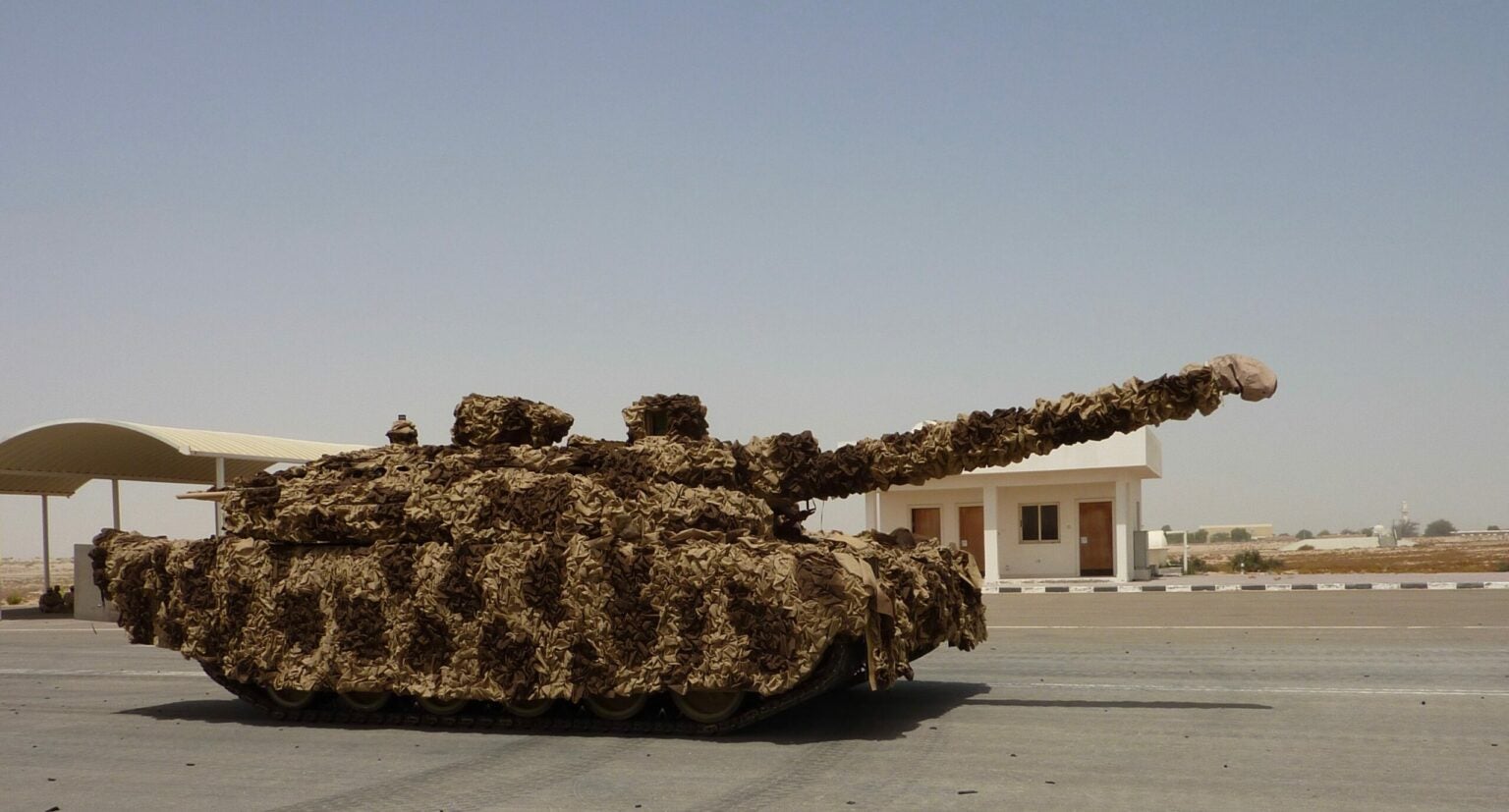
A vastly more effective method than coating is for most surfaces to use something like Multisorb

The Russian NII Stali marketed extra camouflage kits based on mats for years ("Nakidka"). They were cheap and at least at some thermal sensor settings spectacularly effective infrared signature management and camouflage tools (and I saw exactly zero of those used on war footage, albeit recently some photos popped up with claims that the Russians were using them).

These camouflage approaches serve the purpose of delaying detection and making identification extremely difficult (the latter is not necessarily good; the Americans even mount identification plates on their tanks that are very easily visible in thermal imagery to make ID easier).

This is an intervention early on in the engagement chain, which goes like (there are different versions, this is a quick recall from memory):

detect - identify - rangefinding&aim - shoot - penetration - behind armour effect (including secondary effects)

Let's look at a completely different paradigm. We could mess with rangefinding and shot (guidance of shot) instead.

Look at this example of a laser target designator. I chose this one because it mentions the wavelength of the laser, unlike most hardware brochures. 1064 nm wavelength, thus it's a Neodymium-doped yttrium aluminum garnet laser. Compatible semi-active laser guided munitions will be optimised to make use of this target designation wavelength, maybe a few others as well (there's a limited quantity of laser wavelengths in practical use). 

Now imagine the tank isn't camouflaged to delay detection, but to mess with the laser rangefinding and semi-active laser guidance.Users of handheld golfing and hunting laser rangefinders (which are incredibly cheap) know by experience that the effective range of the rangefinder depends on the reflexivity of the target. You may measure the distance by aiming at an object close to a target AFV, but for semi-active laser guidance you need to point the laser on the target and get enough reflection off it for the tiny sensor in the missile to detect reliably.

Let's think of a "black" AFV. An AFV that's almost non-reflecting on the wavelengths of target designation lasers and laser rangefinders, and possibly even so at the expense of traditional camouflage in the visual and IR spectrum. There are materials that absorb extremely well at certain wavelengths and absorb little at others (example article), similar to coloured glass in the visual spectrum.

Now if we found and applied a suitable material that absorbs the troublesome laser wavelengths extremely well, then the effective of laser laser target designation and on open fields also laser rangefinding might be reduced greatly. The effect could be comparable to the reduction of effective radar ranges by "stealth" aircraft.

The optimum camouflage coating (or camouflage mat) for warfare against a threat that relies very much on laser target designation (such as certain drones that drop semi active laser-guided glide bombs on AFVs) might actually not look like camouflage to the naked eye (visible spectrum).

There might be huge tactical consequences from this. Such a different approach would lend itself well to a full-size tank company attack and use by tanks in overwatch positions (in both cases detection and ID is simple regardless of camouflage), but would be much less suitable for tank platoons in delaying actions (essentially ambush tactics). 

Camouflage mats could be designed to be reversible, with high laser absorption on one side and good camouflage against detection on the other side.

 - - - - -

Previous D&F blog posts that were similarly disrespectful to the orthodox concept of camouflage:

/2009/10/camnouflage-for-choppers-in-afghanistan.html

/2010/11/camouflage-is-no-end-in-itself.html

/2013/11/a-thought-about-individual-camouflage.html

/2021/09/uniforms-are-obsolete-concept.html

A general blog post on visible spectrum camouflage:

/2018/05/individual-visible-spectrum-camouflage.html


S O

defence_and_freedom@gmx.de


P.S.: I'm totally aware that arms industry industry engineers have very likely thought of this decades ago, and the approach may be more or less implemented by paying attention to absorption  properties when selecting coatings. It may also be true that no super-convincing absorption material is known and half-assed efforts yield no decisive advantage. I'm just pointing out there may be something, and it may be a big deal in a world with many semi active laser guidance threats. This also means you should not trust SAL-guided AT missiles completely, for even if your country doesn't know a super absorber material, your adversary might do so.

I also understand that this problem applies in some seasons and areas.

.