2011/10/19

A history of the infantry gun in the U.S. (and elsewhere)

.
The German army/armies improvised the concept of an infantry gun for knocking out pockets of resistance that survived artillery preparations. I wrote about that in an earlier post. The French did something similar, and eventually many countries employed relatively light guns for such purposes during the Inter-war Years.

Anti-tank guns, mountain guns and even light field cannons were imperfect substitutes for dedicated infantry guns in the direct fire role and Brandt-pattern mortars were imperfect substitutes for infantry guns in the indirect fire roles. So in theory, you could make do without infantry guns - and infantry guns were squeezed considerably by such competition.

The U.S. Army was a bit slow to catch up with the whole concept and was especially interested in the indirect fire role, as it seems. Its quite belated adoption became known as 105 mm howitzer M3.

In 1941, the U.S. Army requested a 105 mm howitzer suitable for carriage by air, and as a rough guideline, a weight of 2,500lb and a range of no less than 7,000 yards were stipulated. In response, the M2A1 howitzer was cut down in length by 27 inches, to become the Howitzer T7. The carriage of the 75 mm Howitzer M3A1 was adopted as a Carriage T6, and the recoil mechanism of the 75 mm Pack Howitzer, much modified, became the Recoil Mechanism 105 mm Howitzer T13. Surprisingly, when it was all put together it worked quite well and required very little further modification, and the design was standardized as the Howitzer M3 on Carriage M3 in February 1943. Trials of production models revealed a lack of strength of the carriage, so those converted from 75 mm matériel remained the M3, while a newly-manufactured design, with thicker metal in the trail, became the M3A1. [...] 2,580 were built [...].
(Ian V. Hogg "British and American Artillery of World War Two", 1978)

105 mm M3 Howitzer in action, WW2
 
These guns - eventually used as a kind of medium infantry gun since there weren't even remotely enough airborne troops to make use of such a production run, were a moderate success. The Army didn't exactly fall in love with them. U.S.Army field artillery of the time was a huge fan of multi-battalion "time on target" fire missions that united the firepower of many batteries, while infantry guns lack the range to be available for this and are inherently rather point target destruction tools for commanders below division level (that would be battalion or "Combat Command" a.k.a. brigade in the WW2 U.S.Army).

There was a lot of competition as well. Mortars, recoilless guns, bazookas, artillery, on-call fighter bombers and most of all a huge quantity of Sherman tanks in direct cooperation with infantry.

There's also the possibility that the U.S.Army knew about infantry guns, but didn't understand them.

- - - - -

You might think that this was the end of the American infantry gun story, but there's a funny twist. One hand didn't exactly understand what the other did, and the Marines re-invented the wheel. The M3 Howitzer was - as the quote showed - a 105 mm howitzer (rifled barrel) on a modified 75 mm pack howitzer (=mountain gun) carriage.
The Marines - being Marines and all, but most importantly different - had post-war the glorious idea that their 4.2" mortar could be mounted on a carriage. A modified 75 mm pack howitzer carriage. Yeah, THAT 75 mm pack howitzer carriage.
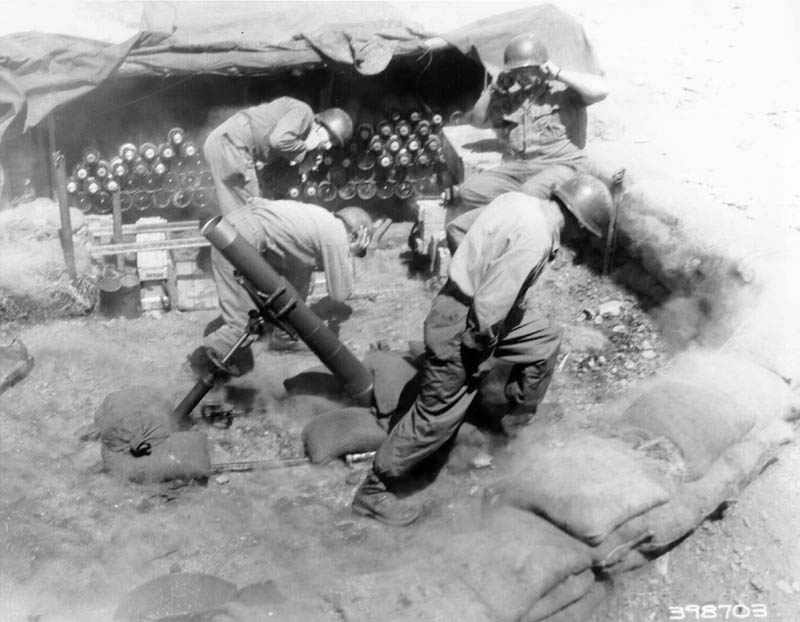
4.2" M30 mortar in action in Korea, 1952


Well, the 4.2" mortar was an unusual one - it had rifling just like a howitzer. Most mortars have smooth-bore barrels.

Let's see - 4.2", what's that in millimetre? 107 mm. Interesting.
What was its range? 7,400 yards as a mortar.

Well, that's only a coincidence! ;)

The Marines being Marines and innovative and all did some PR. They didn't call this bastard gun a howitzer. No, they called it M98 Howtar ("Howtar" being an unofficial designation).


 Ain't that funny?

(The Marines became actually innovative afterwards, but that was not exactly a success.)

- - - - -

Meanwhile (or actually slightly after the M3 Howitzer), German engineers thought hard about an improvement of the infantry gun idea. They combined mortar-ish hardware with a gun-ish carriage as well.

They had the idea for the High-Low pressure system in which the propellant has first some volume for expansion (into a lower pressure state) before the projectile begins to move much. This allowed for a much lighter (but longer) barrel and a lighter carriage.
Everything had to be done in great haste, so the projectile of a 81.4 mm mortar and the carriage of the semi-obsolete 50 mm anti-tank gun were married with (afaik) the muzzle brake of a 75 mm anti-tank gun and, well, what else a gun needs. There was a shaped charge version of the shell and some experimentation with a purpose-built very light carriage, too.

8 cm PAW 600 a.k.a. PWK 8H63, true calibre: 81.4 mm (smoothbore)

This gun did not have a great maximum barrel elevation (only 32°), but it combined light infantry gun weight, reasonable effective range and penetration in the important anti-tank role and a reasonable performance in the indirect fire role (out-ranging the common 81.4 mm mortar by much and being about on par with the other regimental indirect fire asset, the new 120 mm mortar).
It's still amazing that it was a quite accurate weapon despite launching a subsonic mortar bomb with an according made-for-subsonic shape with a muzzle velocity of 520 m/s (about Mach 1.5).

The USMC re-invented the Army's M3 Howitzer / medium infantry gun, but the Bundeswehr failed to get the high-low pressure guns (there was also a 100 mm model), too. Instead, recoilless guns were in fashion during the mid-50's (moderately practical, but even cheaper than a high-low pressure gun!) and later on there were the first generation anti-tank guided missiles that finally evolved into practical munitions.


Now guess what was fired in anger against Argentine field bunkers in 1982 during the re-conquest of the Falklands, in best WW1 infantry gun fashion ...

BTW, those 2nd generation ATGMs (with typical SACLOS guidance) were in turn replaced elsewhere with more modern ones, and Hezbollah used those against Israelis troops pinned in buildings during the 2006 Lebanon War.

The infantry gun thing keeps bouncing back.

S O

edit 2016-11: A related (old) article in a South African military journal, pp.47-50. I suspect the author is Russian (judging by spelling certainly not American or British, so it wasn't Storr). The described D-395 gun design would be interesting for 3rd World ground forces if it is fully compatible with standard munitions.

Also, see this about infantry guns today.
.

2011/10/18

Some good stuff from other blogs

.
...after complaining about them in general.

"No wonder we need a $700 billion defense budget: some of us are planning strike operations at the hint of an anti-American plan."


"Why I Published US Intelligence Secrets About Israel's Anti-Iran Campaign"


"Which begs the question: What, exactly, is the purpose of ISAF reports in the first place? Is ISAF seriously going on record to say that the data that they are making public cannot be relied upon? If analysts cannot build arguments out of the “basic, factual information” that ISAF is providing, why provide it at all?"

"Die de facto unabhängige Region Somaliland schafft es auf erstaunliche Weise, relative Sicherheit und Stabilität zu gewährleisten. Und doch wird der Enklave auch nach ihrem 20-jährigen Bestehen die Abspaltung von Somalia verwehrt."

.

2011/10/17

A rule of thumb for the allocation of specialist support

.
About long-range long-radius specialist support assets (such as helicopters, artillery, engineers, maybe scouts) in general: A rule of thumb (of mine) is:

Long-radius specialist support assets should as a rule of thumb be assigned to a level of command that has approximately the radius of (short-term, ~24 hrs) responsibility / operations as the asset has radius of effect (very short term, minutes to 4 hours).

I developed this as a my rule of thumb (or rather as a description of the common ground of my opinions on different force designs) a while ago and mentioned it indirectly in earlier posts. The reasoning behind this is mostly about efficiency. Longer range assets than needed (say, 80 km artillery instead of 13 km mortars when you need 8 km radius) are more costly and thus often wasted at lower levels. It's on the other hand not convincing to give a formation commander an asset that doesn't enable him to relocate his main effort quickly (which is big chunk of his job, after all) because of its lack of effective radius.

There are complicating considerations that have to be taken into account as well, of course. Horizontal support doctrine, Schwerpunkt idea in a slow-moving campaign, speed of assets (scouts, for example) and many other considerations play into this.
Thus it's only a rule of thumb. I justify the elevated position for the radius variable over the other considerations with my assumption (observation) that it appears to be the dominant factor most of the time.

- - - - -

Now let's move over to a specific application (I mentioned this one in an earlier post as well): Helicopters as brigade or division assets. This is particularly popular with U.S.Americans and in small war contexts, but rarely if ever being mentioned in other contexts. Helicopters as division assets has been the dominant pattern in the U.S.Army for a long time (+ helicopters in armoured cavalry regiments ~ brigades, helicopters in marine expeditionary units ~ very small brigades).

The radius of effect of a helicopter unit is in excess of 100 km and thus much greater than the short-term area of operations of a brigade. A brigade may occasionally move 100 km over night, but something goes awfully wrong if its elements are in combat 100 km away from its temporary helicopter base.
What's more to be considered?
Helicopters are  fuel hogs while armour, mech and even infantry brigades are manoeuvre formations (heavy divisions too). The combination of both looks quite wrong if you take into account that the mere supply of a moving brigade for its ground element's essential supply needs is already a logistical problem of the highest quality (and rarely mastered for long).

The fiscal cost of helicopters may contribute to them being an inefficient aerial support asset in comparison to alternatives, such as aerial recce drones and guided indirect fire munitions.

U.S. ground forces are the greatest proponents of a strong use of helicopters in regiments, brigades and divisions. They have been much-influenced by the Vietnam experience, a de facto ban for fixed wing aircraft in the U.S.Army and the assumption of air supremacy and effective suppression of enemy air defences.
They are quite specific and alone in this regard, which can be taken as an inspiration to think about whether their conclusions are correct and generally valid (which would mean that dozens of other modern armies were wrong about it).

The availability of helicopter support far forward (= in a brigade combat area) may be marginal due to hostile air defences. If in effect, this might turn the organic helicopter support into deadweight.

Helicopter support may be somewhat similar to other organic support (a subsittute). This resembles the 'UAV' point above. "KISS - keep it simple, stupid!" and the concept of friction in war (v.Clausewitz) appear to suggest that such redundancies may at times be a mistake.

An organic helicopter force impact the march agility of the brigade. The additional vehicles add to column length and duration of passing of a bde convoy. The responsiveness to a march order may be poor because of helicopters still away or not in flyable condition.

Centralisation vs. decentralisation. Different armies have different preferences here, for good reasons. The responsibeness to a formation's support needs is better with organic assets, but having them organic reduces their availability for large operational-level actions. Decentralisation also reduces the efficiency of the dedicated support (~more aircraft mechanics needed for same qty of helos).

The temporary helicopter base in a brigade's area would be in range of (much) hostile artillery and even of hostile air surveillance. This would be the foundation for a high exposure to artillery fire on the base, which is unlikely if the base was more centralised with the corps, for example.

Finally, there are usually* alternative levels for the allocation of helicopter support assets at available:
# division
# corps
# theatre / Armee
I prefer the corps level, for  modern corps would have a radius of short-term responsibility that matches about the (practical, ~90% of missions) radius of effect of helicopters.
(*: Marines and forces in small wars being an exception at times.)

- - - - -

Similar considerations can be applied especially to artillery support, which appear to have advanced in range even more than the (linear) growth of the area of responsibility / operations of formations did.

My approach can be contrasted with the (let me call it) "wish list" approach of some others who at times appear like spoiled children in their expectation of near-unlimited resources no matter what costs. The agility- and logistics-related points even show that having more does not necessarily equal being better off.

Armies have a responsibility to serve their people, but they have also a responsibility to avoid waste. This means they need to allocate resources rationally, not the least because this habit is important for great wars when practically all resources become very scarce.


S O

P.S.: I apologise if anyone finds my texts difficult to read because I cut them down to the bones without much explanation. I take much as self-evident and attempt to keep blog posts at a bearable length and thus omit some explanations.
.

2011/10/14

Depressed

.
An hour ago, I activated dozens on of bookmarks in Firefox to sweep over all bookmarked Milblogs. Then I proceeded with reading ... and now I'm kinda depressed.

To state it nicely, I feel alone with my idea of a Milblog.

I feel also quite alone in my appraisal of the costs of war, and my subsequent rejection of most wars and 'opportunities' for war as net harmful to all communities involved.

There are two explanations;
(a) I'm wrong.
or 
(b) The Milblogosphere is quite terrible.

Neither is charming.

S Ortmann
.

2011/10/11

Analog-mechanical computers

.
If you were ever curious about the technological level of World War 2...


That was slightly below cutting edge back in '45; tube-based electric computer did exist, but were apparently not preferred for the harsh conditions on a warship.

S Ortmann
.

2011/10/06

"War is a racket" (Repeat)

.
"War is a racket" by Major General Smedley D. Butler is an antiwar classic by a highly decorated U.S. Marine Cops officer. There's still a USMC base in Japan named for this officer.

One quote of this remarkable officer sums his experience up, but isn't from his "War is a racket" text itself:

MG Smedley D. Butler, USMC, 1920's
I spent 33 years and four months in active military service and during that period I spent most of my time as a high class muscle man for Big Business, for Wall Street and the bankers. In short, I was a racketeer, a gangster for capitalism. I helped make Mexico and especially Tampico safe for American oil interests in 1914. I helped make Haiti and Cuba a decent place for the National City Bank boys to collect revenues in. I helped in the raping of half a dozen Central American republics for the benefit of Wall Street. I helped purify Nicaragua for the International Banking House of Brown Brothers in 1902-1912. I brought light to the Dominican Republic for the American sugar interests in 1916. I helped make Honduras right for the American fruit companies in 1903. In China in 1927 I helped see to it that Standard Oil went on its way unmolested. Looking back on it, I might have given Al Capone a few hints.
The horrors of war, the unjustified profits of the war industry, the suffering at home, mutilated soldiers and especially his experience in many needless and corrupt small wars convinced MG Butler that war is a racket, evil. I read his book twice in the past years, and it's obviously applicable to our time as well as to the early and late 20th century.

He judged by his personal experience of his lifetime - the "Great War" and many small interventions against sovereign nations in Latin America.

He wrote "War is a racket" in 1935, in hindsight probably one of the worst times ever if you want to have lasting impact and fame for an anti-war work . The axis powers didn't allow peace for long any more (he warned only about Italy in his book) and showed that there are two kinds of war; those you can avoid and those you cannot avoid without submission.

This distinction is very important if we try to apply lessons learned from history for a better future.
Patriotism is a good thing if used to mobilize for unavoidable wars, and it's evil if it's exploited to reinforce support for needless wars.
Furthermore, the arguments of pacifists should not be dismissed completely, but considered for each and every war in detail - they apply to some wars and not so much to others.

Not only the understanding of patriotism should be influenced by past experiences - the whole approach to war needs to be checked. Are our societies really prepared to repel attempts to lure us into needless small or major wars in the future? Or will we fall prey to such attempts as the British did in 2003, when their head of government was able to participate in a war that the majority of the British didn't even want and that became a disaster?


S O

P.S.: This is a modified and abridged repeat of a four year old post of mine. I think it deserved this repeat. After all, almost nobody read this blog four years ago any way.;)
.

2011/10/04

National security policy the rational way (a partial view)

.
I laid out in my previous blog post that the military has different political purposes in wartime and peacetime. That's quite self-evident, but also important.

The political purpose of armed forces in peacetime should be to impress potential aggressors, to add a risk premium to whatever aggression might be contemplated against the country. The risk of excessive costs or outright failure of any aggression shall reduce the probability of war (deterrence).

This requires an impressive military; impressive in the eyes of politicians and the public.
The classic Cold War metrics for military power were combat aircraft, tanks, artillery pieces, divisions, nuclear warheads. The published matchups were really that simplistic (NAT-internal documents referred to "heavy division equivalents" instead - not much better). Nobody discussed in a newspaper whether the infantry of a nation was well-versed in nightly infiltration attacks.

This superficial part of military power must not be exaggerated, though. It might pervert its national security purpose if you had too much of it. Too much overt military strength may provoke an arms race. Arms races are counterproductive because they cost much in peacetime and lead to a greater net damage in wartime.
It's even worse; one or more parties of an arms race might go beyond a sustainable spending level (resulting in a lack of national capital investments, lack of system-stabilising consumption or a tradebalance deficit). This is not only wasteful, but might even lead to war. One such overextended racer might be tempted to seek an exit in actual war, rather than to admit arms race defeat (= risky loss of deterrence) or even a system collapse.


The importance of the obvious during peacetime leads to an emphasis on the obvious (high-profile hardware, quantity) during peacetime. The matchups show combat aircraft, not the annual flying hours of their pilots, after all.
- - - - -

It's all different during wartime:
During wartime the armed forces should be capable enough to achieve a low net damage outcome. It shall get the country out of the mess that is war, back to constructive peace instead of destructive war. The age of net profit wars is gone, nowadays only a tiny minority can benefit from war.

Yesterday I wrote "minimal net damage" instead of "low net damage", and this is correct if you look at the wartime period only. A national security strategy needs to consider that such minimal net damage would be bought with increased effort (= costs, damage to prosperity) in peacetime. A country with some confidence in its ability to keep the peace would accept a trade-off (with low peacetime expenses at somewhat increased expectation value for wartime damages). Such a compromise might look cynical to the reader, but think of the savings being invested in curing otherwise terminally ill people. A world of scarce resources (such as ours) requires some seemingly cynical trade-offs.

Anyway, the wartime demand for actual capability instead of show-off puts an emphasis on the quality of the personnel and generally 'hidden' qualities of the armed forces.

It's noteworthy that this requires some preparation during peacetime as well, and accordingly no national defence strategy that rests on national armed forces must neglect the nurturing of 'hidden' qualities.
This is where the competence of press, public and politicians as well as the influence of lobbyists (even from inside the armed forces) may be to blame for a suboptimal defence policy in just about every country.

By the way; I don't spot much of a semblance between this and actual national security policies of today. Do you?

S Ortmann
.

2011/10/03

Some really, really basic things about national security

.
I got into a kind of ranting mode when confronted with a specific opinion on a forum. The discussion was about whether it's acceptable to wish that a country's officer corps is combat-experienced. My point was that this requires involvement in warfare and is thus only achievable under condition of a failure of national security policy, resulting in the conclusion that combat experience is logically not desirable if you look at the whole.

Another forum member intervened with this helpful remark

It wasn't long ago I asked you what a military should do (other than attain victory). You responded with me earning a load of disrespect (but yet, never answered my question).

I don't remember the specific instance, but his description may nevertheless be correct. I'm at times "abrasive" when I'm "appalled" by a behaviour or opinion.
Anyway, here's an excerpt of my reply. I think it's decent blog material, too:

Victory as commonly defined is often a form of failure. The harm done to the own country by warfare is often greater than the harm done by not going to war (if there's any of the latter at all).
(The foolishness of the 2003-2011 Iraq conflict is a good example: pretty much nothing was gained but the busting of a few stupid fantasies. Thousands died, ten thousands were crippled, trillions of dollars were spent - for no real gain.)

The military shall -in the event of war- achieve the minimal net damage outcome for the country, with political efforts to the same end in parallel.

The mission for the government as a whole is to avoid damage altogether, to maximise the benefits of the population. The details are tricky from a philosophical point of view, but it's quite obvious that in our age you cannot really be better off with "winning" a war of choice than choosing not to go to it. You don't get to annex fertile lands or gold mines any more these days, not even oil fields.

This leaves wars of necessity, which again are only meeting the criteria if they're the least terrible alternative. To choose a more terrible alternative than a less terrible one is folly/incompetence, thus you gotta choose the least terrible (again, determining this is tricky detail stuff). Obviously, if the least terrible alternative is the only one that should be used, war can only be the way to go if it's the least terrible way to go.

After all, war is a terrible alternative, thus it's in the context "of war or not war" pointless to cover the "most beneficial" line of argument that applies to many peacetime policy outcomes.

So what's the military's purpose in peacetime?
Support the policy in its quest for good outcomes by making war and sovereignty violations less likely. This can be pursued by putting a hefty risk premium on all foreign aggressions. This risk premium is the visible and widely known probability that an aggression would fail to overcome the resistance (at costs that appear to be acceptable to the aggressor's top decisionmakers).
Thus I finally found an answer to my question what to post on this blog today. I've got some draft texts too, but it seems there's a reason why I didn't hit the "publish" button on them yet.


About war and peace (which, btw, is a label here on this blog!):
People in uniform, people in war ministries (whatever their name nowadays is) and people with a focus on the military (or even its hardware) drown out the voices of philosophy, reason and diplomacy in regard to national security debates.
It's a shame. More brain less guns could have kept many conflicts cold, millions of people alive, entire nations intact.

There may not be enough people out there who can detach from emotions and silly ideas and think rationally about war and peace when needed, but that's no excuse for not accepting that rationality is the way to go.

S Ortmann
.

2011/10/02

Functions in military theory / front lines

.
I have written about different functions in military stuff over the course of this blog.
I wrote about repulsion and how having a long range may actually reduce the functional utility of a weapon (even ceteris paribus).
I referred often to the functions of a front line, which fell away when armies gave up the idea of establishing a front line.
Recently I wrote about how you could create the effects of encirclement by meeting the function of an encirclement without actually make it look like an encirclement.

Unsurprisingly, I think there's some merit in this way of looking at military theory.

The technical capability of weapons and the physical capability of soldiers very rarely coincides with what happens in real warfare. A main battle tank may be able to aim, shoot and hit while driving at 60 km/h speed, but that's not how tank combat really looks like.

A missile may be developed to destroy a radar station - and end up merely forcing the radar operators to switch their radar off for a few seconds.

An assault rifle may have the technical capability to slaughter a whole platoon in a minute, but that doesn't happen.

The difference between input potential and actual outcome isn't the only indicator for the importance of function, though. Actions have usually effects that are not obvious at all. Many actions serve a purpose, a function in war.

The difference between potential and actual result is the really important thing. We need to understand the functions that rule warfare, more so than the tools. A look at the tools is too deceiving, for it merely reveals the potential, not the actual effect.

- - - - -

Let's finally look in detail at one of the functions that interest me very much, for I see no substitute in place after its loss yet: The front line.

What does a front line do?

Basically it keeps weak forces from advancing much. A proper front line may be infiltrated, but the risk/price is usually high. It can be penetrated by an offensive (under some circumstances), but it cannot be overwhelmed by a general advance along most of its length.

It does thus keep the enemy largely from advancing and thus creates security in the rear. This in turn enhances the efficiency of forces in the rear, for they can train, repair and move supplies without needing to pull much local 360° security. Of course, they also sleep better. Sleep deprivation is a big issue in wartime.

Front lines have a geometrical reason for their (past) existence.
Back in the 18th and even 19th century artillery wasn't long-ranged. It was feasible to protect a town against fires with a fortified ring around it. The longer the artillery ranges became, the greater the necessary diameter of the fortifications. This in turn led to an ever longer circumference (2 * π * radius)- up to the point when it became pointless to allocate so many defenders to a single town. In some places the defensive rings of multiple towns came in contact and it was less inefficient to give them a joint defence.
expanding fortifications lines of Cologne,
4th century to 1877, (c) D. Herdemerten


By the late 19th century it was obvious that town fortifications were pointless. To fortify the border of a state was an alternative. The geometrical reason is simple. Imagine a large circle and now fill it up with dozens of small circles. The large circle surrounds more area than the sum of the small ones, but its circumference is much smaller than the sum of theirs.

The increased lethality of small arms (= less defenders needed per length) and the mass mobilisation of troops with conscription actually enabled the fortification of an uninterrupted front line from Switzerland to the North Sea in late 1914 (as predicted by Bloch). The same was never fully possible on the Russian front in the First World War, but there was still a front line: The function of a front line was met with less ambition than total resistance against offensives.

The probably weakest form of front line came into being in World War Two, again on the vast Eastern Front; the weakened Wehrmacht wasn't able to fully man a front line, thus it had to create its effects with very few resources.
It was mostly a strong point defence with connecting trenches for patrol and surveillance purposes. Indirect fires (especially artillery and mortars) dominated the observed ground without much small arms fire. Again, it was possible to infiltrate, but infiltrations were met by counter-attacks. The less troops with direct fire weapons man a front line, the more they need to be substituted for with indirect fires. A continuous trench line was desirable for the safety of patrolling, but it was no longer always an integral  component as in 1916.


The key for such a front line was to force the superior opponent to concentrate forces for an overwhelming breakthrough offensive. The rear troops were quite secure till this breakthrough occurred, and there were operational counters even to successful breakthroughs. A front line can meet its function even if it's unable to stop the enemy.

Nowadays it's unlikely that traditional, continuous front lines will be established in a conventional war. There are likely too few troops. This has actually been correct since the early Cold War, but the fixation on nukes kept many from seeing it.

- - - - -

The essential components of defence: Direct fires - counterattacks - indirect fires - surveillance.
The less forces per length, the more emphasis has to be shifted away from direct fires. Artillery fires are the classic gap-filler for thin defences.

Modern forces couldn't have short range direct fires along the length of a front line.
Their surveillance of a long line is also in doubt because of weak scout and infantry components (contrary to the sensors fashion). Indirect fires are now high quality, but low quantity (and accurate indirect fires against moving targets are still difficult).
Could all this be made up for with counter-attacks? Hardly.

You need a substitute for the discouraging effect of an established front line, or else your opposing force may put you into extremely risky and disadvantageous situations by exploiting much of its mobility potential. There's no front line that forces them to concentrate for hours or days for a predictable push, after all. They might appear just about everywhere, at any time.


I actually gave away parts of my idea for a substitute in earlier posts. My working title is "skirmish corridor".
I won't describe it in detail here because the point of most of my blog posts isn't to inject my ideas into readers' brains; it's to inspire their thought. A single brain rarely produces great ideas, but a thinking society will succeed. Well, that and the text is already long enough.


S O
.

2011/09/28

A "15 years too late" analysis on precision munitions and survivability

.
Precision munitions and smart munitions were the big hype of the 90's, but obviously I didn't blog during the 90's. Nor did I have particularly well-founded views on them back in the 90's. So pardon me for coming late to the party, please.


First some context, for no analysis should be done with an empty stomach:

Back in the World War Two era, the best defensive practice on flat land (against an enemy who preferred night attacks) was to have a forward line of own troops (FLOT, VRV - Vorderer Rand der Verteidigung) as a screen for the main daylight defensive positions (1). This forward screen was made up of small teams in ambush/observation positions or on patrol. Such far forward troops were naturally exposed to detection, no matter how well they camouflaged and concealed themselves. Sooner or later they were spotted.

In short: The more important position was to be screened against detection by a more expendable position. This led to a surprise advantage for the defender in major defensive battles and added uncertainty for the attacker in general.

- - - - -

Long-time readers of this blog do probably remember that I advocate camouflage and concealment all the time, period. Even small exposure is in my opinion acceptable only for very short duration (about 2 minutes).
That's of course a judgement result, not the reasoning itself.

To prove that I'm correct I would need to prove that even the aforementioned forward screen could not expose itself nowadays without unacceptable attrition rates or mission failures.

The relation of overall lethality of fires (most notably indirect fires, = rocket, howitzers and mortars) is the key. It has to be worse (=more lethal to the defender) today than back in WW2 to yield worse (for the defender) results. This lethality has to be seen in context of target quantity if you look at the macro scale (this relation isn't so important on the tactical level).

WW2:
Many high explosive warheads  x  low probability of hit Ph.(2)
Fires usually had to be 'walked in' on the target, spending the surprise effect.(3)

2011:
Few high explosive warheads x high probability of hit
Fires can be very accurate on first salvo.


Now the question is whether
much HE x low Ph
is smaller, equal or bigger
few HE x high Ph


"smaller":
This would mean that accuracy (surprise) is the key advance, while firepower overall has decreased.

"equal":
This would mean that accuracy (surprise) is the key advance, while firepower overall is the same.

"bigger":
This would mean that dispersion and accuracy (surprise) advances are overmatching the loss of ammunitions quantity.

The "smaller" and "equal" cases would -if true- allow the conclusion that precision munitions are not so much important as is the accuracy (knowledge of positions, environment and trajectory, correct calculation). You could -in this simplistic model- have the same effect with lots of dumb rounds being fired by good gunners and good guns.

The "bigger" case (which is widely implied or asserted to be true in publications) would suggest that the hype about the small dispersion of precision munitions (small circular error probability, CEP) was correct.


Well, what's the overall lethality that I meant?
'Shells' times quality of dispersion (less dispersion = better quality) is the measure against targets which don't evade fires when possible.
Against targets which do evade incoming fires you need to magnify the effects a lot to represent today's situation, for modern fires take immediate effect and leave no time for running to a secondary position.

- - - - -

I may not have made myself clear about this in previous texts (can only point out so much at once). The dispersion is in my opinion important, but not in itself the reason why modern ground forces need to break contact after a short time to prevent getting caught by support fires. They need to do so because you cannot run away from modern mortar or artillery fires.


That's why I have my conclusions about the role of modern support (indirect) fires, even without being able to solve the high explosives x dispersion equation (which is extremely complicated if you want to do it thoroughly) even though publications focus usually on one variable of this equation.

By the way; there has been near-constant frustration about the lack of realism in training in regard to indirect fires lethality and thus wrong training and doctrine. This goes back to at least the early 80's in literature. Unsurprisingly, I have yet to see an army manual from any country (I know infantry manuals from eight) that emphasises that unlike in WW2, hostile indirect fires are accurate on first salvo now.

The incompetent harassment mortar teams of Third World insurgents did certainly not help to press this point about modern indirect fires into the minds of our army leaders.


S Ortmann

(1): An approach similar to scouting in general: Jeopardize few in order to buy better security for many. This fundamental approach has mostly been lost to today's Western officer Corps due to their quest for (almost) no KIA on their teams. Such an approach is incompatible with singling out few for high risks, as high risks have (supposedly) to be avoided altogether. Their approach would increase the average risk-taking in a great war.

(2): A measure of dispersion rather than accuracy in this context.Dispersion tells how close the impacts are to each other, while accuracy tells whether the centre of the impacts group was close to the target.

(3): It was possible to avoid this and instead just fire short fire mission with many artillery battalions at once. This shotgun effect came surprisingly and at least some firing batteries were usually on target without corrections. The ammunition expenditure of this tactic permitted it only for large target groups and afaik it was preferred as a defensive fires tactic and not used much for the destruction of defensive positions. The exception was IIRC rocket artillery.


edit 2012/08: I read this old blog text today and now I understand it's very difficult to grasp, for I laid out my thoughts poorly. In case you don't get what I mean, just focus on the underlined parts and keep in mind that the classic responses to indirect fires were to (a) find shelter in field fortifications or (b) run to a new position faster than the enemy can correct his indirect fires aim.
.