2019/04/27

Ship detection by synthetic aperture radar imaging of wakes

.

A radar could indirectly 'see' a moving ship by 'seeing' its wake even 36 years ago:
source (chapter 12)
I've seen even more impressive SAR imagery of a moving ship being visible by its wake (SEASAT imagery, 1978), published in the mid-80's already. The principle of detecting a moving ship by sensing its wake should nevertheless be obvious by this available lower quality image.

Radar's ability to find ships by their wakes has multiple important consequences in the naval domain:
  • radar stealth for surface ships is likely of little use against high altitude or orbital radars which can employ a SAR mode
  • as a consequence, radar satellites (even civilian ones meant for land imagery) may be of great importance to navies
  • as another consequence, the supersonic and high-flying anti-ship missiles (and Chinese quasiballistic anti-ship missiles) may have a vastly better capability to discriminate real moving ships from decoys than the typical Western approach of radar-guided seaskimmer missiles
  • and as yet another consequence, there's an additional realm for camouflage and deception; wakes* (this may also help a bit against wake-homing torpedoes)
I simply meant to point this out in a bit more detail than before because I find this hardly ever mentioned in the context of naval surface warfare and anti-shipping air warfare.

related:
Radar stealth is helpful at long distances, but  (...) In theory it's even possible that a missile could climb after being detected and look at the sea surface to spot ship's the wake pattern to tell real ship targets from decoys and boats (...).

S O
.

2019/04/20

Just some old aircraft projects

.
I don't have much prepared for the Easter days' release, so I'll simply drop a few hints to fascinating  old aircraft types that never really made it to production. (This post was in the draft stage since 2013, so this is really a kind of emergency filler for the blog.)
Historic aircraft are an old hobby of mine. People with a similar interest should have a look at the secretprojects.co.uk forum.

Horten Ho X

Here's an artist's impression of a Horten Ho X. This could have been a fighter of the 1947 generation with the second German generation of turbojets (HeS 011 engine, 13 kN). Turbojets coupled with such a large wing area would have yielded a superb performance at high and extremely high altitude (if cabin was properly pressurised), but the fighter would have been quite useless at low altitude and still inefficient at medium altitude (fuel consumption was tripled at low altitude). The project didn't advance much and it's questionable if the small developing company would have been able to stem the development in a few years. Maybe some other company could have taken over the detail development as happened with Ho IX/Gotha P.60.

XB-28

Next, a North American XB-28 Dragon prototype, I rate it as one of the very best bombers of its period. The USAF was pig-headed and insisted on thinking of it as a medium bomber despite having heavy bomber performance. Its high altitude performance was not needed for medium altitude. Cheaper medium bombers of significantly lesser flight performance (B-25 and B-26) were available for bombing at medium altitudes, thus no B-28 quantity production orders were given. The B-28 would have been a most famous WW2 aircraft today if it had been employed as a strategic bomber to replace B-17s in combination with RAZON munitions in '44.


Ju 288V-13, prototype for C version
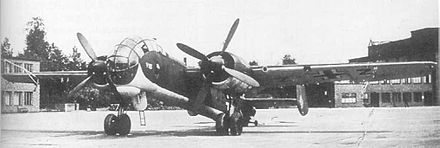
Junkers Ju 288. It's similar to the XB-28 with pressurised cabin and remotely operated armament, but with greater speed and bombload. Intercepting this bomber would have been difficult, pursuit would have been quite pointless - and this in addition to it having good range, normal armour protection, self-sealing fuel tanks and defensive guns.
It was overall a much better design than the XB-28 (quite a feat!), but Germany didn't get remote control of defensive guns as right throughout WW2 (despite employment in Me 210/410 and some He 177) as did the Americans. This bomber was tied to an exceptional aircraft engine (Jumo 222), and it's never been completely understood why this engine never left development stage. It may have been a mix of political intervention, mission creep and use of scarce metal alloys. The Ju 288 design had mission creep as well, with the B version being a larger redesign of the A version and C version being meant for some vastly inferior engines. The relatively ordinary DB 603 engine had reached enough power (1,900 hp) and reliability to propel the Ju 288A version by 1944, but by then there was no interest in a new piston engine bomber any more.

Hs 127 V-1

Hs 127 three-view line drawing

This is the Henschel Hs 127. It looks like a de Havilland Mosquito, right? It flew in 1937 and was meant to be faster than any fighter at that time (actually as fast as the fastest in-service fighters in 1940). Its bad luck was that it competed against the excellent Junkers Ju 88 while being the more tactically daring and unusual concept. Later in WW2, the Mosquito proved the soundness of the Hs 127's concept in many roles including night fighter. I do not quite understand why the Hs 127 design (which did reach the prototype stage) is never being mentioned when the issue of aircraft types available to Germany as night fighters in 1940-1945 comes up.


S O
.

2019/04/13

Fair burden-sharing in NATO


The silly idea that NATO members should allocate 2% of their national income to deterrence and defence annoyed me a lot for a long time. It's not only too much given the modest conventional threat, but it also distracts.  Total military power is of little interest to our deterrence and defence as long as almost all of it is far from our frontier, and a coup de main-style grab of the Baltics is the least unlikely scenario of aggression against NATO. We shouldn't focus on raw quantity, but on smart allocation.
Furthermore, it's nonsense to ask poor or heavily indebted countries far from the threatened Eastern European region to spend much on the military. They would be better off with Ireland's security policy (~0.4% GDP military spending, member of EU, not part of NATO).*

So I gave it a try and created a table to see if I could come up with a more sensible distribution of burden:
minor inaccuracies regarding GDP and GDP per capita are possible
The rule should be a bit more fluent than the simple '100% GDP public debt' rule above to avoid unintended incentives to keep the public debt above 100% GDP, but I think the table conveys the basic idea on taking into account public debt well.
The U.S. could separately choose to have higher military spending because of the PR China, but that would be unrelated to NATO. Norway and Canada could consider themselves frontier countries because of the Arctic territories (and a rather negligible Norway-Russia border), but I don't.

357 bn USD military spending is plenty. I didn't add the extra effort to convert in USD PPP, but the picture should be clear; this is easily enough to deter and defend against Russia (66.3 bn USD) + Belarus (0.6 bn USD). Any minister of defence or general or admiral who claims otherwise should be fired immediately for gross incompetence.
 
Readers might associate hollowed-out, ineffective armed services with the hypothetical budget levels in the table. Such symptoms are NOT the consequence of such spending levels, but of intentional cynical dereliction of duty by ministers of defence, generals and admirals who prefer to keep structures nominally powerful and cut the budgets for fuels, spare parts, repairs, upgrades and munitions instead of adapting the force to the appropriate size and make it fit. The hollow force syndrome is not something you should blame fiscal politicians for, but something the top brass and ministers of defence should be fired for.
I excluded legacy costs such as pensions on the bottom of the table, so it should very well be possible to trim the forces to an appropriate size and high fitness for their mission with those budgets.

I suppose my hypothetical framework for fair burden-sharing in deterrence & defence of NATO makes a lot more sense than the crude 2% nonsense rule that was really just a poorly veiled effort to push the Europeans into becoming more useful auxiliaries for stupid American small wars. It was never really founded on any actual threat, as evidenced by the military spending disparity to Russia since the mid-90's.

S O
defence_and_freedom@gmx.de

*: 'My country first' can be applied by all countries.
.

2019/04/06

Link dump April 2019

.

Yesterday: Your loudspeaker is a microphone.
Today: Your hard disk drive is a microphone.

- - - - -

breakingdefense.com/2019/03/us-gets-its-ass-handed-to-it-in-wargames-heres-a-24-billion-fix/
The mentioned weaknesses have been public knowledge for a long time.
We should always keep in mind that such studies are being financed by a bureaucracy that wants more money.

- - - - -

As usual, it's clearly visible if you know what to look for.

- - - - -

People who get all agitated and fearful about imaginary problems like 'Sharia law in the West' deserve ridicule IMO. I would be fine with everyone simply pitying or ignoring them if they weren't so aggressively spreading their fearfulness and pretending to be the opposite of what they are; fearful pussies.

- - - - -

www.telegraph.co.uk/news/2019/03/24/soldier-charged-going-rogue-computer-game-virtual-battlefield/
He was the only one who snapped in the simulation. That's good-enough reason to believe he'd be among the first to do so in a real warzone. I propose to discharge the jerk.

- - - - -

www.esquire.com/uk/latest-news/a26617960/donald-trumps-now-reportedly-racked-up-more-than-9000-lies-since-taking-office/

- - - - -

www.businessinsider.com/finland-develops-horrific-jumping-land-mine-to-deter-russia-invasions-2018-3
This should be very effective against lying/crawling infantry, but not nearly as much against upright infantry. Maybe it's meant to be used in combination with claymore-pattern remotely controlled mines.
Anyway, it reminds me of some German 120 mm mortar bomb (shrapnel-like) development from the 1990's which had a blunt front plate with tungsten pellets or balls, meant to shoot downwards to the ground (IIRC it was meant to be proximity fused and ditched a ballistic cap prior to explosion).

- - - - -

boingboing.net/2019/03/11/sleep-is-a-brain-repair-mechan.html
"I'm repairing!"
I like that excuse.

This could lead to legal issues in the long term. Soldiers who were sleep-deprived for years might claim brain damage and demand compensation in the 2030's.

- - - - -


I mentioned this technique (water transfer printing) before. This time I'd like to hint that the ability of water transfer printing to bring camo patterns on fairly complicated shapes could be used to solve a common problem of military camouflage: 
All those fancy camouflage patterns mean little if cluttered by webbing, pouches and gear. Camouflage patterns may have a macro pattern to disrupt the shape at distances such as 100 m, but this macro pattern would only become visible on the legs and maybe the arms because the torso is too cluttered with objects on top of the camouflage clothing.
In theory, we could equip a puppet with the full gear, subject it to water transfer printing of a full body camouflage pattern and could (with some imperfections) actually achieve a full body, disruptive macropattern for once.
A reversible Ghillie-like coat would be simpler, though.

- - - - -

"But the president's remarks Friday morning also raise questions about whether he will abide by the terms of any trade deal he strikes or whether he will continue to insist on more concessions from trading partners after agreements have been reached."
www.politico.com/story/2019/04/05/trump-says-mexico-tariff-threat-supersedes-nafta-3022835
The lying moron's own trade deal isn't even ratified yet, but he's already threatening to violate it.

Why should any European country still consider the United States to be an ally?

- - - - -


also
https://9gag.com/gag/az9RGyB


9gag.com/gag/aE2Xbqx

- - - - -

https://9gag.com/gag/az9Z4qq


- - - - -


- - - - -

S O
.

2019/03/30

Climate

.


Climate change has been mentioned as a national security threat by some governments. I don't like such an inflationary use of the term, but I suppose in some places you can only work with so many levers, and "national security" happens to be one that's not stuck.
 
The video shows how early the basic mechanism of global warming / anthropogenic climate change was understood, and even brought to the public's attention. It's astonishing to see the propaganda-driven (and I suppose wilful) ignorance of large parts of Western societies on this issue, but also on other much-discussed issues. One should expect that much attention yields much clarification, but intentional propaganda efforts and dysfunctional motivations often lead to poor results.

(German students skipping school for demonstrations for action against climate change)

More or less related: The USAF keeps having bad luck.

2019/03/23

Nuclear deterrence for Europe (Part III - A dirty solution)

.
previously:

A solution to NATO's nuclear deterrence credibility problem would ideally combine the following features:
  1. Keep NNPT intact
  2. No (additional) crazy person or moron with full control over a nuclear 'trigger'
  3. maintenance of second strike capability in face of extreme nuclear onslaught
  4. high, credible risk that employment of 'strategic' nuclear weapons against a NATO (or EU) country leads to a 'proportional' tit-for-tat second strike
  5. high, credible risk that employment of 'strategic' nuclear weapons against NATO (or EU) military targets on in NATO (or EU) territory leads to a 'proportional' tit-for-tat second strike
  6. moderate (additional) expenses
  7. not deemed to be of aggressive nature (no threat to the Russian second strike capability, for example)
  8. no excessive firepower for 'tactical' second strike (ability to employ a single warhead of at most 150 kt TNTeq)
  9. not destabilising international relations
- - - - -

It's difficult to combine these, especially with the basic problem that a nuclear power cannot credibly proclaim to risk its capital metropolis only because of some nuclear attack on a country with less population than said metropolis. This and the preservation of the NNPT are most difficult to reconcile.
 
I may have a way how to cheat out of this dilemma:
Protect the NNPT in its wording, but effectively (and credibly) risk that in times of war, it does not limit us for more than a few hours.

I will describe how it might be done, but first I'd like to state my distaste for the whole affair. I hope mankind will get past nuclear munitions altogether in my lifetime, and without ever using any more of them.

The scenario: We (European NATO/EU) develop and deploy a nuclear triad in addition to the traditional great powers' SSBN/SLBM arsenals:
  • few road-mobile IRBMs with a single approx. one Mt TNTeq warhead without re-entry vehicle each
  • road-mobile IRBMs (same type, but with with decoys and other countermeasures against BMD) with a single approx. 100 kt TNTeq warhead each
  • short range quasiballistic (manoeuvring) missiles in semi-trailers with a  single approx. 100 kt TNteq warhead each
The one Megaton IRBMs would be an EMP threat. Five* such explosions 400...500 km above Western Russia would damage much of the electrical equipment there. This is the EMP tit-for-tat deterrent.
The other IRBMs would be the city-destroying tit-for-tat deterrent.
The short range missiles would be the 'tactical' nuclear attack tit-for-tat deterrent.
I suppose no deterrent against nuclear attacks at sea is necessary. That stupid tsunami/Tsar bomba torpedo would be covered by the city-destroying tit-for-tat deterrent, and nuclear attacks on warships are something where we should 'offer the other cheek'.
This was the mere hardware side of deterrence.

- - - - -

The credible deterrence effect would stem from the dispersion of these nuclear forces (especially the 2nd and 3rd category): They would be scattered all over European NATO/EU (or rather all agreeing countries).
The nuclear power that provides these assets would be in control and not share control (thus no violation of the NNPT), but if Russia (hypothetically) wiped out Warsaw, the Polish government could get mad, order the evacuation of all other Polish cities, seize what nuclear arsenal is on Polish roads and then send an IRBM or two to St. Petersburg for revenge.
Likewise with 'tactical' nuclear attacks on land targets.
I suppose France itself would initiate the EMP tit-for-tat if Western Europe was hit in such a way first, so the few one Megaton warheads would not need to be dispersed in Europe.

The public might not even be fully aware of such potential sharing of nuclear second strike launch capability, but any realistic potential nuclear aggressor would be. That would be ensured behind the scenes.

So the technical (and organisational) side would need to include on one hand the ability of attacked countries to seize and use the nuclear munitions, and on the other hand no host country should be able to turn itself into a permanent nuclear power by simply seizing the nuclear munitions.** I suppose the warheads should become unusable if they hadn't received some 'keep alive' code for more than a month or were opened without first receiving a correct 'opening' code. The seizing country could still recycle the plutonium and some components, but it would take months or years to create a practical nuclear warhead with this without prior detailed knowledge of the warhead design's details.
Obviously, no criminal or errorist elements must be allowed to seize and use such nuclear munitions either, which can be ensured by spacing the launcher vehicles and the command & control vehicles (which would have to be essential for the employment).***

The necessary quantity of nuclear warheads would still be relatively small (maybe 100...200 for all of European NATO/EU). The costs for the warheads would have to be borne by France, but I suppose NATO could find an AWACS-like joint financing scheme for the missiles and the related hardware (launcher and control vehicles).

Now let's look at the criteria again:
  1. Keep NNPT intact formally yes, but complaints are to be expected
  2. No (additional) crazy person or moron with full control of a nuclear 'trigger' OK
  3. maintenance of second strike capability in face of extreme nuclear onslaught challenging, but possible
  4. high, credible risk that employment of 'strategic' nuclear weapons against a NATO (or EU) country leads to a 'proportional' tit-for-tat second strike OK
  5. high, credible risk that employment of 'strategic' nuclear weapons against NATO (or EU) military targets on in NATO (or EU) territory leads to a 'proportional' tit-for-tat second strike OK
  6. moderate (additional) expenses The cost could very well be dozens of billions of Euros.
  7. not deemed to be of aggressive nature (no threat to the Russian second strike capability, for example) OK
  8. no excessive firepower for 'tactical' second strike (ability to employ a single warhead of at most 150 kt TNTeq) OK
  9. not destabilising Maybe it is destabilising. Pakistan might get an idea about its "Muslim nuclear weapons". People might find the security against for example the Hungarian government seizing nuclear warheads (and thus possibly necessitating an invasion by allies to retake those) unsatisfactory. Another issue is the transition period (easily a decade) during which the first strike risk may actually be slightly elevated.
A return to an INF-like ban on MRBMs and IRBMs would be almost impossible once such a deterrence scheme was employed, but on the other hand it could serve as bargaining chip for a INF renewal if the great powers' nuclear deterrence was judged to be sufficiently credible again in the meantime.

I'm not really satisfied. It feels like a step backwards, especially if it's not accompanied by a reduction of SLBM warheads (though that's exactly where some of the warheads could come from almost for free!). I wish we could just get along without the damn nukes.

S O

P.S.: The IRBM could be based on the French S-3 IRBM, though I'm not sure how well that design would handle being stored and moved on road while in a horizontal position.

Regarding Russia being used as a kind-of-bogeyman; remember that I'm generally in favour of stagnant or reduced military spending in Europe given the small and unlikely threats. There  is some remnant of justification for military spending, though - and for Europeans that's de facto only Russia. So what little resources we should spend on military affairs in Europe should be spent first and foremost with deterrence and if need be defence against Russia. More specifically, the least unlikely scenario of hot conflict appears to be an aggression against NATO's and EU's Baltic members. This blog post should not be mistaken for a conflict-promoting, or hawkish one.

*: Multiple warhead explosions for multiple EMPs because direction to the EMP source matters.
**: The current  nuclear participation regime does actually not provide such a protection, but it deploys American nuclear warheads in much fewer countries.
***: I suppose this would be no more a violation of the NNPT than was to store nuclear warheads that required no codes at all in foreign host countries during the 70's. The whole scheme is a violation of the NNPT in spirit, of course.
.

2019/03/16

Nuclear deterrence for Europe (Part II - No easy solutions)

.
Part I described why nuclear deterrence may have poor credibility, notwithstanding the immense destructive potential that the three NATO nuclear powers have at hand. There's little reason why Estonians should trust any of the nuclear power to use nuclear strikes in defence of Estonia, for example.* To do so would risk the existence of New York, London or Paris.

  
A simple response could be a call for more nuclear powers in Europe. Nukes for Germany! Nukes for Spain! Nukes for Italy! Nukes for Poland!
That wouldn't solve the basic problem, though. Nobody would want to risk Berlin, Madrid, Rome or Warsaw over some NATO-peripheral attack either. The whole approach would risk the global nuclear non-proliferation treaty (NNPT) that so far appears to have been very useful at avoiding nuclear warfare. We wouldn't want to see some Saudi nukes, Indonesian nukes, Nigerian nukes, Brazilian nukes, Mexican nukes, Argentinian nukes, Chilean nukes, Iranian nukes, Japanese nukes, South Korean nukes, Taiwanese nukes, Algerian nukes or Turkish nukes, right?

Shared control of existing nuclear arms stocks also violates the NNPT (article 2). 

Another approach would be to build and keep ready and in range a conventional military that could successfully defend even against nuclear-armed invaders. This isn't impossible, but it would put greater demands for stealth, agility and dispersion on this force than on the invaders. This puts the defenders at a disadvantage at least according to 20th century military theory. This disadvantage could be overcome by greater allocation of resources, which is an undesirable condition. Nuclear-survivable conventional forces may be an answer to a tactical nuclear strikes-supported conventional aggressor, but not to a 'strategic' nuclear threat. The threat of 'strategic' nuclear attacks (on cities) could stall the employment of such conventional forces on the political level.

Another relatively simple solution is to bolster credibility again by putting an unstable person in control of one of NATO's nuclear arsenals. This person must not be a Russian asset or otherwise easily corruptible, though. This is another rather unsatisfactory approach for obvious reasons.

We could - what a weird idea(!) - also strive to reduce if not eliminate lingering conflicts and possible motivations for aggression. In all honesty, NATO doesn't appear to be capable of a much more serious attempt to do so than was already tried, and Russia doesn't seem to move towards such conflict relaxation, either. There's currently very little reason to believe in the imminence of a Russian invasion of the Baltics or other NATO territory, and it appears to be very hard to consistently further reduce the risk by addressing existing conflicts of interests or opinion.

To distract a nuclear threat by provoking a hostility or rivalry between the threat and some distant power (say, Russia vs. PRC) is difficult to pull off and unethical anyway.

Likewise, a return to the craze of the Cold War appears to be counterproductive. The own deterrence could become more credible because of the craze, but the very same craze could also trigger a war. Moreover, the associated arms racing would be extremely expensive and wasteful.

A distributed capability of devastating non-nuclear second strike (devastating enough to lead to a collapse of governance, such as by EMP or 'cyber' attacks that shut down the electricity grid for months) is an interesting idea.
Its deterrence value depends on its credibility, though. Any novel idea faces difficulty in getting respect, and reliably so.
For example, imagine every country in NATO and EU had a 'kill switch' for the entire Russian electrical grid, with a capability to outright destroy so much of it by overloading that repairs for restoring power to Moscow would take a year. That 'kill switch' would still be worthless as a deterrent if this capability was not believed to exist by the Russian president.


There don't appear to be any obvious, easy, elegant or otherwise really satisfactory solutions to the identified problem.

S O

*: Estonians, stop producing fodder for Russian propaganda with your anti-Russian rhetoric and politics already! 17.9% for a party that's hostile to Russia and Russians (especially the Russian minority) as well as claiming territory from Russia - that's asking for utterly unnecessary trouble.
.

2019/03/09

Nuclear deterrence for Europe (Part I - The problem)

.
There are three nuclear powers in NATO; United States, United Kingdom and United France.

The traditional Cold War view was that NATO's main nuclear deterrent to the Soviet nuclear might was the American arsenal which was capable of ending human civilisation several times over.
The British nukes were considered more of a national asset that extended British great power status claims to the post-Empire era and the French nukes were clearly meant as a national asset, France abstains to this day from NATO's (quite meaningless) nuclear planning group (it also extended their claim to great power status past their colonial empire disintegration, despite a weak army).
There were isolated statements about British and French nuclear power protecting all of (European) NATO, but this didn't change the perception or sentiment much.

Fast forward to 2019:

Now we've got an American president who may or may not be a Russian asset and certainly wouldn't consider risking nuclear attacks on his country by doing strategic nuclear strikes on Russia. Cabinet and Congress would take a while to depose him, and even if they did, they would certainly not destroy Russian cities in a retaliatory strike as a matter of principle if so far no American city was nuked. Such retaliatory strikes become less likely the more time people have to think (in my opinion).

Their Ballistic Missile Defence may protect them against small-scale tit-for-tat nuclear exchanges; Russia might not be able to respond to a single of its cities getting annihilated by doing the same to an American city, for a launch of a single or very few missiles might be defended against by BMD (and their stupid nuclear torpedo would be very slow to arrive). A nuclear exchange might step straight from battlefield nukes to total urban centres annihilation, even without the ingredient of Cold War craziness.
So in the end, the American nuclear umbrella over Europe isn't credible until 2021 at the very least. The American nuclear arsenal appears to join much of what other military power they have in the bin of what's outright useless and irrelevant for European deterrence and defence.

- - - - -

The British are in a bit of political disarray and a moment of extraordinarily weak political leadership. Brexit signals their intent to decouple from Europe and pretend that they're something of a mid-Atlantic island instead of an island almost in line of sight to the continent of Europe. The whole decoupling policy puts giant question marks behind their credibility as an alliance-wide nuclear deterrent.
Their only nuclear 2nd strike capability rests in Trident missiles in nuclear-powered submarines, of which typically one is hiding at sea while often all but one are in port. These nuclear warheads are a terrible choice for intervention on a battlefield. The submarine would give away its position with the launch (not necessarily a problem) and there are multiple warheads per missile.
A single such submarine might be able to kill about 20% of the Russian population in an hour (if the Russian cities weren't evacuated in time).* This doesn't change that it's unlikely that they would risk getting London and Birmingham nuked out of existence only because this happened to Berlin or Warsaw.

French Rafale with ASMP-A (big white missile on centreline pylon)
copyright Ministère des Armées

The French are traditionally national-egoistical, and many of their foreign policy attitudes and ideas are poorly aligned with the attitudes and ideas in the rest of Europe. Germany famously attempts to find common ground with France first in order to get the EU moving on major issues. The French never clearly stated or established as national ethos that their nukes are a deterrent that protects all of European NATO or all of the EU.
Their nuclear force consists of a rough equivalent of the British force (up to 64 submarine-launched ballistic missiles) plus 54 supersonic air-launched cruise missiles* (ASMP-A with each a single warhead capable of destroying a city or about one normally dispersed mechanised brigade in the field). The latter can as far as I know be employed by their small and not always available carrier aviation force, too.
Yet again, it's unlikely they would risk getting Paris and Marseilles nuked out of existence after the same happened to Warsaw or Berlin.

The end of the Cold War craziness took quite a bite out of the credibility of NATO's nuclear deterrence.

Part II follows next Saturday unless something outrageous happens.

S O

P.S.: I know that I wrote more optimistically about the European nuclear deterrence in the past. It's a change of mind. 

*: All three nuclear powers (and also Russia) appear to have substantial stockpiles of nuclear warheads that are not deployed and thus not readily usable. Some of those warheads are temporarily disassembled for refurbishment. I neglect these reserve stockpiles for the purpose of this article. Their relevance as munitions for nuclear strike is very questionable because they could fairly easily be taken out by a first strike.
.

2019/03/02

Link drop March 2019

.


I'm not so sure how much rational thought may help to understand the conflict, or to find solutions for it.
  
- - - - -


- - - - -

https://9gag.com/gag/aB0LVRD

- - - - -

https://www.newscientist.com/article/2195334-mice-given-night-vision-by-injecting-nanoparticles-into-their-eyes/
 related:
/2010/02/improving-soldier-body-functions.html

- - - - -

https://www.bbc.com/news/technology-47198426

- - - - -


This is a combat footage video from Donezk Basin (Ukraine), about two years old. The Spray & Pray, the mostly old equipment, the sloppiness - it looks like some African civil war video. I wonder whether and if yes how much the regular Russian army differs.

- - - - -

(edited in later:)
Draft isn't really a thing in most NATO, EU or OECD countries, but the issue is indeed calling for equality. And the "way out" mentioned is indeed a thing in the volunteer forces, merely shifted towards avoiding deployments.

- - - - -

Die hier angesprochenen Unzulänglichkeiten können auch in Sachen "Krieg oder Frieden" zur Geltung kommen. Man kennt das leider schon aus der Vergangenheit. Die schwierigste Zeit ist da der Sommer.

- - - - -


Ganz ehrlich; ich hatte tatsächlich geglaubt, dass die tatsächlich mal kapiert, dass sowas nicht OK ist, wenn sie selbst betroffen ist. Meistens funktioniert das ja so bei empathiearmen Leuten. Scheinbar ist die Lage aber noch übler.
Ich hatte mich mal bei einer Bürgerinitiative gegen Massenüberwachung engagiert, aber nach etwa einem Jahr aufgegeben. Das Problem ist ein principal-agent Problem, dem kommt man nicht dauerhaft über repräsentative Demokratie bei. Dafür braucht es Volksabstimmungen mit entsprechender Wirkmächtigkeit. Insofern bleibt das Engagement gegen den Abhördrang von Staaten auf Rückzugsgefechte beschränkt bis denn mal mit Volksabstimmnungen ein Weg an den Agenten (= der Exekutive und Legislative) vorbei verfügbar ist.


Deren Vermutung zu den Motivationen mag sehr wohl korrekt sein.

S O
.

2019/02/23

North Macedonia joins

.


Its military will be an irrelevant addition, and it posed no threat.

We could (and should) let North Macedonia cut its military expenses to a minimum (such as an infantry regiment with COTS motor vehicles and nothing else) and let them invest in developing health, education and infrastructure for the good of their young and future generations.

Instead, I fear, the bureaucracy of NATO and the national bureaucracy will do business as usual and push for a switch to NATO standard munitions, NATO standard communication tech, maintain a somewhat balanced mini army with tanks and artillery (without the appropriate spares or munition stocks, of course). Some particularly stupid politicians will blather about "2%" sooner or later.

The most ridiculous thing will be the Russian protests about North Macedonia's accession, of course.


S O
.