(Context of the series: Musings about how Free Europe could defend itself against a U.S. after it turned full Fascist, which regrettably is a realistic scenario.)
Those who defend only lose. Free Europe would rather not have allies who strike at Americans if it's under attack by an America turned Fascist. Thus its needs its own offensive and thus deterrence potential.
Economic warfare
The asymmetry in favour of the Americans is real, but I suppose it's widely underestimated how much Europeans can hurt Americans with economic sanctions. The Americans deindustrialised and are dependent on imports in many categories of products. There would be not just a giant economic shock to Europe in case of transatlantic hostilities, but also in America.
European deterrence & defence policy should should strive to
reduce American economic warfare potential against Europe
increase European economic warfare potential against America
Realistically, neither faction has the political system or political class to pull much of this off.
Threat to American maritime trade (sea lanes)
The U.S. Navy is a land attack navy, not a trade protection navy. It has ridiculously marginal preparations to protect even only American coastal shipping other than satellite and oceanic hydrophones infrastructure. The American bureaucracy is currently FUBARing a frigate project by spiralling the demands towards its normal preferences. The minehunting capability of the USN is negligible in context of how many ports and straits it has to secure.
The threat to American sea lanes could thus be realised with relatively modest resources compared to the resources the Americans pumped into their (land attack) navy. Three categories come to my mind:
within practical range of Europe-based air power
close to CONUS
distant oceans
#1 can be covered by European air power - it could be turned into a no-go zone for American cargo ships. The challenge would be to inspect the cargo ships to determine whether they have contraband.
#2 Europeans would be the underdogs here, a classic case for the use of submarines. Nuclear-powered attack submarines have deceived people into thinking that diesel-electric submarines are for short distances in coastal waters only, but that's nonsense. Some WW2 submarines exceeded 30,000 nm range at tonnages that would not be very unusual nowadays for a conventional submarine (and small to extremely small for a nuclear one). So Europeans could build conventional (air independent) submarines capable of reaching and operating in American coastal waters, including deploying very capable naval mines (essentially battery-powered torpedoes that slowly cruise to position and then lie in ambush outside of ports).
#3 is a classic case for armed merchantmen used for commerce raiding. The USN might hunt them using satellites, but there are ways to shake off such tracking, particularly if said satellites are being engaged (damaged or destroyed) while they're over Europe. The armed merchantmen could board ships by helicopter, inspect them for contraband and then take them as prize, force them to turn around or sink them. These armed merchantmen might also sneak up to American warships to launch a surprise anti-ship missile or heavyweight torpedo salvo. They would need external intelligence sources to do this, of course.
Both #2 and #3 would benefit somewhat from preparations such as fortified or clandestine overseas bases with diesel, kerosene and possibly even munitions stockpiles as well as a runway.
Threaten CONUS itself
The out of the box approaches for this would be very long range cruise missiles (launched from long-range airliners or disguised ships) and -fashionably- drone swarms. The out-of-the-box approach for Americans who are used to insane military budgets is intercontinental VLO (stealth) bombers supported by long range airliner-based tanker aircraft. These assets would cause some explosions at targets.
But we know that American politicians pursue overwhelmingly the interest of a rich minority (0.1...10% of the population), and a Fascist government would likely do the same plus be paranoid about securing its own power.
Would a few thousand explosions here and there be a deterrent or a welcome propaganda gift to mobilise the population for the war (reduction of consumption to increase military spending)? I suppose the explosions would need to be able to threaten the regime (or provoke infights within it). The super-rich would likely lose relevance once Fascism has taken hold - they're useful idiots to fund Fascism winning the last real elections, and afterwards not so critical any more. It might be more effective to drop USB sticks with propaganda files than to hit even the most leverage targets among industry, military, infrastructure or government buildings. We don't really need to drop USB sticks for that; files can be smuggled past even a great national firewall.
Part V will or would try to cover the "Spaceship" orbital bombardment scenario. The technical side of this is way outside of my comfort zone.
So what could be done for defence of Europe against American airpower?
Defending against aircraft & missiles
We would need to timely detect threats to intercept them. More AEW aircraft and a redundant coverage with long wavelength (metric) air search radars & passive radars would be needed. Distributed sky-scanning imaging infrared and ultraviolet cameras as well as distributed acoustic sensors would complement that. Standoff jammers would need to be detected & triangulated by passive EW.
The American Way of Air War involves intricately-planned strike packages. Stealth aircraft didn't change this much - they merely made the strike packages a bit smaller and more focused on fewer guided munitions. An important part of these strike packages is the anti-radar warfare - "SEAD" (suppression of enemy air defences, albeit they actually aspire to "DEAD" - destruction ...). This means that the defender's radar emitters are at great risk. A way to reduce this risk is to use a large quantity of very cheap emitters in a multi-static radar network. Such very cheap emitters could be nothing but emitters. No receiving of echoes, no processing, no demanding communications. Just cheap emitters with their own electrical power generator. Ten thousands of such cheap emitters could be dispersed throughout free Europe, though with greatest densities in particularly relevant or threatened areas. The passive radars would receive the echoes, process the echo data and communicate using landlines or directional radios. These passive radars would be near-impossible to target for the attackers, as they wouldn't need to emit in the radio frequency spectrum, and what little radio comms they'd have could be done with antennas hundreds of metres away from the actual passive radar trailer.
Active electronic warfare would be required to counter communications and navigation of the attackers. This includes jamming and possibly disabling of communications satellites (including civilian ones used by the attackers) and jamming the satellite navigation signals (GPS, Europe's own Galileo, Russian Glonass, Chinese Beidou) in the areas where there are attacking missiles. The jamming of satellite signals needs to come from above for good effectiveness, ideally by low orbit satellites or numerous low cost very high altitude aircraft. Incoming cruise missiles could also exploit civilian emissions for navigation, so mobile phone networks might need to be temporarily deactivated where the cruise missiles are as well. This degradation of cheap navigation technologies would force the attackers to use more expensive forms of guidance, especially pattern recognition and terrain referencing sensors. It might not yield a large or even decisive advantage, though. A consumer-grade thermal camera is available for less than 1,000 € in wholesale and a minicomputer with pattern recognition software and sufficient data storage would cost less than 100 € in wholesale. Shaheed-style cheap cruise missiles of 1,000+ km range are thus still feasible at very low costs (much less than 100,000 € per missile). Annual mass production of such missiles would be feasible by the millions. Ordinary "Tomahawk" cruise missiles cost more than a million $ for more range and much bigger warheads.
Hard kill defences need to take these missile costs into account. We cannot protect all of Europe with SAMP/T style missiles, for they are too expensive (and of limited promise against very low observable aircraft).
Free Europe needs
low density and redundancy of defences for defeating very low observable aircraft (B-21) up to more than 60,000 ft altitude
low density and redundancy of defences for defeating aeroballistic/quasiballistic missiles (at first only PrSM) with densified defences for priority areas (such as Greater Paris region)
low density and redundancy of defences for defeating low observable aircraft (F-35) up to more than 60,000 ft altitude
anti-saturation defences for defeating massed (~300 against a country in one wave) 'normal type' (Tomahawk, stealthier JASSM) cruise missile waves
anti-saturation defences for defeating massed (~3,000 against a country in one wave) 'cheap type' (Shaheed-136 class, Shaheed-238 class) cruise missile waves
Surviving the hits by aircraft & missiles
WW2 in Europe and again the current Russo-Ukrainian War have shown that enormous damage can be repaired away or compensated by long-distance grids for energy until the supporting economic base collapses (early 1945 collapse of German railway transportation). A thousand cruise missile hits may have a very unconvincing effect on the European continent unless they are targeted very well with this repair-ability in mind. Much less than a hundred key factories would absolutely have to stay in production to maintain this ability to repair damage.
Some things cannot be produced in great quantities within a year or two, though. A thousand cruise missiles hits at electrical grid transformer stations and maybe a dozen related factories could leave free Europe unable to resist much longer. Cruise missiles of the 'normal type' render all but the most extreme bunkers ineffective, so we should consider dispersion of such installations over much larger areas to increase how many cruise missile hits are required for decisive effect. We should also do R&D and hardware upgrades to minimise secondary effects (secondary fires, electrical overload damage et cetera).
Base denial
The obvious launchers for attacks on free Europe would be carrier aviation, destroyers and submarines. It's impractical to keep submarines beyond cruise missile range, so it appears unreasonable to pursue an anti-launcher strategy against cruise missiles.
Carrier aviation is different. The Americans make the mistake of producing many F-35 in an air force version that could not be used on aircraft carriers. The sum of existing and planned B-2, F-35B/C and F-18E/F/G in U.S. armed forces is about 1,500. That's a much more manageable threat than if the USAF F-35 fleet was added. Keep in mind the Americans also have to keep an eye on East Asia and could not risk to exhaust their entire inventory without scrapping their war plans contingency plans regarding PR China.
Still, it appears that taking out about a dozen supercarriers is easier than to take out 1,500 1st and 2nd rate combat aircraft. It's clearly feasible if French SLBMs were used. This would leave the Americans with only their amphibious carriers with F-35B (and no real AEW), unlikely to strike at the industrial cores of free Europe.
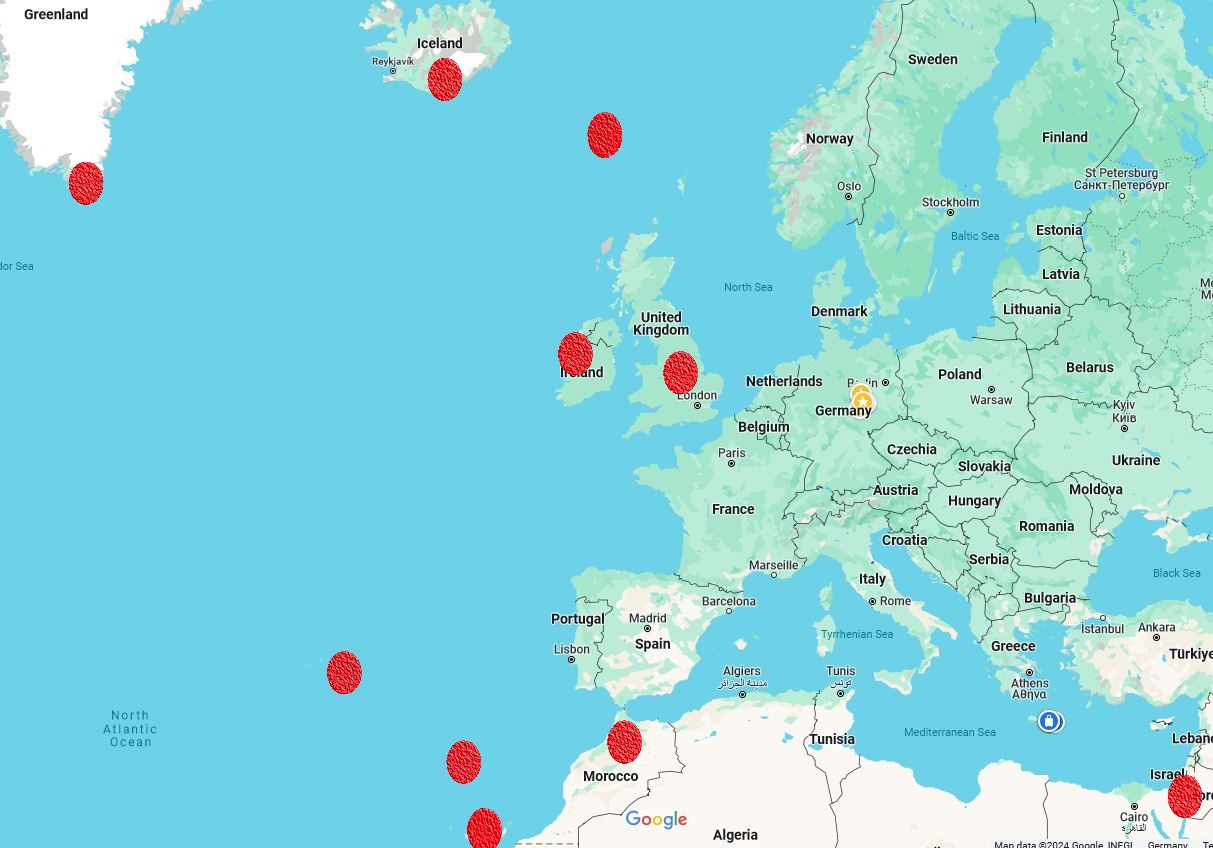
This leaves mostly the existing map of land bases as a huge (USAF-sized) issue:
Greenland would be difficult to garrison sufficiently in peacetime.
Morocco, Israel (and possibly Egypt) are sovereign non-allied countries and could rather not be garrisoned.
Iceland, Faroers, Ireland, Azores, Madeira and Canary Islands could be defended, but fortifying these with missile-based defences and artillery-strong garrisons (though largely just pre-positioned hardware for such) would require much local real estate, budgeting for more than € 100 bn initial costs, consent by the respective sovereign European country and most of all politicians who actually understand that we may need to deter & defend towards the West. They were raised into a world where this sounds like mirror universe concerns. Additionally, the Eastern European countries are obsessed with the threat posed by Russia for understandable reasons.
What does it take to defend an island base against a dozen supercarriers and the USN's amphibious fleet? The easiest approach would be detection + area bombing with SLBMs.* This should be an option, for this option would force the attacker to disperse. Dispersed forces are easier to keep out (though not easier to defend against air strikes). Moreover, a "Marianas" base for bombing Europe would probably need to be annihilated by SLBM anyway. This means an evacuation of civilians from the smaller islands at the beginning of armed hostilities would be advisable (at the very least from the Azores). Such an evacuation might be decisive at deterring an invasion; who would execute a risky invasion knowing that it won't give a usable base?
Another important ability would be to enter the fight over Faroers, Madeira and maybe Moroccan Coast in the air. This is similar to the need to fight a conventional air war against carriers. We should have hundreds of sets for turning airliners into tankers and platforms for (anti-ship capable) cruise missiles. Moreover, we should have diverse (in case one technological approach proves a failure) anti-ship-capable cruise missiles and similarly-ranged anti-radar missiles in stocks. These munitions would also be relevant for deterrence & defence in the East (in land attack roles), so the expense may be justified rather easily.
A conventional approach against bases is to attack them via air strikes or to blockade them. A close blockade might be a job for non-nuclear submarines, while a far blockade could be executed using armed merchantman commerce raiders. Air strikes on bases would be quite similar to air strikes on carriers; a standoff launch of missiles would be preferable. Converted airliners could serve as launch platforms for attack and decoy munitions while military aircraft provide the strike package's escorts (fighters, standoff jammers, passive electronic warfare).
Free Europe might have a good case for cooperating with unfree China to develop such strike package capabilities during the 2030's - all out of necessity.
Finally (for part III), a general statement:
It's foolish to buy any air forces or navy equipment from the U.S. that has a radio frequency antenna or anything that could technically serve as such. All such equipment might have a backdoor command embedded that permits the Americans to sabotage its employment up to exploding while carried by its platform. Such systems often stay in service for decades and take yeas to replace, so it's unacceptable to buy American NOW, not only once America turned full Fascist.
This includes that all F-35 purchases by European countries are foolish, and less obviously so, al Americans-dependent aircraft systems (such as the Korean F-35 equivalent) are off limits as well.
Part III got quite long, so the deterrence topic will be covered in part IV.
*: I'm sure that a first use of nuclear munitions against population centres is unacceptable, but a first use against naval forces of an aggressor is IMO neither unethical nor too risky. It depends on what alternatives are available, of course.
We should quit eventually (there's a 12 month period between quitting and actually leaving the treaty, see article 13), though. The time should be used to build up deterrence & defence against the United States of America (that would be part III of the series).
The lessons learned about Putin's fifth columns in Hungary, Slovakia and kind of (more complicated) Poland point strongly at the EU not being fit for acting as a multinational defence organisation for Europe.
The European unification fanatics, EU politicians and EU bureaucrats would oppose it, but we would have to create a separate and functional European Defence initiative. It doesn't need to be a real alliance; the Lisbon Treaty can serve that purpose. We'd need a coordinating and meetings agency because we'd need to keep Americans, Canadians, Russia's 5th column, America's 5th column and unstable partners who might fall into such a category out of the core consultations and core preparations.
I mentioned the Lisbon Treaty. We really should raise awareness about it now that the "neutral" Swedes have shed their neutrality. Disregard Austrian sensitivities about them wanting to pretend to remain neutral! They signed the Lisbon Treaty as well. The public needs to understand that the Lisbon Treaty is at least as much an alliance as is the North Atlantic Treaty. Perception makes treaties powerful. Just look at Article I of the North Atlantic Treaty, which hardly anyone knows and thus almost nobody complaints about its violations. How many comments in newspapers or on television would point out our EU collective defence obligation if Vienna was hit by a Russian missile? They would probably manage to notice -with Wikipedia's help- that Austria is not NATO member, that's all.
We need to change that! A Turkish attack on a Greek island means the EU members go to war with Turkey. A Russian missile on Vienna means the EU members go to war with Russia. An American missile on Paris means the EU members go to war with America. This should be self-evident to the majority of adults in all middle-sized and large EU countries.
Finally, we need to stockpile strategic raw materials more and develop alternative routes of transportation with enough capacity for very high value but small volume and mass exports and imports. We could not make do with only services & air freight as objects of trade beyond Europe and its periphery. The stockpiling in particular would be difficult (and capital-intensive), but also useful in case of a Pacific War.
The problem with all this is that the current generation of politicians in the larger European countries is utterly worthless. They would rather misgovern so badly that their own country falls to extremists than to get their act together for European security in less than a generation.
Part III will be more about development, procurement and force design.
The risk of the United States of America turning full Fascist has entered more mainstream media. I wrote about it years ago, but there's no reward for being early.
What would it mean threat-wise to Europe?
The threat ranking would change, and not just because of Americans: The Russians turn into Italians with nukes. They consume their Soviet arms arsenal inheritance in Ukraine. The addition of the Finnish army to NATO and the ruin of the VDV render Russia impotent versus free Europe, even if Turks and Hungarians would side with Russia.
The PRC being mostly of concern regarding a possible reinforcement of Russia if we (Europeans) are stupid enough to get involved too much in the Far East. (I believe that embargo & arms sales are the way to go in case of a Chinese assault on Taiwan main island, Philippines, ROK or Vietnam.)
So, what could the United States of America do to free Europe?
It could also subject free Europe to air attacks. This would mostly be cruise missile attacks (that damage would be repairable, though key repair industries require protection or redundancy). "Stealth" bombers could be a problem because we didn't face them so far and haven't built up the necessary long wavelength search radar network to detect them at useful distances. Those "stealth" bombers would mostly drop just some more cruise missiles, though.
Then there's the threat of naval aviation and worst of all, the USAF could set up bases in striking range, and striking range is thousands of km to them.
So let's look at the map:
Greenland, Iceland, Faroe Islands, Ireland, UK, Azores, Madeira, Canary Islands, Morocco and Israel are plausible bases for air attack. I omitted Egypt because that seems too much trouble for Americans and too much at risk nuclear-wise. Only UK and Israel might be voluntary bases, the rest would be invaded.
The parallels between U.S. vs. free Europe and U.S. vs. PRC are evident now. The U.S. needs in both cases
not really fear attacks on its own territory
attack primarily by air power
especially by cruise missiles
use nearby bases that need no great land force for their defence
the ability to take said bases by amphibious/triphibious invasion
cut off oceanic trade
produce (ten) thousands of guided missiles during wartime
This means it's near-impossible to enhance European security vs. Americans by pushing for arms limitations on the American side. They wouldn't agree to those because they need those arms for the conflict with China that's on their minds.
A Fascist America in conflict with free Europe could actually lead to a Sino-European alliance instead of a Sino-Russian alliance. The Americans may have what it takes to defeat the Chinese, but they cannot afford what it takes to defeat both China and free Europe at the same time - not even if Taiwan, South Korea, Japan & Philippines aid them out of self-preservation motives.
On the other hand, a quasi (Hindu-)Fascist India could ally with the U.S. due to its issues with Pakistan and China and then we've got about the same mess as if China allies with Russia, for India will become a huge industrial powerhouse especially so with the war economy-relevant 'old' industries soon.
Part II will cover what European defence policy (basically, force design) needs to include to tackle the 'hostile Fascist America' contingency.
.
I wrote before about how the world's shipbuilding industry appears to be concentrated in approximately even shares in PR China, South Korea and Japan, leaving little shipbuilding in Europe and almost none in North America:
The simplistic calls for American arms racing at sea are thus facing a terrible industrial base.
Now I'd like to add information that adds much to this, also reducing the alarm level:
The Chinese produce almost no marine diesel engines.
Ships are driven typically by one of two engine types; big marine diesel engines or gas turbines. Gas turbines are relevant almost exclusively to fast warships. It's possible to build warships with COGOG propulsion (combined gas and gas) using two cruise gas turbines and two sprint gas turbines, but gas turbines are less efficient for cruise than marine diesels.
I looked at the freely available information about the marine engine industry (not the expensive reports) and found that the main producers of marine diesel engines appear to be:
Some sources don't even mention STX Engine as a top company. STX Engine appears to have about 900 employees only and a turnover of almost 500 million $ (2023) in a global market of about 17 billion $.
So the PR China's shipbuilding industry is a bit like Russia's arms industry; largely dependent on Western parts. This does not bode so well for Chinese arms racing any more, because welding together sheets of steel to form a hull is not as challenging as the production of those giant marine diesels.
Then again, arms racing at sea could be done with China using STX Engine's (expanding) capacity and domestic gas turbines. They do produce some gas turbines domestically, but again, their capacity is not that great.
And then I found crap like this that awfully reminded me of how intellectually unarmed and strategically illiterate German politicians are.
edit: It was brought to my attention that foreign companies have joint-venture factories in PRC. So the real question may be whether the PRC could keep those running (short and medium term) if the Western companies become obliged to try to pull the plug.
(1) Missiles such as Iskander, LORA et cetera can and should substitute and complement strike by combat aviation, particularly early in a conflict.
They require much lower operating costs due to no flying hours required
for training. At the same time they don't serve the officer corps'
interests well because they're not 'sexy' like fighters and missile
units require few officers.
This looks very fine, even though the recent reports about GPS guidance issues after two years of conflict restrict a bit what can be done with missiles.
(2) MEADS is overpriced nonsense. The IRIS-T-SL addition is actually interesting, but I greatly favoured the SAMP/T
area air defence system (with by now substantial missile defence
capability) as it could have been bought military off-the shelf after
its introduction by France and Italy. VL MICA could have complemented it the way IRIS-T SL is a short(er) range missile component in MEADS.
MEADS has a ridiculous program cost: batteries planned for purchase ratio.
The CAMM ground variant may become another alternative if we regain senses and finally cancel MEADS after all.
MEADS was cancelled. Patriot looks better than I expected in Ukraine because PAC-3 actually performs well against SRBMs and the Russians are too stupid or too cowardly to effectively go after large air defence radars.
(3) Air power will compete with ground forces for airlift capacity,
particularly early on in an unplanned hot conflict. It will also be very
busy with its counterpart and ground-based air defences early on, and
likely possess little ability to decisively affect ground operations in
the first days or weeks. I think air power fanbois such as British folks
who point at the theoretical load carrying capacity of 18 Brimstones
under a Typhoon - theoretically enough to wipe out a tank company -
would be very disappointed if modern combat aircraft were ever used in
the anti-tank role against a great power's army.
The air/ground has certainly been unimpressive over Ukraine, but they don't use Western weapons. Brimstone was delivered to Ukraine for ground/ground use, but I have not seen much effect or praise for it.
6x3 Brimstone missiles under a Typhoon
Actual airbases in German: Path dependency rules!
(4) The German Luftwaffe isn't a necessity for NATO or EU or even only
Germany, but -if done well- it can be useful because it would be (a)
barely at a safe distance to survive a surprise attack and (b) barely
still close enough to the Eastern frontier to help Poland and Lithuania
from German airbases. The usefulness of airbases and auxiliary airfields in Eastern Germany is much higher than the West German ones'.
The Russians weren't able to fully suppress the Ukrainian Air Force. They waste missiles on irrelevant targets and had for two years of conflict a too long process from collecting sensor data to strike a fleeting target (such as a parked operational aircraft) on the ground. So I underestimated the usefulness of Polish airbases, but my point about the desirability of airbases in East Germany and Czech Republic stands.
(5) It's still up for debate whether the next fighter generation will be manned, unmanned or optionally manned,
but this is missing much of future air war anyway (in my opinion).
Traditional air war is about growing aircraft flying high and fast,
while in future much of the air war may or will be about small,
low-flying and short-ranged drones that may even mimic birds. Thousands
of these could be unleashed into an area for attack and/or
reconnaissance. It's not apparent that ground forces have adapted to
this with appropriate changes in battlefield air defences, but it's
astonishing to me how Western air forces appear to ignore the entire
possibility and thus cede this probably more decisive air power element
to the ground forces. Current fighter types and designs certainly don't
incorporate counters; the missiles in use cost 10-100x as much as a
small drone needs to cost.
I was proved correct.
(6) Air combat will consume a terribly high quantity of expensive
missiles. The kill probability will be terrible (AMRAAM has a 50% pk
track record, and that was gained in very advantageous situations). We
may need more than 30 air combat missiles in stocks to kill a single top
quality fighter, which means we should purchase 40+ missiles per air
combat kill expected to be necessary. Foreign powers that shall be
deterred are likely aware of this, and they're likely aware that such
munitions purchases have a low priority in air forces that stare on
aircraft quantities and where the officer corps in control doesn't
benefit from higher ammunition stocks directly.
It appears that both Ukrainian and Russian combat aircraft have little air combat, as S-300 and S-400 area air defences repulse them so far back (above 200 ft) that they rarely come no escape zone ranges with hostile aircraft.
(7) It should be obvious once again by now, but let's spell it out: I
think of air forces as bureaucracies. The caste in control is the
officer corps. The junior officers are typically fine, but beginning
approx. at Lt.Col. the officer corps begins to follow the descriptions
of the principal-agent problem when it comes to resources.
I moved my blaming for poor decisions from the industry profit motive to
the principal-agent problem in the bureaucracy (and its political
overseers) years ago already.
The wars give no evidence in this regard IMO.
(8) The public is poorly informed about air power matters because
important info isn't communicated (mostly for obvious reasons). We learn
how many aircraft of a particular type were purchased and in service,
but we rarely learn how many daily sorties
they could generate, for example. The difference between two and eight
daily sorties changes the utility of the aircraft in question by very
much, of course. Higher sorties rates can be generated with aircraft
meant for shorter ranges and of more simple technology - that is,
aircraft that run against the actual procurement trends.
The wars give no evidence in this regard IMO.
(9) Many mistakes have been made in procurement
by air forces. There's no reason to trust the bureaucracy's expertise
in future procurement projects, even though we don't learn about many
important variables.
The wars give no evidence in this regard IMO.
(10) The trend towards using air bases far away (much farther than 500
km) from the targets and the thus exaggerated need for tanker aircraft
is worrying. NATO appears to be so lazy that it rather adds a 500 km
transit than to move a wing or detachment to a less fully developed but
much better located airfield.
The wars give no evidence in this regard IMO.
(11) Equally disturbing is the obsession about bunker-busting. I suspect
that many "bunker buster" munitions are secretly meant to penetrate
into reinforced concrete pillars of river bridges to blow them up from
the inside, but even this enlargement of target options doesn't really
justify the obsession with bunker busting. To penetrate aircraft bunkers
on airfields would typically not even require a standard-sized bomb, much less a dedicated bunker penetration warhead as in the Taurus missile.
Bunker busting was so far quite irrelevant in the Russo-Ukrainian War and bridge pillars weren't blown up.
(12) Western air power military theory and campaign plans/command are utterly unimpressive. Strike choreography has been rather impressive since the 1960's,
but the typical answer of air power to problems is still to throw more
resources at the problem, to bomb more. I'm utterly unimpressed by
supposed stars of air warfare theory, such as Warden whose theory is an
utterly useless fig leaf for incompetence campaign ideas. I tried to
criticise constructively, of course.
The Russian air power strategy appears to be so dumb that they could do better if they asked ChatGPT for help. The Ukrainian air power strategy appears to be on about the same level, albeit there are rudimentary signs of a counter-oil strategy.
(13) I don't like the assassination-by-drone campaign, but most of the
time the country's government appears to have green-lighted it. Cruise
missile diplomacy on the other hand is much worse; it's plain arrogance
and aggression most of the time.
The wars give no evidence in this regard IMO.
(14) Western air forces don't need bigger budgets. They should make
better use of their budgets, oriented at (collective) defence and
deterrence.
The impotence of Russian air power in face of old (and totally known to them) air defences as well as the ability of Ukrainians to conduct 1,500 km long strike missions with cheap improvised cruise missiles kind of proves my point.
(15) Close air support is overrated
because it was available in a much bigger ratio to ground forces in
contact than this would be the case in Europe. In Europe, individual
platoons wouldn't be heard by the air force; maybe individual reinforced
battalion battlegroups would be heard. CAS was also exaggerated because
air defences haven't distracted and impeded CAS after 1991 any more.
Close air support was not very important or very effective in the Russo-Ukrainian War until recently, when guided Russian glide bombs began to pound known Ukrainian field fortifications in an effort to do what Russian artillery is apparently too impotent to do. Still, it's only relevant at main efforts. Meanwhile, the classic CAS as Westerners think of it is absent and there's instead a drone plague in effect at up to 20 km depth. I consider such short-ranged drones to be more akin to artillery, not air force-like assets.
(16) I'm no fan of large airlift capacity. I understand that the
Americans need it to deploy past the oceans quickly, but Germany doesn't
need any military transport aircraft in my opinion. Most needs can be
(and many are being)
covered by chartered aviation, some can be eliminated by doctrine and
others are merely imagined. The A400M project was an embarrassing de
facto subsidy to a most ungrateful (and unexpectedly incompetent)
industry.
The wars give no evidence in this regard IMO.
(17) Long-range radar aircraft (E-3 and E-8 as examples) are impressive,
but would likely be pushed back if facing modern Russian technology.
Once pushed back by fighters and batteries with long-range missiles,
they could look barely or not at all into 'hostile' territory any more,
and thus wouldn't play their huge potential roles in attacks and
offensive operations on the ground. A possible countermeasure would be supersonic businessjets
turned into radar aircraft since these could survive 50-100 km farther
forward, but no such businessjets ever seem to reach the prototype
stage.
Electronic countermeasures add another big question mark behind the utility of air and ground surveillance radar aircraft.
The Russian A-50 Mainstay AEW aircraft was able to operate for a long time, but a few losses in the air and attacks on their airbase appear to have neutralised these assets. They would sure love to have a survivable AEW aircraft, but they did generally neglect AEW and had too few of the ordinary AEW aircraft to begin with. ECM effect against Mainstay and electronic intelligence aircraft was not published AFAIK.
(18) Maybe - contrary to Brimstone fanboyism et cetera - tactical air support of the future (CAS) will primarily be about detecting and identifying targets
for ground forces' artillery that grew very much in range and precision
during the last 20 years. This means that the old (since early 80's) Brevel/KZO or Aquila approach for an artillery spotter drone may still prove to be the way to go.
This is what drones did and do; originally the TB-2, nowadays quadcopter/multicopter drones.
(19) Airspace deconfliction has gotten out of hand.
This event looked scary, but did no harm. I have not read about or heard of any losses due to lacking deconfliction between artillery and airpower. There weren't terribly many aircraft over the frontlines, though. The biggest deconfliction issue appears t be 'friendly fire' against drones (especially with jammers) and of Russian air defences against Russian combat aircraft.
So overall, I think my theses look pretty good, kind of above average compared to most publications about modern war in the air.
A brigade of the line should be modestly ambitious, high end only in critical key areas (reliable instant communication in the field and ability to defeat any AFV type) and it can be designed to be very dependent on higher level support. This way we can force design a brigade of the line ('infantry brigade') that has the training requirements toned down enough that reservists can fill 99% of its jobs (all jobs except battalion CO, brigade CO and XO and some brigade HQ positions).
It would be dependent on such support anyway, so the force designer can -in an act of self-discipline- drop the pretence that such a brigade could stand against a main effort attack on its own.
Long range artillery fires are amongst what can be outsourced to above brigade level. Supporting fires on several kilometres front width and several kilometres front depth on the other hand is an every day need and should be organic, thus more reliable.
There are two ways to address this; we could think at battalion level and require the range needed to support a battalion. This leads to a 120 mm mortar with usually much less than 10 km range.
To address a brigade sector with all indirect fire support weapons requires more range. How much depends on many factors. A brigade sector is often assumed to be about 20 km wide, which requires about 15 km effective (with acceptable dispersion!) range. That's more than 120 mm mortar offer.
One might say 155 mm could cover much more than that, but shells flying that far isn't quite the same as capability to support well at that distance. The dispersion gets ever worse with longer ranges (especially with RAP shells) and 155 mm shells have ceteris paribus a greater danger close footprint than 105 mm shells have. In combination, you could not give 155 mm fire support against targets close to friendly troops at much greater distances (if any greater ones at all) than with 105 mm guns.
You can expect a dispersion better than 0.3% of range (30 m shot length dispersion at 10 km shot range) and better than 1% of range left/right (with gun set after first shot, about 10 m shot dispersion left/right at 10 km shot range) from a modern 105 mm howitzer.
120 mm mortars are popular as battalion-level support, but they are largely unavailable for brigade main effort fires due to their short range (their time of flight and sensitivity to wind is bad at extended ranges). This makes them reliable organic weapons for the battalion commander, but suboptimal for the brigade. A brigade with 120 mm mortars would need howitzers (105...155 mm) as brigade asset to be able to move fires quickly in the whole brigade area of responsibility. 105 mm field howitzers can also be reliable organic assets; standing orders and hardcoded priorities in fire control software can ensure that a battalion in contact always has support by two ro three howitzers. A brigade with three infantry battalions and 18 105 mm howitzers would still have 12...14 howitzers available for the brigade CO's main effort this way.
Moreover, think of the typical frontline deployment of an infantry brigade: Either one infantry battalion forward and two behind or two forward and one in reserve. Brigade fire support that consists 100% of 105 mm howitzers could be 100% available in such dispositions, while 1/3 to 2/3 of 120 mm mortars would either be detached forward or unavailable for fires at most of the line of contact. A one battalion forward deployment also shows that this battalion's mortars would be overstretched on a 15 km brigade frontage.
- - - - -
So let's look at 105 mm howitzers for affordable brigades of the line, brigades suitable for creating, holding and occasionally slowly moving a defensible (often entrenched) frontline.
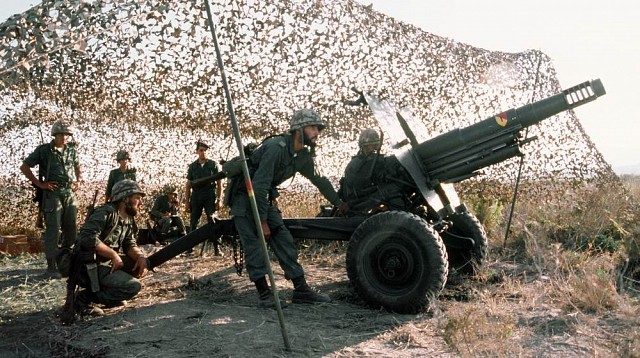
105 mm mountain howitzer OTO Melara Mod 56
The old light (mountain) howitzer OTO Melara 105 mm Mod 56 may serve as an example. Its dimensions in travelling configuration are
Both fit into a normal European car garage, which has approx. the internal dimensions
5.5 m length
2.3 m width
2 m height
An ISO 20 ft container (which could be dropped in the landscape by the thousands) has the internal dimensions
5.89 m length
2.35 m width
2.39 m height
This makes it much more feasible to effectively hide with such a gun than with 155 mm or self-propelled guns.
I say it's possible to design a more modern light howitzer that fits this description:
shorter than 5.4 m
narrower than 2.2 m
lower than 2 m
fits into a typical European car garage
fits into ISO 20 ft container
boattail shell range no shorter than 10 km
maximum elevation 70°
I strongly suppose it's possible to add these features without exceeding the dimensions
integral accurate position- and northfinding equipment
integral auxiliary drive (battery-electric or 2-stroke diesel or a hybrid of both) for moving on flat hard surfaces under own power forward/backward up to running speed
hydraulic power from auxiliary drive can be used to raise the spades (getting them unstuck manually may take time)
burst rate of fire 12 shots in one minute (as have L118 and LG-1 howitzers)
barrel (liner) durability (and carriage durability) better than 5,000 EFC (equivalent full charges)
without it becoming too big to hide, to difficult to move or unsuitable for a 4x4 SUV as towing vehicle.
This would give the howitzer fire support qualities against all line-of-sight threats that the friendly forces face. Most targets that are identifiable with small (highly expendable) quadcopter drones or mast-mounted sensors would be within range as well. Deeper fires would be left to 'real' artillery, while this 105 mm howitzer would be more of a 120 mm mortar (practical range less than 10 km) alternative. Some danger close fire missions would be executed with SatNav-independent trajectory-correcting munitions to reduce the dispersion in range.
The howitzer could hide in a partially destroyed building, a 20 ft ISO container, a concealed trench, a garage or in woodland. The crew could receive a fire mission, move the howitzer into firing position in less than a minute, fire twelve shots in one minute (first shot least accurate and possibly self-destructing used for setting and measuring muzzle velocity only, others benefitting of now embedded spades and measured muzzle velocity of first shot) and go back into hiding within up to 2 minutes.
The munition of such twelve shots would weigh less than 250 kg including fuzes and propellants. This means a transportation with some kind of wheelbarrows would suffice for 100 m, alternatively even a small car such as Suzuki Jimny could provide a platform for the munition, for a fire control laptop, a radio and also serve as a towing vehicle (towing capacity of Suzuki Jimny is 1.3 t).
It might even be possible to hide the gun inside a shovel-dug trench (with overhead concealment if not cover and a ramp). The gun's auxiliary propulsion might drive an onboard winch to pull the gun out of the trench easily and quickly.
Even a combination of counter-artillery radar, standoff observation drones and PGM for counterfires is not very effective if the opposition can move and hide its guns like this. You might need to hit 5...20 probable locations to hit one gun, and such guns are difficult to take out of action for good. The guns would be dispersed; counterfires could never hit more than one gun and its crew. Friendly forces and civilians would be banned in the general area and the gun would thus be deployed at a safe distance to important roads and villages.
So what would be the jobs of such brigade artillery?
suppressing fires (105 mm is about as effective as 155 mm at this)
destructive fires at soft targets of opportunity (single gun or few guns on point targets, massed fires on area targets), including fires on mortar teams and triangulated radio frequency emitters
fires at marshalling areas
(IR) illumination shots
(multispectral) smoke fires
leaflet (propaganda) fires
occasional neutralising fires
possibly shooting down observation drones if they are close enough (using proximity fuses)
This leaves especially deep fires, fires on hardened targets and most neutralising fires to the higher level artillery (divisional or corps artillery). This frees the brigade HQ of tasks, as they would not have to handle such activities. The forward observer teams and aerial observation would communicate targets for deep strikes and hardened targets directly o higher level fire support.
The brigade HQ would not pay much attention to what happens beyond about 5 km of its troops other than receiving warnings about incoming hostile forces. This limitation of the brigade HQ is possible and driven by not giving the brigade longer-ranged artillery (such as 155 mm howitzers or MRL) and it helps with allowing a slim, quick and largely reservists-staffed brigade HQ.
Europeans need to wake up to more than one threat and we need to eject the tunnel vision "Atlantiker" (friendship with America ideologues) from positions of influence.
Around 2011 I wrote multiple times about a scenario of a Russian surprise attack on NATO (at the only kind of attack that makes kinda sense, for it's the only scenario that gives the Russians a chance) and how this would lead to low force densities (very wide brigade sectors). This in turn would not allow to properly defend a frontline, and the benefits of a frontline (stability, safe resting area behind, counter-scouting) would disappear, the opportunities of a more fluid theatre situation would appear.
Consequently, I wrote many blog posts relevant to that scenario. Now Russia started the biggest post-WW2 war in Europe and the Ukrainians defend the full frontline. Neither Russians nor Ukrainians appear capable of breakthrough. I suppose that's a matter of competence, not of state of the technology or art of war. The Russians even botched the "strategic surprise" part and stumbled into Ukraine as they did into Chechnya in 1994.
My views seemed to be disproven (and I wrote about that a couple times).
Now I would like to claim that the war we're seeing is very similar in many aspects to both World Wars, the Spanish Civil War and the Iran-Iraq War. So there's little new. Even the drones merely repeat the accelerated advance of military aviation in WW1 and the accelerated advance of electronic warfare in WW2.
The concept of both sides appears to be to have a bulk of forces (80-90% ?) suitable for holding a frontline and a few formations set up for either breakthrough (Russian storm units) or main effort (Ukrainian mechanised brigades with Western gear).
Neither side has the competence to do a proper combined arms breakthrough, and the Ukrainian tank forces resemble rather the 'fire brigade' Panzerdivisionen of late 1944 than the 'Blitzkrieg' Panzerdivisionen of 1940-1942. The Russian mechanised forces resemble the French tank divisions of 1940.
It may not sound nice, but both sides suffer badly from insufficient reserves training prior to 2022 and are by now rather amateurish and incapable of combined arms warfare. Both sides are using armed forces that were ridden by corruption for three decades and are rooted in the at most modestly competent Russian army tradition. It's a common symptom that amateurish armies form when armies expand very quickly in wartime, with much of the pre-war experts killed in the opening stage. The American Civil War was such a amateur war. The British Expeditionary Forces were quite amateurish around 1916, too. Historians are usually too nice to point out that insufficiently-trained leaders and troops lead to amateurish, incompetent armies. They do usually research & write about their own country, after all.
The upside of all this is that the Russians gt a demonstration of the limit of their abilities. They do now understand they cannot defeat a 80/20 low-high mix force in the field. They understand that they suffer higher material and personnel losses than a moderately well-done 80/20 mix army, and without the Chinese helping them by the millions of troops the Russians would stand no chance against NATO even if NATO used 80/20 instead of trying to go for all high end forces (in the richer countries).
An all high end NATO might get swamped and overrun by a Sino-Russian force of three million troops in Europe, so maybe we need to counter mass with mass anyway, again leading to 80/20. The Chinese mobilisation potential is well in excess of 150 million men + millions of women for non-combat roles, so NATO might face a sustained incredible numerical inflow of PLA troops of low quality during a long war. We could defeat this only if we're prepared for it - this means at the very least have enough trained junior NCOs to do proper training for our own mobilised mass armies. The point of preparing for this scenario is to deter, avoid the scenario.
The Western way of war proved to be overwhelming to the Soviet arms-equipped 80/20 approach during 1991, but it did so at a time when the West enjoyed a near-monopoly on thermal vision in ground combat and it was in featureless terrain. High-quality munitions were expended at an unsustainable rate. Moreover, most of the ground combat was actually against Iraqi troops already withdrawing in disorder.
The fiscal argument is strongly in favour of 80/20. The 80% troops of the line would not need terribly much training and could be reserve troops. This would greatly save on the scarce personnel, as such reserve forces could have 1,000,000 troops mobilised strength with a peacetime active strength of less than 100,000. This reduces the high direct personnel expenses AND it frees up personnel for civilian, GDP-raising and taxes-paying jobs. A 100,000 € personnel costs soldier job has a true cost to the society of about 150,000...200,000 €. It's plain stupid to unnecessarily keep troops in active duty.
Moreover, those 80% troops of the line would be technologically and fiscally as well as doctrinally feasible for almost all NATO countries. The challenges of a high end tank brigade may not be met by any Western countries these days, and with better effort (focus on conventional warfare) maybe half a dozen NATO countries could master the tank brigade/exploitation brigade pattern well enough for consistent success with it.
So in my opinion
We should prepare NATO defence against Russian strategic surprise attack by 2028 or later
This still means first weeks would have low force densities
This still means it's important to get combat-ready forces to the front en masse within a few weeks
We should prepare NATO defence against a 3 million men Sino-Russian land force 2026 or later
This requires enough mass
Facing demographic challenges and high costs of labour, we should make use of a hi/low mix with focus on mobilised strength after a few weeks. Peacetime military strength of most NATO members does not matter much for defence. To boost it is inefficient.
We should consider helping the poorer NATO members with equipping & training proper brigades of the line
We should consider helping the NATO frontier countries with equipping & training surprise-resistant 'first line of defence' forces that can delay incursions well.
Is there a place for my low force density ideas left? Well, yes, in the exploitation brigades. They do not need to be classic tank brigades or French-style 6x6 wheeled armoured car-based formations.
P.S.: I should mention that the German, Japanese and Soviet forces of WW2 followed a similar pattern of bulk of forces being poor quality but 15...20% being either elite light infantry or fully motorized troops. The only Italian troops of WW2 that were effective were concentrated in two divisions and the Bersaglieri battalions of the infantry divisions. Armies had no such high-low mix during the First World War (they thought they had it with the cavalry divisions being high end, but they proved to rarely be of use). The German army started to be able to breakthrough the Entente in France once it created high end units (assault infantry with actual trench attack training and equipment) in combination with smarter artillery plans. Overall, a high/low mix proved to be the most cost-efficient approach through centuries in Europe. To go all high-end (as Americans with their fully motorised and tank-rich invasion force in 1944) is a luxury left to those with vastly superior industrial resources (or in peacetime: insane military spending).