2020/06/06

Link drop June 2020

.
February's "Disruptive technologies" text did not mention one potential tech: Hydrogen (fusion) warheads without a fission stage. "H-bombs" require the energy of a fission device (Uranium or Plutonium fission) for an intensive x-ray radiation burst that triggers the second (fusion) stage.
Nuclear warheads could be much simpler to produce and have less fallout without that first stage. One of the ideas for alternatives to this fission stage is to use incredibly highly energetic materials. And one idea for what materials could qualify is metallic hydrogen.
It passed way under my radar, but physicists actually have made progress and created metallic hydrogen a while ago.

https://www.sciencealert.com/hydrogen-has-been-turned-into-a-metal-for-the-first-time-ever

https://www.sciencealert.com/french-scientists-believe-they-have-created-metallic-hydrogen

I am not enough of a physics nerd to understand whether this is really a potentially practical alternative or what the (physical) effects of such a no-fission nuclear warhead would be. Still, there might actually be disruptive technologies in the nuclear warhead corner.

- - - - -


- - - - -

bgr.com/2020/05/30/minnesota-protest-contact-tracing-used-to-track-demonstrators/
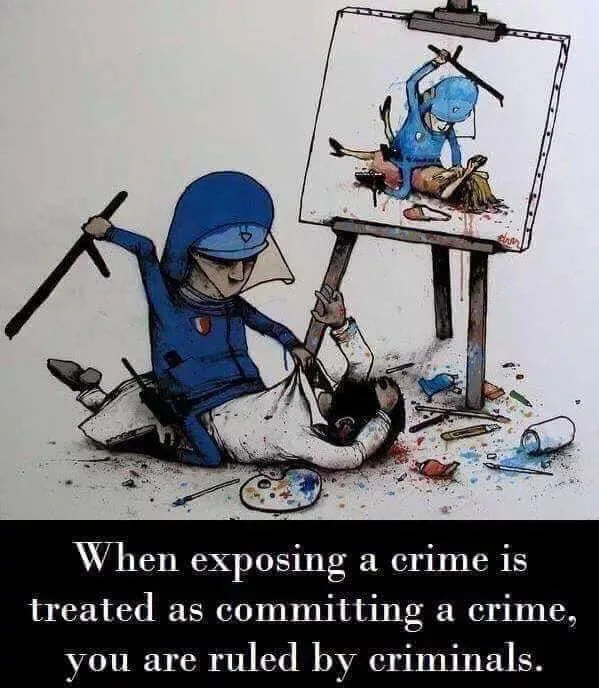
Hence the discussion about the privacy design of the German tracking app. There's absolutely zero reason to trust ANY government with surveillance capabilities or surveillance authority.

- - - - -


It's striking that there's this time around almost no talk of much public investment as a counter-'cyclical' economic stimulus. Economists do actually not know for sure whether the recovery from the corona-induced crisis will be a sharp V-shaped one or a more drawn-out one. We might not even have any full recovery (=no return to the old trend line of GDP growth), just as many Western countries had after the 2008 crisis.
Medical experts don't know whether the pandemic will force us to have at least mildly economy-depressing countermeasures for a few more weeks, months or up to two years.

This seems like excuses for not investing much in the future, but consider this; there's no substantial harm in setting up investment efforts, but then being unable to execute them because of continued troubles. There is considerable harm in the opposite scenario of needing such stimulus, but not having it.

- - - - -


some personal notes:
The news are almost all-round horrible in 2020. Meanwhile, I have a very pleasant private life in 2020. There's a little feeling of guilt over this.

On another note, I expect to completely lose faith in median human intelligence by about 2030 and will then turn into a very, very cynical person. I should limit my exposure to morons to slow this process down. (This is not about commenters at D&F; it's a much more general issue.)

I have tried to come up with some real breakthrough military theory thinking or a concept for some 'magnum opus' on land or air warfare comparable to the 80 book pages equivalent series that I did on modern surface warships. It appears that you cannot force such a thing. Yet, I have recently toyed around with the idea of a military theory/military history commentary on Sun Tzu's "Art of War". This classic is very small and still interesting.


S O
.

2020/05/30

Deploying for attack and speed of advance

.
The point of delaying actions is to threaten the advancing hostile force enough to force it from a marching stance into a combat stance. The vehicles leave the road, deploy into combat formations, probe, use otherwise ignored routes to flank the defender and so on. All this takes a lot more time than to keep advancing along a road. The delaying force then retires before it gets involved in too much combat and ideally the next delaying force repeats the trick so the original one can prepare another such delay in its back.

source U.S. Army FM 3-90.2
(It's a too linear thinking version of a delaying action.)
The training (and technical communication & navigation capabilities) of the attacking force is hugely influential for how quickly it can deploy for battle (and revert to marching order). 

Another hugely important factor is whether the attacking force is armour-centric or infantry-centric. 
Armour can be very quick in such actions. Infantry-centric forces have a much greater difference between road march speed and battle movement speed. Infantry-centric forces may use their line of sight firepower (including from wheeled IFVs and missiles) together with direct fires to defeat defenders, but it should under most circumstances take much longer than for a competent armoured force.

An important difference between infantry-centric and tank-centric forces is how selective infantry has to be in regard to choice of routes. It has to exploit the microterrain for cover and concealment,  and any of their lightly protected armoured vehicles would have to do so (if capable) to a greater degree than tanks, too. The greater stealthiness requirement slows down infantry even more in addition to its lower nominal speed limit.

A delaying action should thus be much more effective against infantry-centric forces than against tank-centric forces. A tank force might be delayed for minutes when the very same delaying effort could delay an infantry-centric force by an hour. Moreover, the road march speed of an infantry-centric force (which typically lacks tracked vehicles) is usually higher than that of a tank-centric force.

A slowed (and more or less slowly weakened) brigade or battlegroup would often be a good target for indirect fires, a flank attack or even a pincer attack. Slowness is self-defeating in mobile warfare.

- - - - -

I've seen people trying to justify brigade designs that lack main battle tanks or powerful infantry fighting vehicles by pointing out their (notional) ability to defeat tank brigades with missile firepower.
Well, that's nice to have.*
I still cannot see how an infantry-centric force could possibly advance quickly against a competent and intact hostile force of half its manpower size. Both infantry-centric and armour-centric brigades should be able to slow down an advancing infantry-centric brigade or two in most Eastern European terrains.

I don't trust in-service ATGMs. Formations without tanks would still be tactically slower and more vulnerable than formations without tanks even if ATGMs work as advertised. It's this slowness of infantry-centric land battle designs that disqualifies the fashionable no-tracks brigade types for mobile land warfare under many if not most conditions.**

S O

*: Well, it's nice if you really think your enemy doesn't have the means to defeat your ATGM guidance after its operating principle has been public knowledge for 30+ years. And then you also need to trust the ATGM warhead.
**: There may be situations in which an all-wheeled battlegroup successfully executes a deep raid in modern chevauchée fashion. It would be essential to not face a powerful aerial threat and to avoid getting caught up in battle with strong hostile forces. Essentially, their reaction to a threat would need to be evasion, not deployment for battle. This would be an available course of action in some circumstances (only).
.

2020/05/23

Specialised forces

.
I observed something peculiar about specialised forces in strategy gaming (such as WITP:AE) and history: They are very rarely where you need them, even if you try hard to bring them into the best position.


The Japanese torpedo cruisers Kitakami and Oi of WW2 are examples: They were capable of launching dozens of the most fearsome torpedoes of WW2 each. Their torpedo firepower could have defeated the Royal Navy's Home Fleet at Jutland. They did never launch such a salvo. In fact, they weren't even where they would have had the best odds to do so - at the Solomons.

The Italian ramming ship Affondatore was designed with one purpose in mind; sink a powerful warship by ramming. It was present at the battle at Lissa and there was a ship sunk by ramming, but Affondatore didn't ram any ship, ever.

The British battlecruisers of the Furious class were built with some crazy Baltic invasion scheme in mind - and never entered the Baltic.

The early battlecruisers were all about defeating armoured cruisers with superior primary artillery at long ranges - with dozens of battlecruisers, there was but one action ever where such a thing happened.

The French battlecruisers Dunkerque and Strasbourg were designed to sink German Deutschland class heavy cruisers, but they never faced any.

The Deutschland class itself was built for commerce raiding on the oceans. Fast enough to run away from battleships, strong enough to defeat cruisers. The entire class saw very few successful patrols and the only action against cruisers was followed by the scuttling of the Graf Spee itself.

Surcouf was a submarine with extraordinary gun armament - and never used for anything, really.

- - - - -

These were examples from the naval realm.
There were also examples from land warfare. Leaving technical oddities aside, entire light (Jäger / infantry) divisions were raised by the Wehrmacht for combat at the Caucasus. That didn't happen.

Specialised artillery divisions were raised to lend extra artillery firepower to breakthrough operations, sieges or crisis areas. They were wasted as frontline divisions instead, overstretching their weak infantry component.

Mountain warfare and paratroops formations of WW2 mostly fought like infantry divisions, albeit often in swampy or woodland terrain.

- - - - -

The one area where highly specialised assets appear to be mostly successful and even often employed according to their purpose seems to be air warfare. The extreme mobility of air power and by comparison static nature of its targets appears to be an important factor. It enables the mission planning to send the specialised assets to where and when they can serve their purpose.

Many specialised air power assets such as jamming aircraft or reconnaissance aircraft tend to be highly dependent on a technological advantage for their missions, though. Old reconnaissance aircraft that became too slow have failed in WW2. A reconnaissance aircraft that gets its imaging radar jammed would fail today. A jamming aircraft that fails to jam effectively is pointless.

- - - - -

Specialisation appears to be less successful whenever it's directed against few hostile forces or for a relatively small area. Highly specialised minesweepers that faced hundreds of thousands of naval mines were a very successful asset in WW2, for example.

Long story short, I feel we should guard ourselves against the strong pursuit of highly specialised assets at least if they are meant to face a small quantity of threats. Versatile units tended to be more worthwhile and mostly better-suited for what actual action they saw, and I suppose this may continue.
We cannot avoid specialisation entirely, but I suspect we go too much for it if we don't deliberately  guard ourselves against an overemphasis on specialisation.

S O
.

2020/05/16

The West is naked, and everyone sees it

.
There's a torrent building up slowly but steadily: A torrent of articles that point out the failure of the West, its star industries and institutions, to rise to the pandemic challenge. There was an earlier wave of more or less humorous content on humour website about how the U.S. fails to rise to the challenge and save earth as it does in Hollywood movies all the time. Hollywood disaster movies usually have some scientist who doesn't get listened to until the disaster is happening, then he gets listened to, the president rises to the challenge, some genius idea, disaster defeated. Oh yes, and New York gets pummeled every time.
The Cassandra aspect and the NY pummeling were the only things that happened for real (that bis, only the bad aspects did happen).

But it's not only the U.S. that's failing grossly. The left wing-controlled Canada has failed to bend the curve of infections and is still in the linear growth phase as well (as of today). European countries fail with characteristic diversity of outcomes, and Russia fails, no matter how many shirtless photos its autocrat-in-chief has made.

I do suppose that the roots of failure are not merely about cultural issues with masks, though this added difficulty. Likewise, the loud but small minority of super egoists and anarchists who resist united action against the pandemic doesn't seem to be the driving failure to me, either.

My suspicion is rather that a strength of the West happens to be a weakness in this particular event: The Western focus on cooperation and consensus proves to be a weakness this time, as it has accustomed politicians and others to small steps rather than to decisive action. Now we do need decisive action, but our political leadership and public service are simply unsuitable for this.
This doesn't apply to the Americans and British, who famously rejected this style of policymaking. They fail for a different reason. They elected a clown, so they get a circus - it's that simple.

The real question in regard to defence is whether this show of weakness undermines our deterrence. I was pleasantly surprised by the American's ability to develop and quickly field MRAPs by the thousands in the 2000s despite their rotten procurement bureaucracy. The current crisis does now undermine this signal. Maybe the ventilator and mask production mobilization will at least signal an ability to respond with large-scale production within three months after the need becomes obvious.

The pandemic crisis also suggests that devastating economic and cultural warfare against the West may be as simple as manipulating some ordinary virus to create another pandemic or two.

The one upside that I see in this is a bit cynical; the Russians appear to fail even more badly (and cannot hide it any more). So basically the only somewhat capable potential threat to Europe in Europe is looking even worse (and badly hurt by the concurrent oil price collapse).

Still, it's a totally unsatisfactory picture in my opinion. Sadly, the rally-around-the-flag aspect and the loud noises of the moron faction diminish the chance for real, well-aimed improvements.

S O
defence_and_freedom@gmx.de

P.S.: I cautioned about what became a pandemic on February 1st and sounded full alarm on February 24th. This was without unusual access and without being in a job that would require me to care about public health. My dissatisfaction with the policies and their timing is rooted in part on my opinion that public knowledge suffices to do better than what the politicians did. The hesitation may have been an attempt to reduce the economic damage, but  the lack of early warning to the industries and lack of early prioritised orders for critical supplies indicates that the decision-making lag was really as long as it seems.

2020/05/02

Link drop May 2020

.
A website dedicated to Soviet Armed Forces 1945-1091
 
- - - - -

arstechnica.com/features/2020/04/some-shirts-hide-you-from-cameras-but-will-anyone-wear-them/

- - - - -
 
https://9gag.com/gag/aK74R23

The question our executive branch politicians have to answer before the next elections is "Why didn't we have this by February already?!?".

The costs of the supplies are negligible, and all countries have enough unemployed people to provide the necessary labour.

- - - - -

defence-blog.com/news/u-s-air-force-test-a-mobile-aircraft-arresting-system-at-an-undisclosed-location-in-southwest-asia.html
The U.S. had something similar in the Vietnam War era and I have long considered it a scandal that such tech (preferably coupled with a mobile ski jump ramp) isn't standard equipment in air forces. I suppose that's a result of the top bras' bias towards peacetime flying things.

- - - - -


My question is: "How can a person possibly be so dumb to not see that this is an total moron? He is OBVIOUSLY dumber than an average 3rd grader. His knowledge on things has been displayed as irritatingly deficient again and again on utterly normal things to know. He didn't know that people died of the flu even though his grandfather did. "Nobody knew that health care could be so complicated." after claiming to have a plan that gives better care to more people for less money.

How can an adult be so stupid? I used to think that the crazies who sit on park benches and loudly argue with themselves are the most dysfunctional people not yet locket up in psychiatric wards, but apparently that was wrong.

They gave the nuclear codes to this horse crap version of a brain!

- - - - -

The Onion

Look at the date.

- - - - -

https://www.vox.com/2020/4/10/21214980/coronavirus-economy-jobs-ppe
"5 lessons from World War II for the coronavirus response"

- - - - -

I lost an entire article in April. It was scheduled, then suddenly I had another article scheduled twice for the same date with the same headline. I deleted one of the two copies and next day I noticed that the unrelated scheduled article was gone. That's a never seen before (my me) hiccup of blogger. Luckily, I wasn't fully convinced of the lost article's quality and had delayed its publication since February.

- - - - -

This shall be a reminder that I never sided with the ammosexuals even when I wrote about guns.

- - - - -

[German] www.spiegel.de/politik/ausland/corona-pandemie-populismus-toetet-kolumne-a-00000000-0002-0001-0000-000170435611
Er verwendet das Wort "Populismus" und meint "Demagogerie", aber ansonsten 99% Zustimmung von mir.

- - - - -

.

2020/04/25

Reminder about non-combat troops

.
The comments on the skirmisher topic reminded me of the widespread mistake of today: People are thinking about land warfare as a clash between combat troops. And I may have neglected to push attention towards when it's not.

Combat troops vs. combat troops is a mostly correct scenario only in slow-moving land warfare with defended positions and even then it's only true regarding direct fires.

Highly mobile (fluent) land warfare is in great part about tanks facing (and crushing or dispersing) non-combat troops. Remember; combat troops are a small minority in an army in the field. Well less than 25% of the personnel are combat troops, even less if you don't count recce, arty, mortar teams and the likes as combat troops. 
Even the combat troops are battle-ready only in a fraction of the time and against certain kinds of combat troops (an ATGM team is not of much use in a close fight with infantry, for example). They won't fare much better than non-combat troops when surprised while not battle-ready.

The 'combat troops vs. combat troops' paradigm is completely pointless in regard to elusive forces (skirmishers, guerillas). The U.S.armed forces had more non-combat troops KIA in Iraq than combat troops KIA for this reason (and because they employed non-combat troops as auxiliary security personnel / MP).

Light forces akin to skirmishers cannot only be employed to cause trouble to armoured spearheads. They can persist in the area (leave behind, kind of Jagdkampf* tactic) and then engage the many, many non-combat troops that have negligible to weak combat power. A skirmisher/Jagdkampf platoon doesn't need to measure its combat capability in terms of its ability to destroy MBTs head-on as tank companies do; it primarily has to look at how well it can entrap and annihilate a convoy of 30 non-combat vehicles.

This (and thus the skirmisher and Jagdkampf concepts) has extremely far-reaching consequences. The current force structures in Western land forces may be unbelievably brittle and ill-advised against an opposing force that adapts to exploit the Western infantry and dispersed combat weakness.**

S O

*: I have not found an English summary of Jagdkampf. It's basically about a stealthy infantry platoon fighting in isolation, possibly even guerilla-like as leave-behind forces in the enemy's back. Jagdkampf and Stoßtrupp (infantry assault platoon) are the two dominant German infantry concepts, as opposed to the anglophone obsession with a "patrol".
Jagdkampf as it was in pre-2002 field manuals was a deeply flawed concept based on improbable assumptions. It could have been much better; there were plenty military theory contributions to this end in the 70's and 80's that were not as half-assed. I have not seen how the doctrine was adapted after the Afghanistan experience. The extinction of the German long range scout / LRRP establishment indicates to me that the Heer does not bet on dispersed small unit operations at all.

**: Similar concerns were already voiced by the early 1980's based on a mechanised warfare threat, see as example the booklet "Battlefield Central Europe" by Uhle-Wettler.
.

2020/04/18

Military theory of skirmishing

.
(This is one of the topics a whole book could be written about, but I will try to shrink it to blog post size.)

Skirmishers are well documented since antiquity. Their contributions were likely overlooked by many contemporary authors because skirmishers had no high social standing. This is similar to how some authors pretended that medieval battles were just a class of a couple hundred or thousand knights each, when typically each knight represented a "lance" (a small group comprised by the knight and his followers).

a peltast (javelineer)
We have decent documentation of skirmishers from the actions of Iphicrates and Xenophon, though. Skirmishers of antiquity were often poor citizens who could not afford a heavy infantryman's kit or even slaves who followed their masters into battle and helped out with minimal kit.
The Roman Republic divided its citizens by their wealth (income) and the poorest ended up serving in skirmisher units; mostly slingers and javelineers. 
Skirmishers in antiquity were thus borne out of economic restriction and not necessarily always used for their effectiveness. Some such light troops / skirmishers were recruited as mercenaries, though (Balearic and Rhodian slingers or Cretan archers, for example). Such mercenaries were respected for their skill and apparently employed because of their cost efficiency. Moreover, Xenophon's expedition showed that light troops had a unique selling proposition: They were good at providing security, especially at climbing hills ahead and left and right of the army's march in order to avoid ambushes or harassing fires from them (compare Battle of Lake Trasimene).

The preferred Hellenic battle tactic before Philipp II was to set up two long phalanx lines and clash frontally with the enemy (with notable exception especially of the Battle of Leuctra with the famous oblique order that was later famously revived by Frederick II). The task of skirmishers was to harass and weaken with missiles. They used the lighter weight of their equipment for greater tactical mobility and thus the ability to avoid melee combat. Heavy skirmishers such as the later Roman Velites were also capable of decent performance in melee combat, but at most as addition to closed order tactics of the heavy infantry. Rarely did skirmishers compose the main effort in battle and as far as I know did there was but one well-documented battle in which skirmishers defeated a heavy infantry army without other arms doing the most of the job.
I have never found a mathematical way to express the dynamics of skirmishing in the Hellenic periods era in a useful way.

Parthian light (horse archer) cavalry practised a different kind of skirmishing. Their high value shock force (knight-like armoured lance cavalry) was best-used against hostile heavy infantry when it was not in good (closed) order. The light forces (light missile cavalry) thus attacked over and over again mainly to shape the battlefield for the shock forces. They injured, killed and despaired the enemy (Roman legionaries) to shape the battlefield for successful attacks by armoured lance cavalry.
I have not found a similar battlefield-shaping focus of skirmishing in Hellenic or Roman battles, though skirmishers always had the potential to entice an enemy into making an offensive move when it wouldn't prefer it otherwise.

Now fast forward to the 18th century and Napoleonic era. The skirmishers of this era were very different from antiquity. Moreover, the equipment of foot skirmishers of this era wasn't more lightweight than the equipment of line infantry. In fact, the Napoleonic era saw parts of the line infantry getting dispatched to serve as skirmishers. Skirmishing had become a tactic rather than an equipment issue.
The dominant factor behind the foot skirmishing of this era (and to some extent the Hussars' skirmishing) appears to have been the nature of closed order formations and the poor accuracy (and especially high dispersion) of most firearms.
Infantry in closed (linear) order (here grenadiers = relatively tall men)
The infantry of the era was employed in linear order (usually three ranks deep, but everything from two to six ranks were employed from late 17th century to Napoleonic era with three ranks being typical in the 2nd half of 18th century). This extreme discipline was rooted in an effort to maximise firepower with quick loading and firing when the blackpowder smoke of the previous salvo was gone. Such formations of hundreds of men in essentially 1.70 m by dozens of metres were easy targets even for inaccurate smoothbore muskets provided the shot wasn't from too far away (about 20% hit probability at about 230 m).
It was much harder to hit dispersed infantry at greater than about 60 m distance or so with the muskets of the time. The dominant skirmishing approach of the era in Europe was thus to have few men disperse and take shots at such easy targets. These dispersed troops would have less smoke problem themselves, but would need to be able to run to safety from hostile cavalry quickly.

French Napoleonic voltigeurs (skirmishers) in open order
The line formation could not really defend itself with full salvoes; to do so would achieve very little (maybe parity of kills), but it would wear out the flintstones of the muskets, foul the barrels of the muskets and disproportionally expend munitions (troops carried only about 40...60 cartridges into battle).* It would almost disable itself ahead of a clash with hostile line infantry. So this battlefield-shaping effect was avoided by employing  more limited countermeasures. The line infantry had small detachments step forward and fire a small salvo to discourage skirmishers. Sometimes a single peloton of the line would shoot a salvo. This did often not suffice, so the appropriate countermeasure was to meet skirmishers with skirmishers. This was already done in antiquity, of course. The fight skirmisher vs. skirmisher allowed for rifles to shine; their better (smaller) dispersion was of little consequence in a skirmisher attack on an infantry line, but highly prized in a fight between dispersed skirmishers.

This era allows for an interesting mathematical description of the mechanics of a skirmisher action, at least against an infantry line. A skirmisher vs. skirmisher action would lead to a Lanchester equation-ish description. Lanchester equations are not of much interest in regard to combat between skirmishers and line infantry because that kind of contact isn't about wiping either out.

The effective firepower (excluding the human factor) of the troops can be described as

effective firepower = qty of men x rate of fire x dispersion factor x target size (shortest edge matters most, so width for a single man but height for a line)

Now let's look at smoothbore musket skirmishers vs. infantry line (a Peloton). For skirmishers, it's like
effective firepower skirmishers = poor x normal x normal x good
Their effectiveness was exclusively from the target size, for they were fewer and the gun technology was identical to their opponents'.

For the infantry line (a Peloton) this reads as
effective firepower Peloton = very good x normal x normal x poor

I suppose it's not really necessary to replace the variables with figures - the abstract level is already informative. It suggests that there was little reason to expect skirmishers to kill more than they would be killed. The fact that the line infantry stood behind each other actually gave them a better ratio of shots fired to target area than the skirmishers had.
Source: Jean-Louis Vial of Nec Pluribus Impar
There were three important factors in favour of the skirmishers: They could often exploit cover (such as stone walls between fields) better than the line infantry (which had to prefer line order over exploitation of cover) and the line infantry should not react with its full potential munition expenditure for the reasons mentioned before. The third factor was that the line infantry could not sustain its effective firepower as they formed a smoke wall in front of themselves and thus increased their own effective shot dispersion.

Skirmishing on other days than battle days offered additional promise: Such skirmishing would typically be ambush salvoes, then the skirmishers would break contact. This worked in America, but not so much in Europe where the desertion-prone armies of the cabinet wars (prior to French Revolution) had to avoid woodland to keep desertion rates low.**

Rifled guns with their better dispersion (but much slower loading) were an obvious way of giving skirmishers not only an edge against other skirmishers, but also against infantry lines. Rifles had such a combination of "rate of fire x dispersion factor" that they could skirmish from an almost safe (against musket fire) distance and skill be effective. Rifles' accuracy also allowed for picking targets, so the riflemen could aim at high value targets (officers, some NCOs, gun crews and flag bearers), albeit this was frowned upon in Europe.


Mounted skirmishing was similar; its main purpose was to entice the enemy into wasting shots and fouling its guns. Hussars and other mounted skirmishers used carbines (smaller calibre, shorter barrel, mostly to exclusively smoothbore). They offered a larger target (+horse, almost no ability to exploit cover) and less firepower (shorter barrel firearm) than dismounted skirmishers did and their skirmishing was not highly regarded in mid-18th century Europe. The increase of the share of rifled carbines*** in the late 18th century has apparently not changed this much.

Modern-day

Skirmishing isn't much of a component in modern-day tactics field manuals for infantry or mechanised forces, but there is some potential.

One potential is about attrition of the opposing force by using small and stealthy/elusive teams to provide targeting information (and possibly battle damage assessment) for artillery and mortar fires.

Another potential is about delaying actions; small and stealthy/elusive teams might use disproportionate firepower (including calls for indirect fires, but also ATGMs, sniping, organic mortars), mines and other obstacles to force the opposing force into deploying and using combat tactical movements (exploiting terrain features for concealment, making use of smoke and so on rather than simply quickly driving along roads) to mitigate the threat. This leads to some attrition, but possibly more importantly it slows the opposing forces down.****

Swarming is another possibility. Swarms in the military sense are not simply loose groups or many small groups. Swarming is about pulsing attacks, similar to submarine wolfpack tactics. Many small elements unite in one effort by having the same target (a formation) and a narrow time window(s) for their (repeated) attack(s). I suppose this could be called skirmishing since it's about dispersed small elements taking on a formation of superior mass. Moreover, those small elements survive only if they avoid a too intense contact.
Such swarming can be combined with a lasting de facto encirclement (as opposed to the usually rather frontal approach of skirmishing against battle lines). A de facto encirclement puts the opposing force formation into a de facto moving pocket situation. It can move, but its external lines of communication are cut.

Finally, there's one element of skirmishing that's actually in at least some modern army doctrines. The U.S. Army with its formalised force-on-force training events at the National Training Centre***** emphasised counterreconnaissance a lot in the 90's and early 2000's. This was in part a lesson from their mock battles******, which had a defined duration of a reconnaissance phase before the main forces were supposed to enter action. This artificial rule elevated reconnaissance and thus counterreconnaissance to prominence. There were no dedicated counterreconnaissance units, so it was in part about reconnaissance forces fighting each other. That's a similar situation to 18th century and Napoleonic skirmishers battling between the two armies' infantry lines, of course.

additional related external links:

S O

*: The fouling of the barrel was the main concern. An infantryman could have carried more than 60 cartridges and flintstones could quickly be exchanged with a screw mechanism after using up their durability of about 50 shots.
**: The more reliable (better pay, more comfortable job, less strict discipline, higher status) heavy cavalry provided security not only against hostiles, but also by guarding the own infantry against desertion as if the own infantry march column was a prisoner march column. They could not really do this in most woodland or swampland areas, of course.
***: Prussian example (Website in German)
****: An article that inspired me about this for decades: https://apps.dtic.mil/dtic/tr/fulltext/u2/a323568.pdf
*****: This changed during the Iraq occupation towards training for occupation and I have no idea how it developed since.
******: The term "counterreconnaissance" can already be found in a 1942 U.S. Army publication, though.
.

2020/04/11

The morale component in battle

.
Terribly much writing about warfare is technology-centric (and I'm guilty of this as well). Those seems largely justified in the naval and air war realms (though it's been humans who keep not having ship air defences ready when a missile is incoming), but it's also inappropriate in the realm of land warfare.

Let's revisit the bayonet charge in 18th century topic: There was hardly ever any mass bayonet melee fight between opposing forces. One line of infantry either broke and ran under the impression of fires or under the impression of a determined bayonet charge - and they ran before the melee started.
 
Battle of Poltava, 1709, painted 1726
Yet, few soldiers [meant: infantrymen] actually fought each other with cold steel. At Austerlitz, the Russian Guards made a classic 300-yard charge, but were exhausted after breaking through the first French line and driven back by fire. Generally, it was the threat of the bayonet, and not the actual clash that decided an issue. After studying the casualties suffered by units in a number of hand to hand combats, Surgeon General Larrey of the Grand Army found only five bayonet wounds and concluded that the effect of the weapon was primarily psychological. And one of Wellington's senior medical officers, George J. Guthrie, asserted that formed regiments 'charging with the bayonet never meet and struggle hand to hand and foot on foot; and this for the best possible reason, that one side turns and runs away as soon as the other comes close enough to do mischief.'
 "The Art of Warfare in the Age of Napoleon",
G.E.Rothenberg, 1979, p.69

18th century field battle tactics were thus not about killing, but about breaking the opponent's morale by either impressing them with firepower (as preferred by Frederick II) or a bayonet charge (as preferred by Suvorov). Many if not most battle deaths happened after the defeat, during pursuit. What mattered was the expected killing rather than the killing that already happened.* Firepower's greatest utility was to convince that worse was about to happen.
Both approaches were very successful, and I suppose either could be the more promising one depending on terrain, own forces, opposing forces and weather (rain reduced firepower). Battles were mostly fought on open terrain in Europe, so this was almost a constant.

Let's apply modern approaches to how websites, journals and even some book authors write about land war: They would obsess about the design of the flintlock musket, about the design of the boots (primary tool of transportation), about the design of bullets, the various types of cuirasses (heavy cavalry plate torso armour) and even about the design of sidearms (infantry sabres). And I kid not when I say they would probably be distracted by uniform design and even perukes design.

Most of that would be relevant, but none of it is directly about what's really interesting:

How can we break them with minimum own casualties? 


To break organised resistance is important because a disorderly opposition can be destroyed with much less effort. The pursuit of a defeated enemy was historically and is in mobile warfare almost certainly still more devastating than the battle that made him disorderly.** Napoleon's pursuit after the in themselves hardly decisive battles of Jena and Auerstädt defeated Prussia in entirety.

Nowadays we still value the human or moral factor highly, but not so much in regard to land warfare itself. Civilised countries strive to dissuade potential enemies from starting a war. They don't prepare to win a war any more. The breaking of the others' intent to fight was moved to the pre-war time.

This works best if you are impressively capable of carnage. The focus is thus on kill, kill, kill, destroy, destroy, destroy. We don't talk about how terrifying things are nearly as much as we talk about how well they hit and penetrate.

Exercises in NATO are famously exaggerating the kill and destroy part. Participating troops do not really fear anything but disappointment during a simulated battle, so they keep fighting till almost their whole force is annihilated or 'victorious' or the exercise ends for some other reason. Historically, anything from company to army usually broke after taking 20...30% of casualties and sought to get at least a break by running.
Our procurement of arms is first and foremost about projected lethality, not about scariness.

This ill-advised focus on the obvious things may be part of why Western forces fails so completely (and expensively) at winning wars where the opposing force is elusive. Officer corps and arms industries focused on breaking the opponent's will rather than breaking things and perforating organisms might fare better in actual warfare.

S O


related:

*: Compare to this /2012/04/decision-making-aid-for-strategic-air.html, the part about a dominant rational enemy.
**: Battles of encirclement are the main exception, which explains their appeal. Encirclement battles are the one widely applicable method to fully destroy the enemy on the field of battle.
.

2020/04/04

Link drop April 2020

.
 It's all fine as long as you're on the matching terrain.
This camo pattern does the micro /macro patterning really well for very short to short distances, though.  I suspect it won't be much different from unicolour beginning at 100...150 m.

- - - - -

Hungary is a dictatorship now.


- - - - - 


- - - - -
 

- - - - -

I have an incomplete knowledge about what's going on in the media of different countries. Still, I find the politically motivated large-scale disinformation about COVID-19 in the U.S. unusual. There are sceptical people and idiots everywhere and certain developing countries have displayed epic stupidity on the issue for want of education. Yet the U.S. stands out with its wilful and politically motivated deception and smearing of some actual experts among western countries.
Well, it stands out if you think of it as a Western country. The U.S. government (executive branch) behaviour fits just fine to what the governments of Russia and Belarus do.

- - - - -

 The effect of propaganda liars on the stupidity and anti-social behaviour of people:

www.nytimes.com/interactive/2020/04/02/us/coronavirus-social-distancing.html
Note: The map shows movements relative to normal movements.
Rural or urban does thus not matter. 

It is almost as if a god had tailored the virus to punish American right wingers: Disinformed, mostly old people who do not trust the government even when their dysfunctional guy is in charge of the executive branch. At least European governments and populations want to fight the virus for real.
 
- - - - -
"A Korean War-era law called the Defense Production Act has been invoked hundreds of thousands of times by President Trump (...) Yet as governors and members of Congress plead with the president to use the law to force the production of ventilators and other medical equipment to combat the coronavirus pandemic, he has for weeks treated it like a “break the glass” last resort, to be invoked only when all else fails."
www.nytimes.com/2020/03/31/us/politics/coronavirus-defense-production-act.html
This tells us about his priorities. American lives aren't among them. He betrays his own people. Why would any ally-by-treaty of the United States think of it as being a reliable ally or partner? That would be stupid.

- - - - -

www.sfchronicle.com/bayarea/article/Exclusive-Captain-of-aircraft-carrier-with-15167883.php
how the story ended so far:
twitter.com/peterwsinger/status/1246060727212916743

- - - - -

healthweather.us/
This is from people who have access to uploaded data from IoT thermometers.
It appears that the social distancing has dramatically reduced fevers (especially by infections other than Covid-19) in general. It does also show the known Covid-19 hot spots Seattle and NYC&NJ, but interestingly also much more extreme fever hot spots in Florida. That's just a preliminary, superficial, marginally informed layman interpretation, of course.

- - - - -

Public morale message:
 Reggae/dance music. It really improves the mood.

example (this was not much of an international hit, it was a German cover group):


- - - - -

[German] https://freiheitsrechte.org/corona-und-grundrechte/

- - - - -

https://9gag.com/gag/a9RwE4D 
 
Corona humour section:


(It's an insider joke. This character was the personification of death in a TV show.
The people around him dropped dead seconds after he passed them, just by his proximity.)


There are going to be sequels.

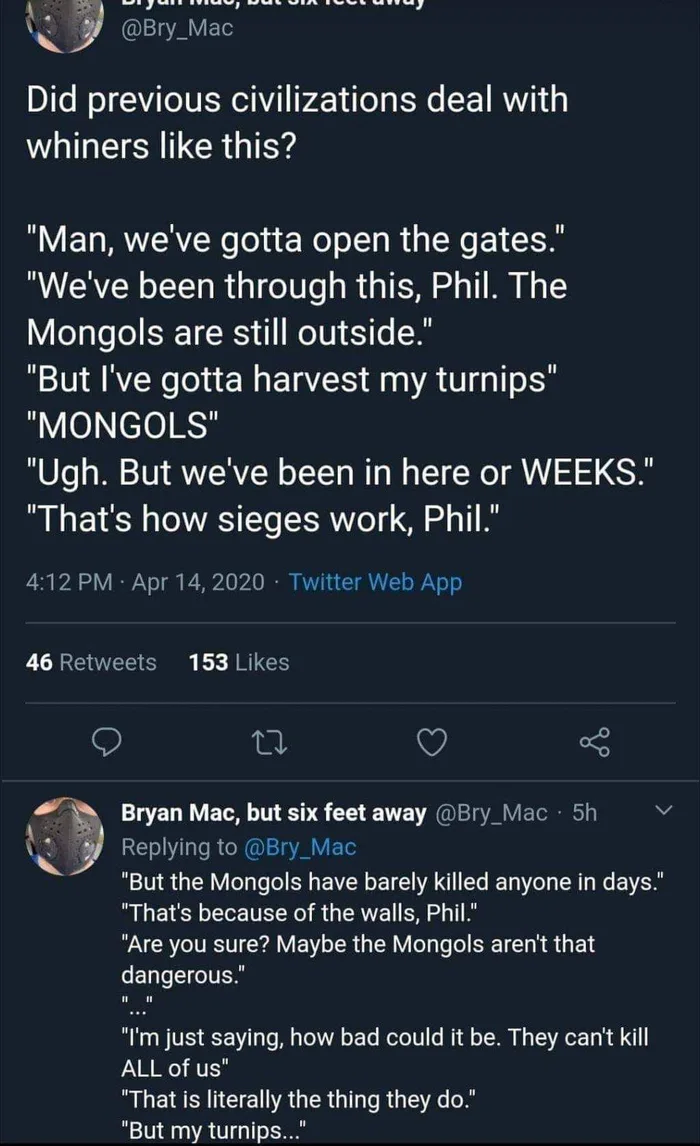
https://9gag.com/gag/a85RENd


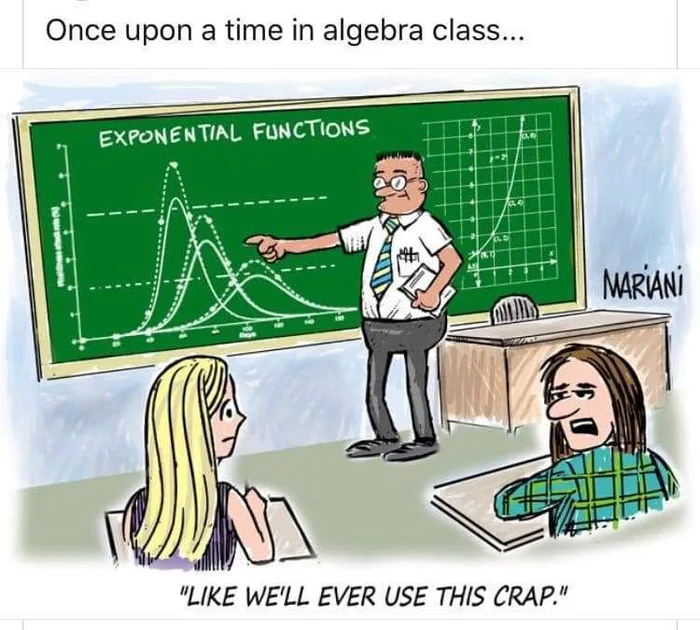
Math teachers must be despairing all over the world.This global, collective display of inability to make use of math lessons to understand the implications of exponential spread of COVID-19 must be disheartening.


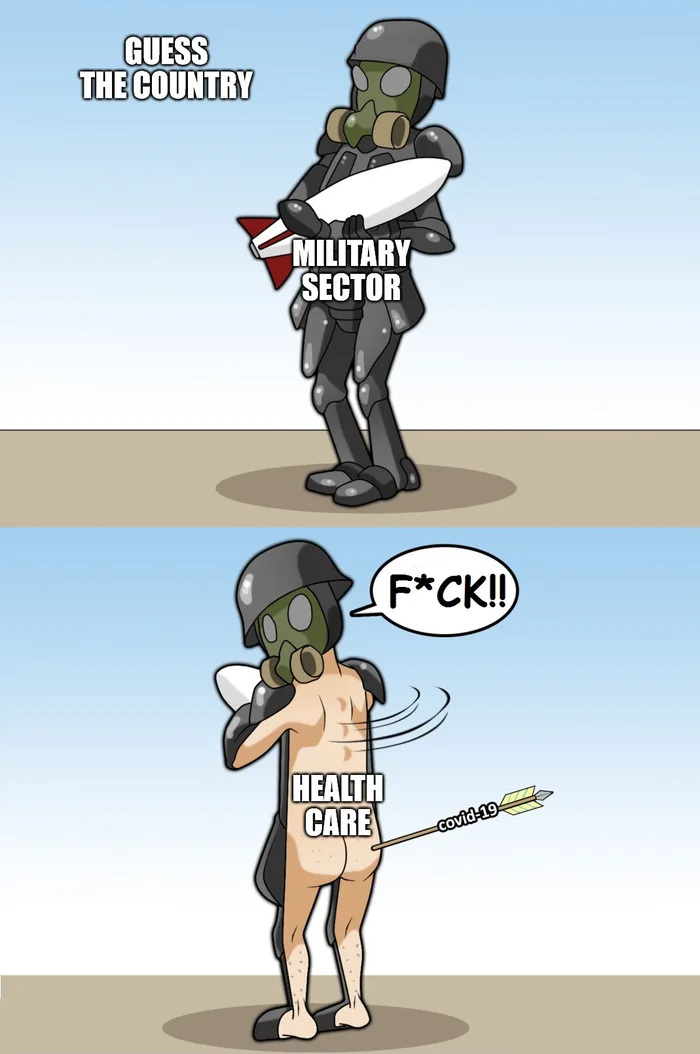
It's funny, but not totally correct. They spend insanely on health care,
but pull off only mediocre to inferior health outcomes. American life expectancy is in free fall.

.